Corporate Wellness
Corporate Wellness Ideas in KL: 8 Practical Activities for Office Teams
Eight practical corporate wellness ideas for KL office teams, from posture workshops and movement sessions to ergonomic reviews and follow-up.
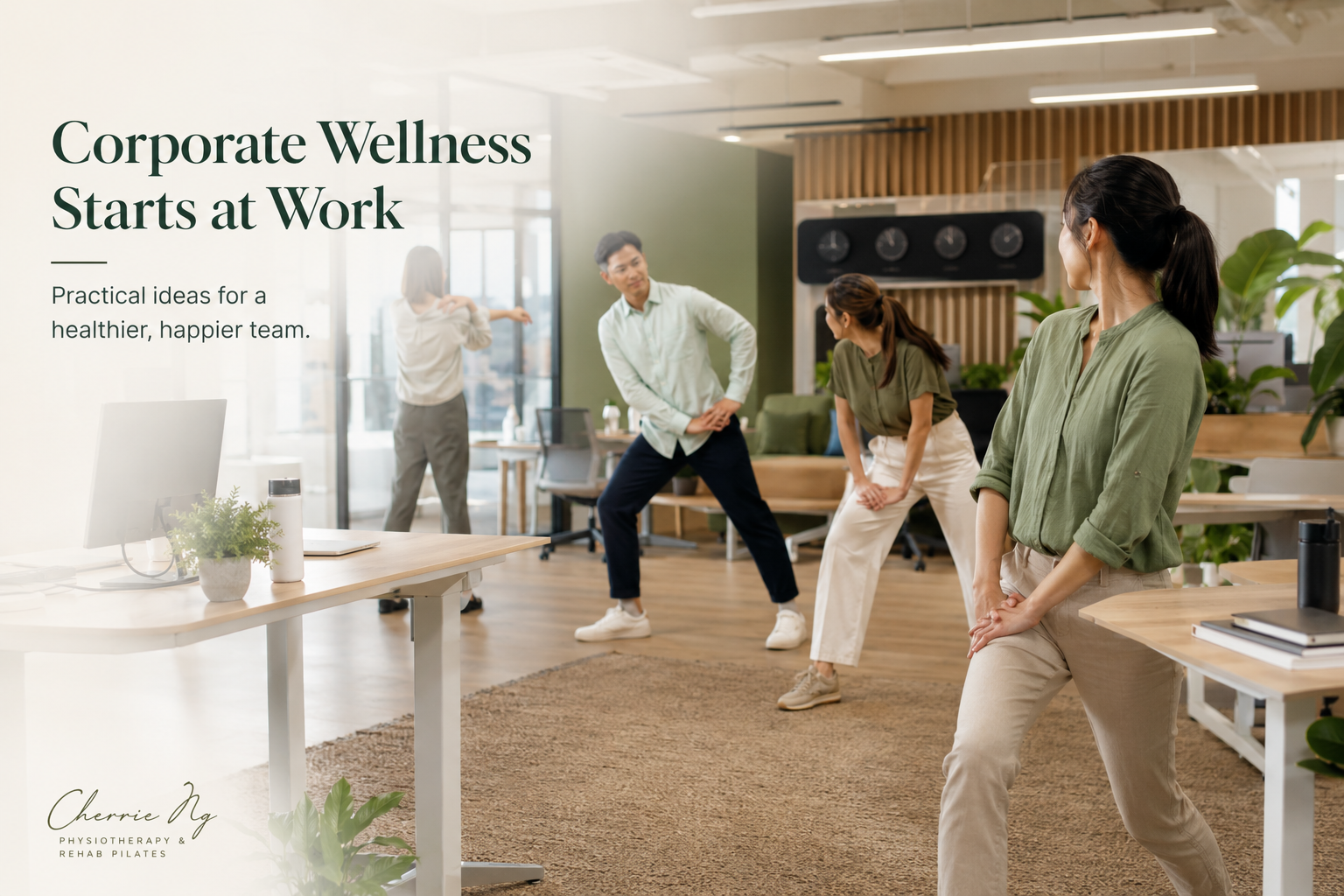
The best corporate wellness ideas for a KL office are practical, inclusive and connected to how the team actually works. Instead of planning one generic “health day,” HR teams can combine posture and workstation education, comfortable movement, employee input and follow-up actions that fit the workplace.
This guide offers eight ideas that can be adapted for offices in Kuala Lumpur and selected Selangor areas. They are educational activities, not medical screening or treatment for individual employees. If you are comparing formats, see Cherrie’s physiotherapist-led corporate wellness programmes in Kuala Lumpur.
Before choosing an activity, ask what the team needs
A popular activity is not automatically the right activity. Start with a short, privacy-conscious needs check:
- Do employees mainly use laptops, fixed desktops, hot desks or multiple screens?
- Is the team office-based, hybrid, travelling or on its feet for much of the day?
- Are people asking about desk setup, stiffness, movement breaks or general activity?
- What room, equipment, timing and budget are realistically available?
- What can the organisation change after the event?
The CDC workplace-health planning model recommends assessing employee interests alongside the physical work environment and organisational practices. It also advises involving employees early and choosing a few well-planned strategies instead of many poorly implemented ones. CDC strategies for building a workplace health programme
That makes a brief anonymous poll, a conversation with team representatives or an observation of common work tasks a useful starting point. Avoid asking staff to disclose diagnoses or personal health details in a group form.
1. A practical posture and workstation workshop
A posture workshop can teach staff how to adjust a chair, screen, keyboard, mouse and laptop setup without promoting one rigid “perfect posture.” Include a live workstation demonstration and let employees practise a repeatable self-check.
Malaysia’s Department of Occupational Safety and Health (DOSH) publishes current guidance covering display-screen equipment, seating, standing and workplace ergonomics risk assessment. This supports looking at the work setup and task demands as a system, rather than blaming an employee’s posture alone. DOSH Malaysia ergonomics guidance library
For a closer look at the format, read what teams learn in a corporate wellness posture workshop.
2. A guided office movement-break session
A short movement session can give employees several comfortable options they can use between calls, documents or meetings. The goal is not an intense workout. It is to make changing position feel simple and realistic during a normal workday.
Options may include gentle shoulder and upper-back movement, standing weight shifts, supported lower-body movements and short walks. Employees should be invited to work within a comfortable range, with seated alternatives when appropriate.
WHO guidance for small and medium-sized enterprises emphasises practical, context-specific workplace physical-activity programmes because workplaces differ in their needs and constraints. WHO guidance on workplace physical activity in small and medium-sized enterprises
You can also share this simple office stretching and movement-break routine after the session as an educational reminder.
3. A Pilates-inspired mobility session for desk workers
A physiotherapist-led, Pilates-inspired session may introduce breathing, trunk control, balance and gentle mobility in a group-friendly format. It should be scaled for the available space and should not assume that every employee has the same movement ability.
This works best when the facilitator:
- explains that participation is optional
- offers easier and more challenging variations
- avoids diagnosing employees in front of colleague
- does not promise to fix pain in one session
- explains how someone can request private support if needed.
The session can stand alone as a wellness activity or be paired with a short desk-health talk. It is not the same as an individual rehab Pilates assessment or personalised exercise programme.
4. A workstation self-check campaign
For a hybrid or multi-floor team, a guided self-check campaign may be more practical than reviewing every desk individually. HR can provide a concise checklist, a short demonstration and a defined period for staff to submit equipment or setup questions.
Useful checkpoints include:
- whether the chair and feet feel supported
- whether the main screen is readable without repeated leaning
- whether the keyboard and mouse require frequent reaching
- whether glare or small text affects viewing position
- whether commonly used items are within easy reach
- whether the day includes opportunities to change task or position
A self-check is an educational first step. Repeated problems involving work design, equipment or multiple employees may need a more structured office ergonomic assessment in KL.
5. A “design your movement break” team challenge
Instead of prescribing the same stretch to everyone, invite small teams to identify natural moments for movement in their own workflow. Examples include walking after a long meeting, standing for part of a suitable call, changing position when switching tasks or placing shared items where a short walk is required.
The challenge should reward workable ideas, not exercise intensity or body changes. It also helps managers notice whether deadlines, meeting patterns or workplace norms make even brief movement difficult.
This reflects a broader principle in workplace-health planning: programmes should include organisational and environmental support, not rely only on individual motivation. CDC strategies for building a workplace health programme
6. A manager briefing on supporting healthy work habits
Employees may learn useful ideas during a workshop but still feel unable to use them if managers treat every short position change as lost productivity. A separate manager briefing can cover:
- how to model reasonable movement and screen breaks
- how to make participation voluntary and respectful
- how to avoid discussing an employee’s symptoms publicly
- how to route equipment concerns to the correct person
- how to distinguish general education from individual medical advice
NIOSH’s Total Worker Health approach prioritises protection from workplace hazards and describes aligned programmes as voluntary and participatory. NIOSH Total Worker Health frequently asked questions
7. A private support pathway after the group session
A group event may prompt questions from employees who already have persistent pain, a previous injury, recent surgery or uncertainty about which movement is suitable. Do not turn the public question-and-answer session into an assessment.
Instead, tell employees how they can seek private, appropriate support. An individual physiotherapy assessment may consider symptom history, movement, mobility, strength, work demands and personal goals. It may also clarify whether physiotherapy, rehab Pilates, workplace changes or another care pathway should be considered.
A group session should not be used to assess new, severe, rapidly worsening or otherwise concerning symptoms. Employees should follow the organisation’s emergency procedures and seek appropriate individual medical care when needed.
8. A simple follow-up and evaluation plan
Decide how the organisation will learn from the activity before it happens. Evaluation does not need to be complicated. HR might review:
- attendance and voluntary participation
- whether staff found the session relevant and understandable
- one or two actions employees intend to try
- recurring equipment or workflow barriers
- requests for a deeper ergonomic review
- what should be changed before the next session.
The CDC model includes evaluation as a core stage so organisations can identify gaps, improve future activities and consider whether a programme can be sustained. CDC strategies for building a workplace health programme
Avoid claiming that one workshop reduced injuries, absence or healthcare costs unless the organisation has appropriate data and a credible evaluation design.
How to choose the right first activity
Use the main workplace question to narrow the choice:
- Staff want practical desk guidance: begin with a posture and workstation workshop.
- The team wants an accessible shared activity: consider a guided movement or Pilates-inspired session.
- Equipment concerns keep recurring: start with a self-check campaign, then consider a structured ergonomic review.
- Employees know what to do but cannot fit it into the day: involve managers and examine work routines.
- Several employees want symptom-specific advice: provide a private route for individual assessment rather than treating the group event as healthcare.
For many organisations, one well-scoped activity plus a realistic follow-up action is a stronger beginning than a crowded wellness day with no next step.
What to include when requesting a corporate wellness proposal
To help Cherrie check whether a session is suitable, share:
- office location
- preferred date or date range
- estimated group size
- whether home and office employees need shared follow-up resources
- typical work tasks and devices
- available space and presentation equipment
- preferred topic and practical goals
- any accessibility or language considerations
Programme scope, duration and availability should be confirmed for each organisation. Corporate wellness sessions may be arranged in Kuala Lumpur and selected Selangor areas, subject to the brief, venue and travel requirements.
Related reading
- Corporate Wellness Workshop Topics in Malaysia: What Will Employees Actually Use?
- Corporate Wellness for SMEs in Malaysia: A Practical Starting Plan
- Inclusive Corporate Wellness Activities: Planning for Different Abilities and Comfort Levels
- How to Measure Corporate Wellness Activities Without Overclaiming ROI
- How to Build a Workplace Movement-Break Programme Employees Can Actually Use
- Corporate Wellness for Hybrid Teams in Malaysia: Supporting Home and Office Workers
- How to Plan an Employee Wellness Day in KL: An HR Checklist
- Corporate Wellness Programme Cost in KL: What Affects a Quote?
- How to Choose an Office Wellness Workshop in KL
- Corporate Pilates in KL: What HR Teams Should Know Before Booking
- Corporate Wellness Posture Workshop in KL: What Teams Learn
- Office Stretching Routine: Simple Movement Breaks for Desk Workers
- Ergonomic Assessment for Offices in KL: When Teams Need Support
- Desk Ergonomics in KL: Simple Setup Tips for Neck and Back Strain
Sources and clinical references
- DOSH Malaysia ergonomics guidance library
- CDC: Strategies for Building a Workplace Health Program
- WHO: Promotion of Health-Enhancing Physical Activity in Small-to-Medium-Sized Enterprises
- NIOSH: Total Worker Health Frequently Asked Questions
Frequently asked questions
What corporate wellness activities are suitable for a small office?
A focused posture workshop, guided movement session or workstation self-check can all be adapted for a smaller team. Choose according to the team’s work and goals rather than trying to include every activity at once.
Can a corporate wellness session be customised?
The proposed content may be adapted around the team’s work tasks, equipment, group size, space and priority questions. Share these details before booking so the scope can be checked.
Should employees with pain join the group activity?
They may participate if the activity is comfortable and appropriate for them, but a general group session does not diagnose symptoms or replace individual care. Participation should be voluntary, with modifications and a private route for questions.
Are corporate wellness sessions available outside Kuala Lumpur?
Selected Selangor locations may be considered depending on the brief, venue, travel and availability. Send the exact office location when requesting a proposal.
Planning a workplace wellness activity in KL? Explore Cherrie’s corporate wellness programmes and WhatsApp the office location, team size and goals to discuss a suitable format.
Foundational clinical sources and further reading
These authoritative sources provide general background relevant to this topic; they are not claim-by-claim citations. This content is educational and does not replace individual assessment, diagnosis or emergency medical care.
- What is physiotherapy? — World Physiotherapy