Corporate Wellness
Corporate Wellness Workshop Topics in Malaysia: What Will Employees Actually Use?
Choose practical corporate wellness workshop topics for Malaysian teams by work pattern, employee input, format, accessibility and follow-up.
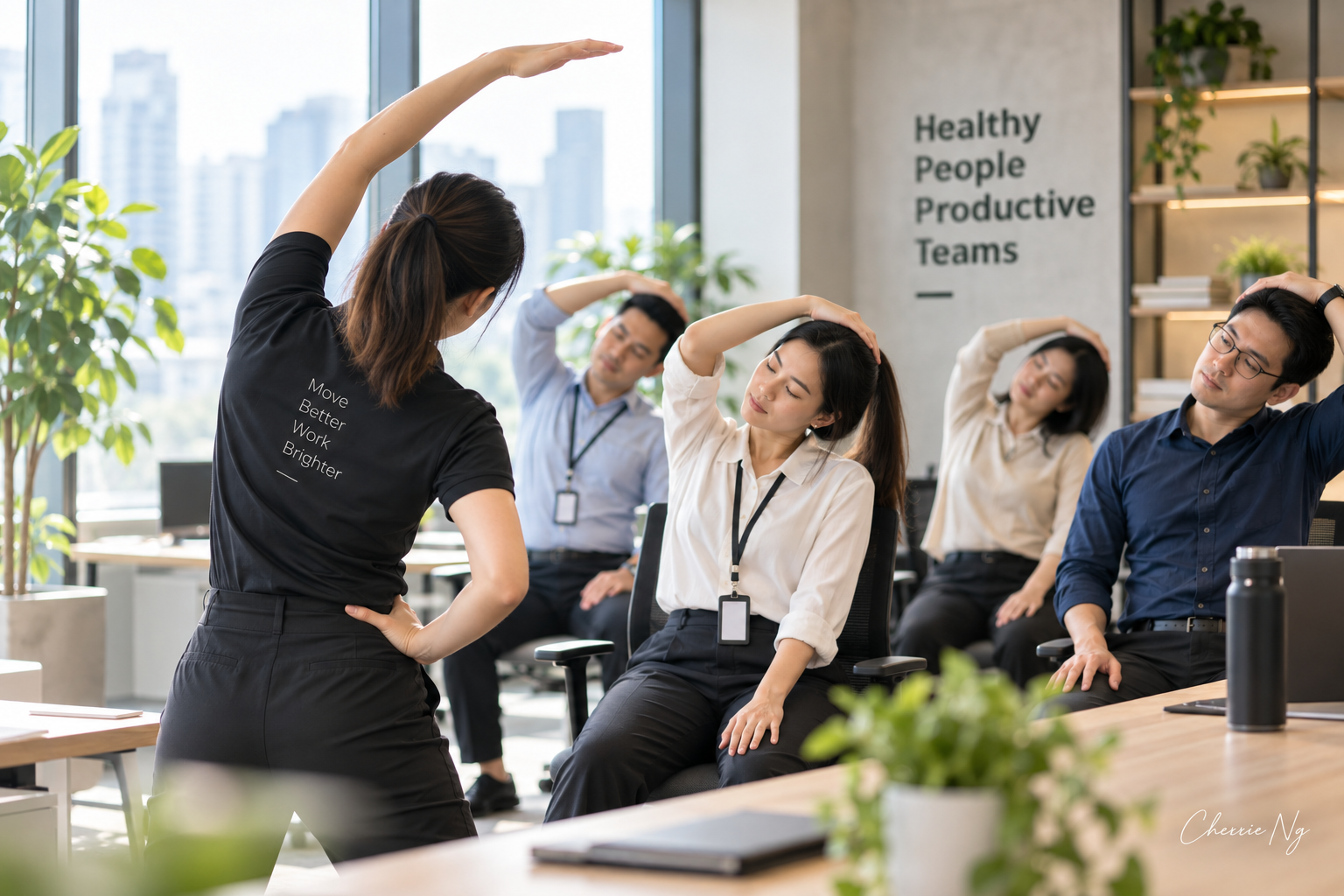
The most useful corporate wellness workshop topic is one that matches how employees actually work and gives them a small number of actions they can use immediately. For a Malaysian office team, that may be a workstation self-check, practical movement breaks, laptop and hybrid-work setup, neck and shoulder comfort, beginner-friendly corporate Pilates or guidance on when an individual assessment is more appropriate.
Do not choose from a generic topic list alone. Ask employees what gets in the way, check the venue and work pattern, and decide what the organisation can improve after the session. Cherrie can discuss physiotherapist-led talks, posture and desk-wellbeing workshops, beginner-friendly corporate Pilates and customised event briefs for organisations in Kuala Lumpur and selected Selangor areas, subject to the brief and availability.
What makes a workshop topic genuinely useful?
A practical topic usually passes five tests:
- Relevant: it reflects the team’s real tasks, devices, space and schedule.
- Specific: the session has one clear purpose rather than trying to cover all of wellbeing.
- Participatory: employees can ask questions, try appropriate options or contribute anonymously.
- Inclusive: people can observe, modify or opt out without explaining personal health information.
- Supported: the employer is willing to address equipment, workflow or policy barriers revealed by the session.
CDC guidance says workplace health programmes should fit the employee population, workplace, employee needs and organisational goals. It recommends assessing individual, environmental and organisational factors, involving employees early and focusing on a few well-chosen strategies. CDC strategies for building a workplace health programme
That is why “What will people use next week?” is a better planning question than “Which wellness topic sounds impressive?”
Corporate wellness topic selector
| If your team mainly needs… | Consider this workshop topic | A practical takeaway |
|---|---|---|
| Help using shared desks | Workstation self-check | A repeatable chair, screen and keyboard setup sequence |
| More movement during desk-heavy days | Movement-break planning | Two or three short options linked to natural work cues |
| Guidance for common neck and shoulder questions | Neck, shoulder and desk-comfort education | Ways to vary position, workload and movement without diagnosing pain |
| Support across home and office | Laptop and hybrid-work setup | A portable setup checklist for different locations |
| A gentle active team session | Beginner-friendly corporate Pilates | Adaptable movement focused on control and body awareness |
| Better meeting habits | Healthy meetings and movement | Ideas for seated options, standing discussion or short activity pauses |
| Support for staff who stand or move at work | Standing-work movement and recovery | Ways to vary tasks and discuss equipment or work-design barriers |
| A clearer route for personal concerns | When to seek individual support | The difference between group education, workstation review and physiotherapy |
The final title should be narrower than the table. A focused workshop such as “Laptop Setup and Movement Breaks for Hybrid Teams” is easier to understand and act on than “Total Employee Wellness in One Hour.”
1. Workstation self-check for desk teams
This topic can show employees how to review chair height, back support, screen position, keyboard and mouse placement, frequently used items and the surrounding environment. The aim is not to find one perfect posture. It is to give people a logical setup process and identify problems they cannot solve alone.
Malaysia’s Department of Occupational Safety and Health identifies display-screen ergonomics factors including awkward, static and sustained postures, repetitive motion, contact stress and environmental factors. Its guidance also covers control measures for furniture, work surfaces, chairs and monitors. DOSH Malaysia: Guidelines for Working with Display Screen Equipment 2024
This topic works best when employees can see a real workstation demonstration. HR should also be ready to record shared issues such as damaged chair controls, monitor shortages or hot-desking constraints.
2. Movement breaks employees can fit into the day
A useful movement-break workshop helps the team identify when movement can realistically happen. Instead of giving a long exercise routine, the session might explore brief seated and standing options, walking during suitable conversations, changing tasks or pairing movement with an existing cue.
The WHO guide for workplace physical activity in small and medium-sized enterprises emphasises practical, context-specific planning because workplaces have different needs and limitations. WHO: Promotion of Health-Enhancing Physical Activity in Small-to-Medium-Sized Enterprises
The goal is a usable choice, not a compulsory timetable. Employees should be able to adapt the activity to their comfort, clothing, space and work responsibilities.
3. Neck, shoulder and back comfort for office work
This can be a valuable topic when employees regularly ask about stiffness, prolonged screen work or the feeling of being “stuck” in one position. A physiotherapist-led session can explain how work habits, task variation, setup and movement may be considered without publicly judging posture or diagnosing anyone.
A strong session distinguishes general education from personal care. General examples can be demonstrated to the group, while persistent, worsening or uncertain symptoms need an appropriate private pathway.
Avoid promising that one posture rule or stretch prevents all pain. The useful outcome is better decision-making: what employees can adjust, what the organisation should review and when individual advice may be suitable.
4. Laptop and hybrid-work setup
Hybrid employees may work at an office desk, dining table, coworking space or temporary travel setup. This topic can focus on portable priorities: screen viewing, external devices where available, chair and table fit, item placement, lighting and ways to change position.
Ask participants to compare two or three common setups rather than pretending every home has dedicated office furniture. A useful follow-up is a short checklist separating “adjust now,” “try with an existing item” and “raise with the organisation.”
For teams split across locations, read the planning guide to corporate wellness for hybrid teams in Malaysia.
5. Beginner-friendly corporate Pilates
Corporate Pilates can provide a guided movement experience for teams that want an active session rather than a talk. The brief should clarify whether the session is mat-based, how much space is available, what employees will wear, whether equipment is provided and what alternatives are needed.
The class should be presented as a group movement experience, not individual rehabilitation. Employees with personal symptoms should not be assessed publicly, and nobody should need to disclose a diagnosis to request a simpler option.
If HR is comparing formats, see what to check before booking corporate Pilates in KL and how it differs from a general office fitness class.
6. Healthy meetings and lunch-and-learn movement
This topic suits teams that want practical ideas without scheduling a separate exercise class. A session may explore seated movement, optional standing discussion, walking conversations where appropriate, room layout and how to place food or hot drinks safely before an active segment.
The WHO healthy-meetings guide provides practical examples for incorporating physical activity into short workplace meetings as well as longer events. WHO: Planning Healthy and Sustainable Meetings
Keep the scope focused. A corporate wellness lunch and learn in KL can work well for one desk-health question, demonstration and Q&A rather than a compressed list of unrelated topics.
7. Standing-work movement and ergonomics
Not every corporate team sits at a computer. Retail, hospitality, events, laboratories and other roles may involve long periods of standing, walking, reaching or repeated tasks.
For these employees, a desk-posture talk may feel irrelevant. Start by learning about the work, then consider a topic around task variation, comfortable movement, recovery between demands, footwear questions or when equipment and work design need formal review.
General wellness education does not replace workplace risk management. NIOSH states that its Total Worker Health approach is not an add-on wellness programme for workplaces where unsafe conditions or work organisation remain unaddressed. NIOSH Total Worker Health frequently asked questions
8. When group education is not enough
Some employees attend because they want an answer about their own pain, injury, surgery or movement limitation. A group workshop cannot responsibly assess each person or decide what treatment they need.
The session can instead explain the available routes:
- general workshop education for shared questions;
- a practical workstation review for a specific setup;
- formal ergonomics assessment when the organisation needs the appropriate occupational-safety scope; or
- private physiotherapy when an employee needs individual clinical assessment.
If this is a major goal, compare a corporate wellness workshop with on-site physiotherapy.
How should HR ask employees what they need?
Use a short anonymous poll before choosing the title. Ask about work patterns and preferences rather than collecting diagnoses.
Possible questions include:
- Where do you work most often: office, home, hybrid or mobile locations?
- Which tasks take up most of your day?
- Which topic would be most useful: workstation setup, movement breaks, guided movement or another suggestion?
- Would you prefer a talk, practical demonstration, gentle group activity or mixed format?
- What would make participation easier: seated choices, no-floor options, language, timing or room access?
- What equipment or workflow issue is difficult to change yourself?
- Would you like an anonymous question option?
NIOSH describes programmes aligned with Total Worker Health as voluntary and participatory, giving workers a voice in workplace offerings. NIOSH Total Worker Health frequently asked questions
Keep answers proportionate and private. A topic poll is not a health screening, and employees should not feel pressured to reveal symptoms to managers.
Topics HR should not combine carelessly
Some subjects require a different professional, privacy level or service format. Be cautious about combining:
- mental-health diagnosis with a general movement workshop;
- individual pain assessments with a public group session;
- health screening with activities when consent and data handling are unclear;
- formal ergonomics compliance with a general posture talk; or
- high-intensity exercise with an inclusive beginner brief.
It is often better to use separate facilitators or separate pathways than ask one workshop to cover areas outside the provider’s scope.
A simple way to shortlist three workshop topics
Score each idea from 1 to 3 against these questions:
| Selection question | 1 | 2 | 3 |
|---|---|---|---|
| Does it match daily work? | Weak match | Some teams | Strong match |
| Did employees ask for it? | No signal | Mixed interest | Clear interest |
| Can people participate comfortably? | Major barriers | Adaptation needed | Accessible format available |
| Can HR follow up? | No owner | Possible action | Owner and next step confirmed |
| Is the facilitator’s scope clear? | Unclear | Needs refinement | Clearly defined |
Choose the strongest topic, then narrow it to one promise. Keep the other two as future sessions or optional proposal alternatives.
What Cherrie can discuss with Malaysian organisations
Cherrie’s corporate wellness formats may include health and movement talks, posture and desk-wellbeing workshops, practical workstation demonstrations, beginner-friendly corporate Pilates and customised event briefs. These are general education or group movement experiences, not public diagnosis or individual treatment.
Sessions may be considered for organisations in Kuala Lumpur and selected Selangor areas. Exact topic, language, duration, activity level, group size, venue, travel, equipment, accessibility, fees and availability are confirmed from the brief. Dry needling is not offered or implied.
Related reading
- Corporate Wellness Ideas in KL: 8 Practical Activities for Office Teams
- How to Choose an Office Wellness Workshop in KL
- Corporate Wellness Lunch and Learn in KL: Practical Posture and Movement Topics
- Physiotherapist-Led Corporate Wellness: What Makes the Approach Different?
Sources and clinical references
- CDC: Strategies for Building a Workplace Health Program
- DOSH Malaysia: Guidelines for Working with Display Screen Equipment 2024
- WHO: Promotion of Health-Enhancing Physical Activity in Small-to-Medium-Sized Enterprises
- WHO: Planning Healthy and Sustainable Meetings
- NIOSH: Total Worker Health Frequently Asked Questions
Frequently asked questions
What is the best corporate wellness workshop topic for office employees?
There is no universal best topic. For a desk-based team, workstation self-checks, movement breaks, laptop setup or neck and shoulder education may be useful starting points. Choose using employee input and the team’s real work.
How many topics should one workshop cover?
Usually fewer topics with practical time are clearer than many rushed subjects. Define one main outcome, then use supporting examples and Q&A around it.
Should a corporate wellness workshop include exercise?
Only when it suits the brief, venue and participants. A workshop may be presentation-based, practical or mixed. Any movement should be optional and adaptable.
Can employees ask about personal pain?
They can ask general questions, but personal symptoms should not be assessed publicly. Provide a private route when someone needs individual advice.
Can Cherrie customise a topic for our company?
A topic may be adapted around the team’s work patterns, priority questions, space, group size and preferred activity level. Feasibility and final scope are confirmed before booking.
Choosing a topic for your team? Explore Cherrie’s corporate wellness programmes and WhatsApp the office location, work pattern, estimated group size, preferred date and two priority questions to discuss a focused session.
Foundational clinical sources and further reading
These authoritative sources provide general background relevant to this topic; they are not claim-by-claim citations. This content is educational and does not replace individual assessment, diagnosis or emergency medical care.
- What is physiotherapy? — World Physiotherapy