Corporate Wellness
Physiotherapist-Led Corporate Wellness: What Makes the Approach Different?
Learn how physiotherapist-led corporate wellness combines movement expertise, adaptable education, clear clinical boundaries and workplace context.
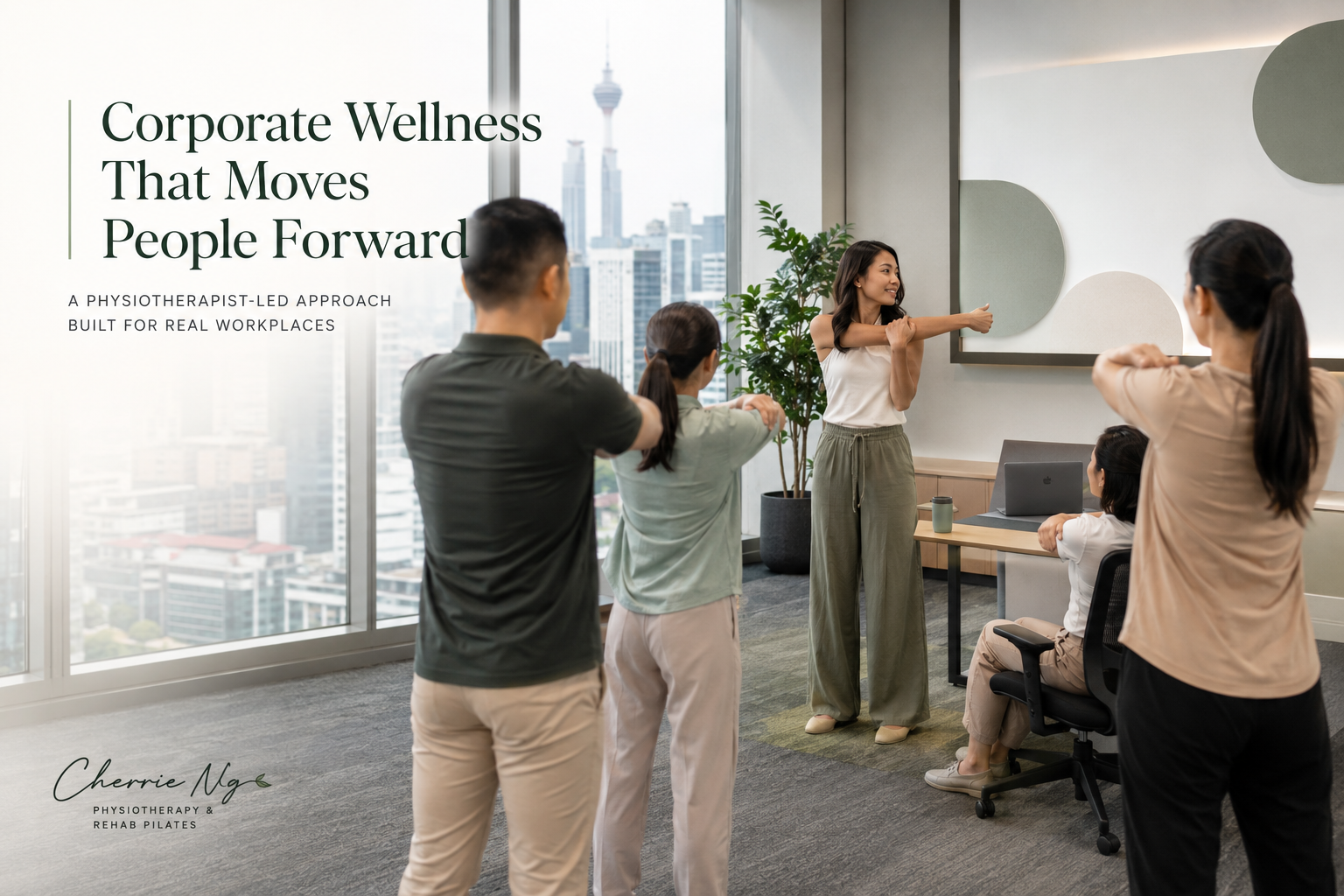
Physiotherapist-led corporate wellness brings movement and rehabilitation knowledge into a workplace-education format. The practical difference is not that every employee receives physiotherapy. It is that the facilitator can plan posture, movement or Pilates-based content with clearer adaptation, symptom-aware boundaries and a better distinction between general education, workplace action and private clinical care.
This approach may suit KL organisations planning a desk-wellbeing workshop, movement talk, beginner-friendly corporate Pilates session or wellness-day activity. It does not automatically make one workshop better than every other wellness format, and it cannot guarantee pain relief or injury prevention. You can review Cherrie’s physiotherapist-led corporate wellness programmes in Kuala Lumpur to see the available formats.
What does “physiotherapist-led” mean in a workplace?
It means a physiotherapist plans and facilitates the relevant programme. The session may draw on knowledge of movement, function, exercise, rehabilitation and health communication, but it remains within the scope agreed with the employer.
World Physiotherapy describes physiotherapists as professionals who assess the needs of individuals or client groups, make clinical judgements within their expertise, provide consultation and recognise when referral to another healthcare professional is needed. World Physiotherapy: What is physiotherapy?
The title alone is not the whole quality check. World Physiotherapy’s practice standard notes that competence in a particular situation is influenced by qualifications, clinical experience, professional development and the ability to integrate knowledge and judgement. HR should still ask who will lead the programme and whether their experience matches the brief. World Physiotherapy standards of physiotherapist practice
In a corporate group setting, those capabilities should improve the quality of the educational process—not turn the room into a clinic. Employees are not diagnosed from across the room, and a shared workshop does not create an individual treatment plan.
1. The content can be connected to real movement and work tasks
A physiotherapist-led session can explain a topic through the movements employees actually perform: typing, mousing, viewing multiple screens, sitting through meetings, standing at a counter, lifting work items or changing between office and home setups.
Instead of presenting one “correct posture,” the facilitator can show how support, equipment position, task duration and movement options interact. For example, a desk-health workshop may demonstrate chair and screen adjustment, then help employees decide which change is most relevant to their own task.
Malaysia’s Department of Occupational Safety and Health publishes guidance specifically for display-screen equipment, alongside guidance for seating, standing and workplace ergonomics risk assessment. That wider framework supports looking beyond an employee’s body to the equipment and work environment. DOSH Malaysia ergonomics guidance library
2. Movement options can be adapted without singling people out
Office teams include people with different ages, exercise experience, mobility, clothing, confidence and health histories. A movement-based session should therefore offer choices rather than expect everyone to copy the same range or position.
Depending on the activity, a physiotherapist may provide:
- seated and standing versions;
- smaller and larger movement ranges;
- slower or more active options;
- stable support for balance-sensitive tasks;
- permission to pause or observe; and
- a private route for questions.
These options are general group adaptations, not personalised rehabilitation. An employee who needs symptom-specific exercise selection should be directed towards private assessment rather than corrected publicly.
3. Exercise readiness can be handled more deliberately
For corporate Pilates or another active session, the organiser should know how participation will be introduced, what information employees receive beforehand and what happens if someone is unsure.
The Canadian Society for Exercise Physiology describes pre-participation screening as one step for identifying people who may need further advice before becoming more active. Its Get Active Questionnaire is self-administered, helping individuals make an informed decision without publicly disclosing their answers to colleagues. CSEP pre-screening for physical activity
A physiotherapist-led programme can use a suitable readiness process while keeping participation voluntary. Screening still does not make a group class an individual clinical assessment.
4. Clinical boundaries can be explained clearly
Employees often ask a facilitator about neck pain, previous injuries, surgery, numbness, weakness or whether a specific movement is “safe for me.” A useful response does not attempt a public diagnosis.
The physiotherapist can:
- answer the general educational part of the question;
- explain why individual suitability cannot be decided for the whole group;
- offer a lower-demand option or invite the person to observe;
- suggest an appropriate private assessment pathway; or
- advise the employee to follow existing medical or rehabilitation guidance.
This boundary protects privacy and prevents a short workplace interaction from being mistaken for treatment.
5. The programme can separate employee actions from employer actions
Many wellness sessions focus only on what the employee should do: sit differently, stretch more or exercise after work. A physiotherapist-led discussion can also identify equipment, task or workflow barriers that employees cannot solve alone.
For example, an employee can learn how to adjust a chair, but management may need to replace a broken control. Staff can try movement breaks, but meeting design or workload may leave no practical opportunity to use them.
NIOSH’s Total Worker Health guidance says workplace wellness should not be an add-on where working conditions remain unsafe or unhealthy. It starts with organisational and environmental action, followed by education and encouragement. NIOSH Total Worker Health frequently asked questions
The workshop should therefore produce two useful lists: what employees can try and what the organisation may need to review.
6. The session can connect group education with appropriate follow-up
A workshop may reveal different levels of need:
| Need identified | More suitable next step |
|---|---|
| Team needs shared desk guidance | Posture and workstation workshop |
| Group wants an accessible movement experience | Beginner-friendly corporate Pilates or movement session |
| Repeated equipment or task problems affect several staff | Practical workplace ergonomic review |
| One employee needs symptom-specific advice | Private physiotherapy or appropriate healthcare assessment |
| Employer requires formal compliance documentation | Confirm the required occupational-safety scope and competent provider |
The value lies partly in recognising which question belongs to which service. A physiotherapist-led workshop is not a substitute for every occupational-health, safety, medical or human-resources function.
7. Outcomes can be framed more carefully
A credible programme can aim for employees to understand a topic, practise a self-check, learn several comfortable movement options or identify workplace barriers. Attendance, relevance, confidence and intended next actions can be reviewed afterwards.
It would be misleading to guarantee that one session will eliminate pain, prevent injury, reduce absence or increase productivity. The CDC workplace-health model recommends fitting programmes to employee and organisational needs and using evaluation to identify gaps and improve future activities. CDC strategies for building a workplace health programme
Careful outcome language makes the proposal more useful because HR knows what the session is genuinely designed to deliver.
What physiotherapist-led corporate wellness does not mean
The label should not be interpreted as:
- diagnosing every employee during a workshop;
- offering individual treatment in front of colleagues;
- promising that pain or injury will be prevented;
- replacing a formal ergonomics risk assessment;
- replacing the organisation’s occupational-safety duties;
- prescribing the same exercise to everyone; or
- implying that all other qualified wellness professionals are unsuitable.
Different providers bring different expertise. A nutrition programme, mental-health workshop, occupational-safety assessment and physiotherapist-led movement session answer different questions. HR should select the professional scope that matches the goal.
Suitable physiotherapist-led formats for office teams
Depending on the brief, Cherrie’s corporate wellness formats may include:
- a health and movement talk;
- a posture and desk-wellbeing workshop;
- a live workstation demonstration;
- beginner-friendly, mat-based corporate Pilates;
- a movement activity within an employee wellness day; or
- a customised event brief combining selected elements.
Group sessions provide general education and movement experiences, not individual medical assessment. Programme scope, venue, group size, travel and availability are confirmed case by case for Kuala Lumpur and selected Selangor locations.
Questions HR should ask before booking
Ask the provider:
- Who will lead the session, and what is their relevant professional scope?
- What will employees understand or practise by the end?
- How will the content match our team’s work and equipment?
- Are participation and movement activities voluntary?
- What seated, standing or lower-demand options will be available?
- How will personal health questions be handled privately?
- What is group education, and what would require individual assessment?
- What venue, equipment and participant information are needed?
- What employee and employer follow-up will be provided?
- Which outcomes are realistic for this format?
Clear answers make it easier to compare scope, value and fit—not only presentation style.
Related reading
- How to Choose a Corporate Wellness Provider in KL: An HR Checklist
- Corporate Wellness Workshop vs On-Site Physiotherapy: Which Does Your Team Need?
- Corporate Pilates vs an Office Fitness Class: Which Format Fits Your Team?
- Corporate Pilates in KL: What HR Teams Should Know Before Booking
- Corporate Wellness Posture Workshop in KL: What Teams Learn
- Ergonomic Assessment for Offices in KL: When Teams Need Support
- How to Choose an Office Wellness Workshop in KL
Sources and clinical references
- World Physiotherapy: What is physiotherapy?
- World Physiotherapy: Standards of physiotherapist practice
- DOSH Malaysia ergonomics guidance library
- CSEP: Pre-Screening for Physical Activity
- NIOSH: Total Worker Health Frequently Asked Questions
- CDC: Strategies for Building a Workplace Health Program
Frequently asked questions
Is physiotherapist-led corporate wellness the same as corporate physiotherapy?
Not necessarily. A corporate wellness workshop is usually shared education or a group movement experience. Individual physiotherapy requires private assessment, clinical reasoning and an appropriate personal plan.
Can employees ask about their pain during the workshop?
They can ask general questions, but personal symptoms should not be assessed publicly. The facilitator can explain general principles and direct the employee towards a private, appropriate pathway if needed.
Does a physiotherapist-led posture workshop prevent pain?
It should not be sold with that guarantee. It can teach practical setup and movement concepts, identify barriers and clarify when individual help is appropriate.
Is physiotherapist-led corporate Pilates suitable for beginners?
A beginner-friendly session may be planned with adaptable options and a readiness process. The organiser should confirm the participant profile, floor space, equipment and activity level in advance.
Where can Cherrie provide corporate wellness sessions?
Sessions may be considered for organisations in Kuala Lumpur and selected Selangor areas, subject to the brief, venue, travel and availability.
Planning a practitioner-led workplace session? Explore Cherrie’s corporate wellness programmes and WhatsApp the office location, team size, date and goal to discuss a suitable format.
Foundational clinical sources and further reading
These authoritative sources provide general background relevant to this topic; they are not claim-by-claim citations. This content is educational and does not replace individual assessment, diagnosis or emergency medical care.
- What is physiotherapy? — World Physiotherapy