Corporate Wellness
Corporate Wellness Workshop vs On-Site Physiotherapy: Which Does Your Team Need?
Compare a corporate wellness workshop with private on-site physiotherapy by purpose, privacy, assessment, group size and follow-up.
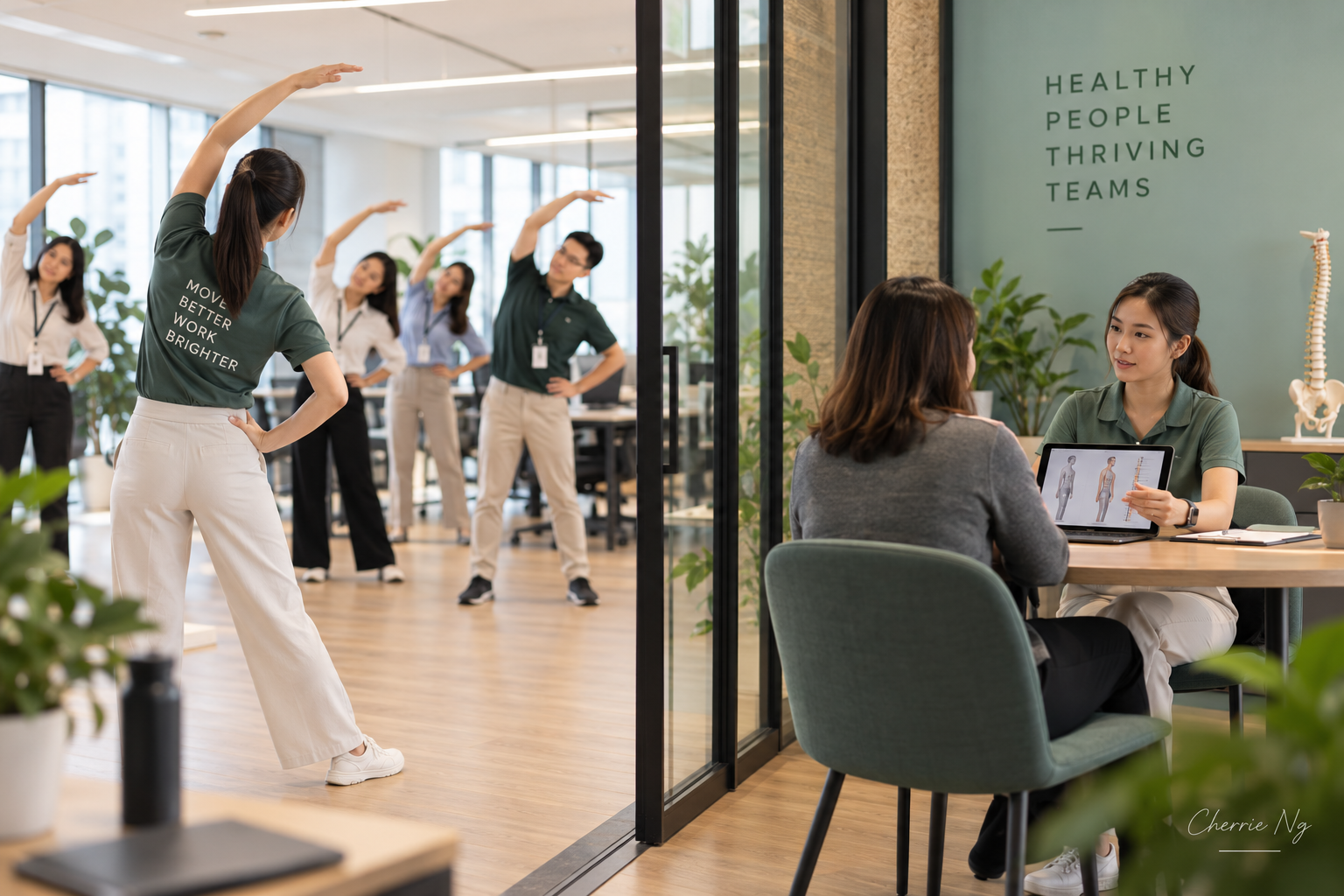
Choose a corporate wellness workshop when many employees need the same general education, such as desk setup, posture, movement breaks or beginner-friendly group movement. Consider on-site physiotherapy when individual employees need private, symptom-specific assessment and a personal plan. The two formats answer different questions and can complement each other, but one should not be presented as a substitute for the other.
For Kuala Lumpur and selected Selangor workplaces, Cherrie can discuss group corporate wellness formats and individual physiotherapy at a suitable home, office or private space, subject to the brief, location and availability. Any workplace-based clinical arrangement needs clear consent, privacy and boundaries about what information the employer receives.
The difference at a glance
| Question | Corporate wellness workshop | On-site physiotherapy |
|---|---|---|
| Main purpose | Shared education or group movement experience | Private assessment and individual care |
| Audience | A team or employee group | One employee at a time |
| Content | General principles, demonstrations and adaptable group activities | Personal history, symptoms, movement assessment and an individual plan |
| Diagnosis | Not provided to employees in a group setting | Clinical reasoning may form part of an individual physiotherapy assessment |
| Privacy | No public disclosure should be required | Requires an appropriate confidential space and consent process |
| Typical follow-up | Team resources and workplace action list | Individual advice, exercises, review or referral where appropriate |
| Employer reporting | Programme-level feedback or agreed workplace themes | Only agreed administrative information; personal clinical details should remain private unless properly authorised |
The exact service should still be written into the proposal. “Workplace physiotherapy” can otherwise be misunderstood as a talk, a screening station, a workstation review or individual treatment.
What is a corporate wellness workshop?
A corporate wellness workshop is a shared learning session for employees. It may include a presentation, live workstation demonstration, guided self-check, posture and movement education, beginner-friendly corporate Pilates or questions about common work situations.
The workshop can help a team develop a common vocabulary and identify workplace barriers. For example, employees might learn how to adjust a chair and screen, while managers note that damaged controls or a hot-desking process require organisational follow-up.
The CDC workplace-health model recommends planning around the employee population, physical work environment and organisational factors, involving employees early and combining individual actions with organisational or environmental support. CDC strategies for building a workplace health programme
A group workshop does not examine every participant, determine the cause of an individual’s pain or create personal rehabilitation plans. Its value lies in relevant education, practical participation and a clear next step—not in pretending the meeting room is a clinic.
What is on-site physiotherapy?
On-site physiotherapy is an individual clinical service delivered at a suitable workplace location instead of a clinic or home. The physiotherapist may ask about the person’s symptoms, health history, work and daily activities, then assess relevant movement, strength, mobility, function and symptom response before discussing a plan.
World Physiotherapy describes physiotherapists as professionals who assess a patient, client or client group’s needs, evaluate findings, make clinical judgements, plan and implement care, recommend self-management and recognise when referral to another healthcare professional is needed. World Physiotherapy: What is physiotherapy?
The workplace setting does not reduce the need for a proper clinical process. The room should allow private conversation and suitable movement assessment. Appointment length, consent, records, payment, equipment and follow-up should be confirmed before the service is offered to employees.
Choose a workshop when the need is shared
A workshop is usually the clearer starting point when HR wants to:
- introduce a topic to many employees at once;
- demonstrate a repeatable workstation self-check;
- discuss practical posture and movement-break ideas;
- provide a beginner-friendly group movement experience;
- answer general questions without collecting medical histories;
- identify common equipment or workflow barriers; or
- pilot an educational activity before planning a wider programme.
The topic should match the team’s actual work. A laptop and desk-wellbeing workshop may suit screen-based employees; a gentle movement session may suit a wellness day; a different workforce may need another occupational-health approach.
NIOSH describes programmes aligned with its Total Worker Health approach as voluntary and participatory. It also warns that wellness activities should not be added while unsafe or unhealthy working conditions remain unaddressed. NIOSH Total Worker Health frequently asked questions
That means a workshop can support learning, but it cannot replace the employer’s responsibility to address workplace hazards, equipment and work design.
Consider on-site physiotherapy when the need is individual
Individual physiotherapy may be more appropriate when an employee needs:
- a private discussion about personal symptoms or health history;
- assessment after an injury or operation;
- help understanding movements or tasks that aggravate symptoms;
- an individual exercise or rehabilitation plan;
- review of walking, balance, strength or mobility;
- guidance about returning to activity or work tasks; or
- referral for medical or other professional review when the concern falls outside physiotherapy scope.
These needs cannot be handled responsibly through general advice directed at a room full of colleagues. The employer can offer access or explain the option, but the individual clinical conversation should remain separate from group education.
On-site physiotherapy is not automatically the best setting for every person. A clinic, home visit, medical assessment or another provider may be more appropriate depending on symptoms, privacy, equipment and access. Suitability should be checked case by case.
When an ergonomic assessment is the better third option
Sometimes the main question is neither “What should the whole team learn?” nor “What treatment does this employee need?” It is “What is happening in the work system, task and equipment?”
An ergonomic review can examine workstations, device use, reach, repeated tasks, furniture, workflow and environmental constraints more closely. Malaysia’s Department of Occupational Safety and Health describes its display-screen equipment guidance as a systematic approach to identifying ergonomics risk factors and planning controls for display-screen work. DOSH Malaysia display-screen equipment guidelines 2024
These formats should stay distinct:
- Workshop: general education and shared skills.
- Practical workstation review: closer observation and adjustment of selected work setups.
- Formal ergonomics risk assessment: an occupational-safety process with defined competence, method and documentation requirements.
- Physiotherapy: private clinical assessment and individual care.
If HR needs statutory compliance advice or formal certification, the organisation should confirm the required scope with DOSH or an appropriately qualified occupational-safety professional. Do not assume a wellness workshop or ordinary physiotherapy appointment fulfils that function.
Can the two formats work together?
Yes. A stepped programme can preserve the strengths of each service:
- Ask employees what would be useful. Use an anonymous poll about topics and participation needs, not a public list of diagnoses.
- Deliver shared education. Run a focused workshop on the issue affecting the wider team.
- Record workplace actions. Assign internal owners for equipment, workflow or policy barriers.
- Offer a private route. Let employees enquire separately when they need individual assessment.
- Review the programme. Measure relevance, understanding and follow-up needs without claiming guaranteed medical or financial outcomes.
The private route should be genuinely optional. Employees should not feel that declining assessment, movement or disclosure will be judged by managers.
Privacy and consent need their own plan
The presence of an employer creates a different context from a normal self-booked appointment. Before offering individual on-site physiotherapy, decide:
- who invites employees and whether participation is voluntary;
- who pays and what the payment covers;
- how appointment times are booked without exposing the reason;
- which room provides visual and sound privacy;
- where clinical information and records are handled;
- what, if anything, the employer receives; and
- how employees arrange follow-up outside the event.
The employer may need administrative information such as available slots or aggregate participation numbers. That does not mean managers should receive an employee’s diagnosis, examination findings or treatment plan. Any sharing beyond agreed administration needs an appropriate purpose and authorisation.
For workshops, protect privacy by accepting anonymous questions, avoiding public posture judgements and never using someone as a demonstration without consent.
What happens during each format?
A group workshop may include
- A brief introduction and clear scope.
- Education linked to the team’s work.
- A live workstation or movement demonstration.
- Optional guided self-checks or group activity.
- General questions.
- Separate employee and employer action lists.
An individual on-site appointment may include
- Private discussion of symptoms, history and goals.
- Relevant movement and functional assessment.
- An explanation of the physiotherapist’s findings and uncertainty.
- Education, exercise, movement strategies or other agreed care.
- A personal follow-up plan or referral where appropriate.
The individual appointment should not be reduced to a rushed public “posture check.” If there is not enough privacy or time for the proposed clinical service, choose a different arrangement.
Space and logistics are different
For a workshop
Confirm group size, seating, presenter visibility, microphone and screen access, clear movement space, accessibility, food arrangements and how questions will be collected. A workshop can use a meeting room, event space or work area if the planned activity fits safely.
For on-site physiotherapy
Confirm a private room, suitable seating, enough space for the agreed assessment, hand hygiene, safe access, appointment scheduling and any equipment the physiotherapist needs. A glass meeting room without blinds or a busy open office may not offer enough privacy.
If the employee’s home or real workstation is important to the assessment, a home or office visit may be useful. If specialised equipment or a more controlled environment is required, another setting may fit better.
How should HR compare cost and value?
A workshop quote is usually based on a group brief: preparation, delivery time, team size, venue, equipment, travel and follow-up materials. Individual on-site physiotherapy involves appointment capacity, clinical time, privacy, scheduling, records and personal follow-up.
Do not compare the two only by total price. Compare what each format is intended to deliver:
| If HR needs… | Compare… |
|---|---|
| Shared learning | Relevance, facilitation, participation options and team follow-up |
| Individual care | Clinical scope, privacy, appointment length and continuity |
| Workplace-system changes | Assessment method, observations, reporting and responsible internal owner |
One format may be lower cost per attendee because it is group education; that does not make it equivalent to individual assessment.
Questions to answer before requesting a proposal
- Is the problem shared across the team or specific to individuals?
- Is the desired outcome education, group movement, workplace review or clinical care?
- How many people need support?
- Does the venue have suitable group space, private space or both?
- What can employees join voluntarily?
- What information will HR collect, and why is it necessary?
- Who will handle workplace actions after the event?
- Who will arrange and fund individual follow-up?
- Does the organisation need a formal occupational-safety scope?
- What will be measured without overclaiming outcomes?
If the answers point in different directions, request separate proposal options instead of asking one session to perform several incompatible roles.
What Cherrie can discuss with KL and Selangor organisations
Cherrie’s corporate wellness formats may include health and movement talks, posture and desk-wellbeing workshops, practical workstation demonstrations, beginner-friendly corporate Pilates and customised event briefs. These are group education or movement experiences rather than individual treatment.
Individual physiotherapy can be discussed separately for a suitable home, office or private location. Exact service scope, location, travel, privacy, scheduling, fees and availability are confirmed case by case. No dry needling service is offered or implied.
Related reading
- On-Site Physiotherapy for Offices in KL: What HR Teams Should Know
- Physiotherapist-Led Corporate Wellness: What Makes the Approach Different?
- Ergonomic Assessment for Offices in KL: When Teams Need Support
- What Happens During Your First Physiotherapy Session?
- Mobile Physiotherapist in KL: When Home-Based Care Makes Sense
- How to Choose an Office Wellness Workshop in KL
Sources and clinical references
- World Physiotherapy: What is physiotherapy?
- CDC: Strategies for Building a Workplace Health Program
- NIOSH: Total Worker Health Frequently Asked Questions
- DOSH Malaysia: Guidelines on Occupational Safety and Health for Working with Display Screen Equipment 2024
Frequently asked questions
Is a posture workshop the same as physiotherapy?
No. A posture workshop provides general education and group demonstrations. Physiotherapy involves an individual clinical process when someone needs symptom-specific assessment and care.
Can a physiotherapist assess employees during a workshop?
A brief general interaction is not a substitute for a private assessment. If individual assessment is part of the request, it should have separate consent, time, privacy, records and follow-up arrangements.
Should every employee receive on-site physiotherapy?
Not necessarily. Use the service for employees who choose it and need individual support. A workshop or workplace review may be more proportionate for shared questions.
Can HR receive an employee’s physiotherapy findings?
Clinical details should not automatically be shared with the employer. Define what administrative information is necessary and obtain appropriate authorisation for anything beyond it.
Can a company book both services on the same day?
Potentially, if there is enough time, an appropriate group area, a genuinely private clinical room and clear scheduling. The workshop and individual appointments should have separate scopes.
Unsure which format fits your workplace? Explore Cherrie’s corporate wellness programmes and WhatsApp the location, team size, main goal and available spaces to discuss a suitable starting point.
Foundational clinical sources and further reading
These authoritative sources provide general background relevant to this topic; they are not claim-by-claim citations. This content is educational and does not replace individual assessment, diagnosis or emergency medical care.
- What is physiotherapy? — World Physiotherapy