Corporate Wellness
How to Choose an Office Wellness Workshop in KL
Compare office wellness workshops in KL by goals, facilitator scope, customisation, accessibility, venue needs, deliverables and follow-up.
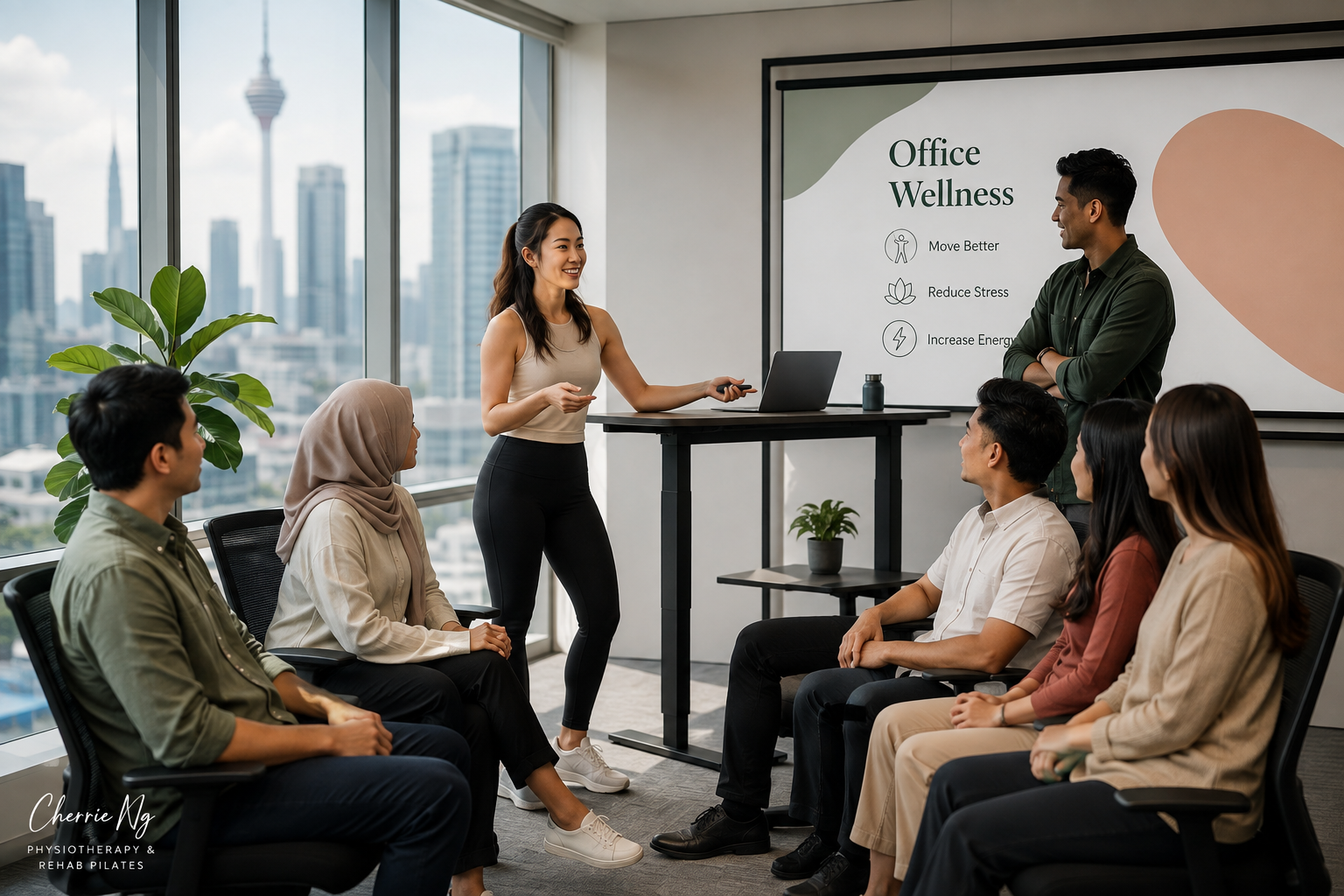
To choose an office wellness workshop in KL, begin with the workplace problem you want to address—not the most impressive activity list. Compare the facilitator’s relevant professional scope, how the content will be adapted, whether employees can participate comfortably, what the venue requires and what happens after the session.
A good proposal should make the purpose and limits of the workshop clear. It should not promise to diagnose employees, fix pain in one event or replace the organisation’s responsibility to address workplace hazards. If you are exploring available formats, see Cherrie’s physiotherapist-led corporate wellness programmes in Kuala Lumpur.
What is an office wellness workshop?
An office wellness workshop is a group education or movement session arranged around a workplace-health topic. Depending on the brief, it may include:
- posture and desk-wellbeing education;
- a live workstation demonstration;
- comfortable movement-break ideas;
- a beginner-friendly corporate Pilates session;
- a health and movement talk with questions; or
- a mix of activities for an employee wellness day.
The group format is important. It provides shared learning, not private assessment or individual treatment. An employee with a specific symptom, injury or medical concern may need an appropriate individual care pathway instead.
Start with the outcome your team actually needs
Before asking providers for a quote, define one or two practical goals. For example:
- help laptop users make better use of their existing equipment;
- give hybrid employees realistic ways to change position during the day;
- introduce an accessible shared movement activity;
- help managers understand recurring workstation barriers; or
- collect common questions before deciding whether a deeper ergonomic review is needed.
The CDC’s workplace-health model recommends assessing the employee population, physical work environment and organisational factors, while involving employees early. It also advises organisations to focus on a few well-chosen strategies and include evaluation in the programme cycle. CDC strategies for building a workplace health programme
A short anonymous poll can help, but avoid asking employees to disclose diagnoses or personal medical histories to the group.
10 questions to ask before booking
1. What problem is the workshop designed to address?
Ask the provider to describe the intended learning outcomes in plain language. “Employees will practise a simple workstation self-check” is more useful than a vague promise to “transform workplace wellbeing.”
The topic should match the team’s real work. A desk-health session may suit computer-based staff, while a general movement workshop may be better for a mixed team seeking an inclusive wellness activity.
2. Is the facilitator’s scope relevant and clearly explained?
Check the facilitator’s professional background against the proposed content. A physiotherapist may bring clinical knowledge to general posture, movement and rehabilitation education, but a group workshop is still not an individual physiotherapy assessment.
Ask who will lead the actual session, what their role covers and what they will not do. Do not rely only on a broad company label or unverified credential claim.
3. How will the content be customised?
A useful provider should ask about the team’s devices, tasks, work pattern, experience, available space and priority questions. WHO guidance for workplace physical-activity programmes emphasises practical, context-specific planning because organisations have different needs and constraints. WHO guidance on workplace physical activity in small and medium-sized enterprises
Customisation does not need to mean a completely new programme. It should mean that the examples, pace and activities fit the people and setting.
4. Is it education, exercise, ergonomic review or healthcare?
These formats should not be presented as interchangeable:
| Format | Main purpose | What it does not provide |
|---|---|---|
| Office wellness workshop | Shared education and practical activities | Individual diagnosis or treatment |
| Corporate Pilates | Adaptable group movement experience | Personal rehab programming |
| Workplace ergonomic review | Closer observation of tasks, equipment and work setup | A medical assessment of each employee |
| Individual physiotherapy | Private symptom and movement assessment | A whole-team workplace solution |
Clarifying the format protects employees and helps HR compare proposals fairly.
5. How will different abilities and comfort levels be supported?
Participation should be voluntary. For a movement-based session, ask whether the facilitator can provide seated or standing options, vary the range and pace, and explain how employees may pause without being singled out.
Also share relevant accessibility needs, room access and language preferences in advance. Avoid competitions based on exercise intensity, weight or body appearance.
6. How will privacy be handled?
Employees should not be asked to describe symptoms, diagnoses or health histories publicly. A workshop can use anonymous questions and provide a private route for concerns that need individual attention.
The provider should also avoid diagnosing someone from their posture in front of colleagues or using a participant as a demonstration without consent.
7. What venue, equipment and setup are required?
Confirm the room size, furniture layout, projector or screen access, power supply and any equipment the provider expects. A posture workshop may benefit from a real desk, adjustable chair and common employee devices. A mat-based activity requires safe, clear floor space and a plan for employees who prefer not to work on the floor.
Malaysia’s Department of Occupational Safety and Health publishes guidance on display-screen equipment, seating, standing and ergonomic risk assessment. That wider guidance is a reminder that desk wellbeing involves equipment, work design and organisational support—not one “perfect” sitting position. DOSH Malaysia ergonomics guidance library
8. What exactly is included in the proposal?
Ask whether the proposed scope includes:
- a planning call or brief review;
- presentation and practical demonstration;
- time for questions;
- handouts or a follow-up summary;
- setup and travel requirements;
- equipment supplied by either party; and
- a feedback method or recommended next action.
Duration, group size and fees should be confirmed for the actual brief rather than assumed from a generic package.
9. Are the promised outcomes realistic?
Reasonable outcomes may include better understanding, confidence using existing equipment, awareness of movement options or clearer identification of recurring workplace barriers.
Be cautious with guarantees that one workshop will prevent injuries, eliminate pain, reduce medical costs or increase productivity. Those outcomes depend on many factors and require appropriate data to evaluate.
10. What happens after the workshop?
Ask how employees will remember the key actions and how the organisation will respond to barriers raised during the session. A concise checklist, manager action list or follow-up review may be more useful than another long presentation.
NIOSH’s Total Worker Health approach prioritises a hazard-free work environment and says effective programmes must address hazardous working conditions. A wellness workshop can support education, but it should not be used instead of workplace safeguards or organisational changes. NIOSH Total Worker Health approach
Red flags when comparing workshop providers
Pause and ask for clarification if a proposal:
- guarantees pain relief, injury prevention or productivity gains;
- uses one posture or exercise prescription for everyone;
- offers to diagnose employees during a public group session;
- cannot explain the facilitator’s role or professional scope;
- has no plan for voluntary participation, modifications or private questions;
- ignores the workplace tasks, equipment and room setup;
- relies on client logos, testimonials or credentials that cannot be verified; or
- leaves the deliverables, travel requirements or follow-up unclear.
Clear boundaries are a sign of a well-scoped workshop, not a weakness.
What should HR include in the first enquiry?
Send the practical details that affect feasibility:
- company and office or event location;
- preferred date or date range;
- estimated participant number;
- main job tasks and usual devices;
- workshop goal and preferred topic;
- available room, furniture and presentation equipment;
- whether the activity is part of a larger wellness day;
- language and accessibility considerations; and
- what the team should be able to understand or do afterwards.
Corporate wellness sessions may be considered in Kuala Lumpur and selected Selangor areas. Programme scope, venue, travel, group size and availability are confirmed case by case.
Related reading
- Corporate Wellness Workshop Topics in Malaysia: What Will Employees Actually Use?
- What to Include in a Corporate Wellness Proposal Request: An HR Checklist
- Corporate Wellness Lunch and Learn in KL: Practical Posture and Movement Topics
- Corporate Wellness for SMEs in Malaysia: A Practical Starting Plan
- How to Measure Corporate Wellness Activities Without Overclaiming ROI
- How to Plan an Employee Wellness Day in KL: An HR Checklist
- Corporate Wellness Programme Cost in KL: What Affects a Quote?
- Corporate Wellness Ideas in KL: 8 Practical Activities for Office Teams
- Corporate Wellness Posture Workshop in KL: What Teams Learn
- Corporate Pilates in KL: What HR Teams Should Know Before Booking
- Ergonomic Assessment for Offices in KL: When Teams Need Support
Sources and clinical references
- CDC: Strategies for Building a Workplace Health Program
- NIOSH: About the Total Worker Health Approach
- WHO: Promotion of Health-Enhancing Physical Activity in Small-to-Medium-Sized Enterprises
- DOSH Malaysia ergonomics guidance library
Frequently asked questions
How long should an office wellness workshop be?
There is no single ideal duration. It depends on the goal, group size, practical activities, question time and venue. Ask the provider to recommend a scope for the brief instead of assuming a fixed package.
Can an office wellness workshop be customised?
The content may be adapted around the team’s work, devices, space, experience and priority questions. Share these details before booking so the facilitator can confirm what is feasible.
Is a wellness workshop the same as an ergonomic assessment?
No. A workshop provides shared education and practical ideas. An ergonomic review looks more closely at tasks, equipment and work setup. The appropriate format depends on the organisation’s question.
Can employees with pain attend?
They may take part when the general activity is comfortable and appropriate, but the workshop cannot decide what is suitable for an individual symptom. Participation should be voluntary, with modifications and a private route for questions or assessment.
Are office wellness workshops available outside Kuala Lumpur?
Selected Selangor locations may be considered depending on the brief, venue, travel and availability. Send the exact location when requesting a proposal.
Comparing workplace wellness options? Explore Cherrie’s corporate wellness programmes and WhatsApp the office location, team size and goal to discuss a suitable format.
Foundational clinical sources and further reading
These authoritative sources provide general background relevant to this topic; they are not claim-by-claim citations. This content is educational and does not replace individual assessment, diagnosis or emergency medical care.
- What is physiotherapy? — World Physiotherapy