Corporate Wellness
Corporate Pilates in KL: What HR Teams Should Know Before Booking
Planning corporate Pilates in KL? Learn what HR should confirm about class format, participant needs, space, screening, modifications and follow-up.
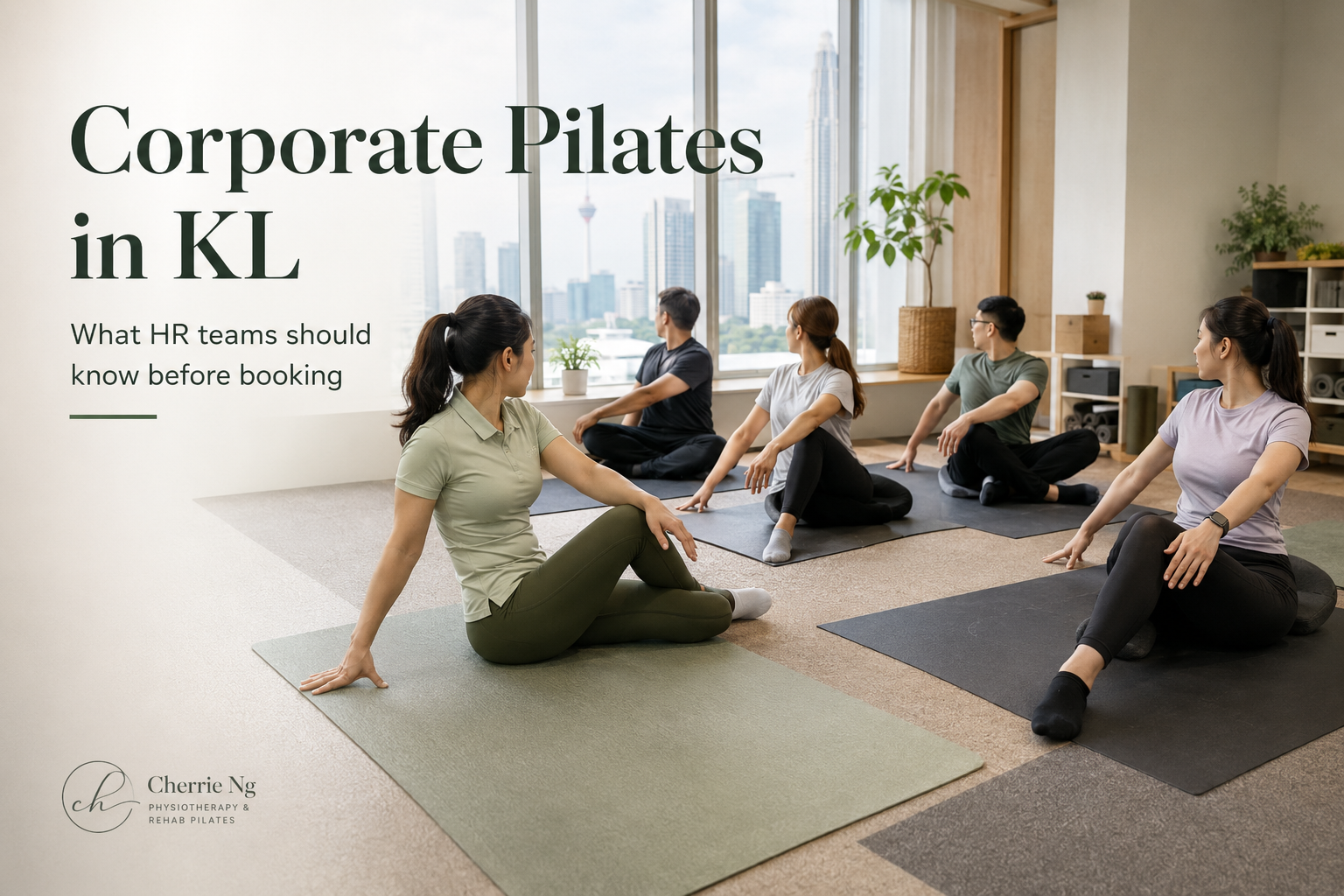
Corporate Pilates in KL can be a practical workplace wellness activity when the class is matched to the team, venue and purpose. Before booking, HR should confirm the participant profile, beginner-friendly format, available floor space, equipment, movement options, pre-class information and what happens if an employee needs individual support.
Cherrie’s workplace format uses adaptable mat-based movement rather than reformer machines. It can introduce mobility, posture awareness, trunk control, breathing and comfortable movement for employees with different experience levels. It remains a group wellness class—not a medical assessment, personal rehabilitation session or promise to prevent workplace pain.
For other possible formats, explore Cherrie’s physiotherapist-led corporate wellness programmes in Kuala Lumpur.
What is corporate Pilates?
Corporate Pilates is a group movement session arranged by an employer for staff, usually at the workplace or an event venue. A class may use mats and simple standing, seated or floor-based movements that can be adjusted for beginners.
The workplace context changes how the session should be planned. Participants may arrive in office clothing, have very different exercise backgrounds and know their colleagues professionally rather than socially. The room may also have fixed furniture, limited changing facilities or a tight timetable.
WHO guidance for workplace physical-activity programmes emphasises practical, context-specific planning because organisations have different needs and constraints. WHO guidance on workplace physical activity for small and medium-sized enterprises
That is why the best first question is not “Which Pilates exercises will we do?” It is “What kind of experience will be safe, useful and realistic for this team?”
Who can a corporate Pilates class suit?
A beginner-friendly class may suit employees who want an accessible introduction to guided movement, including people who have never tried Pilates. It can also work as one activity within an employee wellness day or as a movement component alongside a posture talk.
The class should not assume everyone has the same mobility, balance, confidence or comfort with floor exercise. A useful brief tells the facilitator about the group without asking employees to share private diagnoses publicly.
The CDC workplace-health model recommends assessing employee interests, the work environment and organisational factors before selecting a programme. It also recommends involving employees early rather than designing an activity around assumptions. CDC strategies for building a workplace health programme
HR might use a short anonymous poll to ask about:
- previous Pilates experience;
- preference for standing, chair-supported or mat-based activity;
- accessibility considerations;
- comfort with changing clothes or exercising at work;
- preferred session timing; and
- questions employees want covered.
Participation should be encouraged without becoming compulsory or connected to public disclosure of health information.
What may happen during the session?
The exact plan depends on the brief, group and venue. A corporate Pilates session with Cherrie may include:
- A short welcome explaining the group format and comfortable participation.
- Simple breathing and body-awareness cues.
- Gentle mobility for areas commonly held still during desk work.
- Beginner-friendly trunk and hip control exercises.
- Balance or standing movement where suitable.
- Options to make a movement smaller, more supported or more challenging.
- A calm finish and practical ideas for adding movement to the workday.
The class does not need to imitate a studio workout. The aim is a clear, welcoming experience that suits the available time and space.
Eight things HR should confirm before booking
1. What is the purpose of the class?
Decide whether the main goal is an enjoyable team activity, an introduction to Pilates, a movement break during a conference or one part of a broader wellness event.
Keep the outcome proportionate. One class can provide a guided movement experience, but it should not be marketed as treatment or proof that the organisation has reduced injuries, pain, absence or healthcare costs.
2. Who will attend?
Share the expected group size, general work pattern and whether the session is intended for complete beginners. Mention if the team includes a wide range of ages, movement experience or accessibility needs.
Do not send a list of employees’ medical conditions in an ordinary event brief. Ask the facilitator what information participants should receive privately before the class and how individual questions will be handled.
3. Is the format mat-based, standing or mixed?
Cherrie’s corporate Pilates offer is described as beginner-friendly mat movement, with the session adapted around the team and venue. A mixed format may include standing or chair-supported alternatives when appropriate.
Confirm the format before promoting the event so employees know whether they will be expected to get down to and up from the floor. If a fully mat-based class does not fit the room or audience, a movement workshop or posture session may be a better option.
4. Is the room suitable?
Check the usable floor area after tables, chairs, cables and presentation equipment are moved. Each participant needs enough personal space to change position without contacting furniture or another person.
Also confirm:
- ventilation and temperature;
- a clean, level and non-slip floor;
- access to drinking water;
- whether shoes can be stored safely;
- privacy from through-traffic; and
- whether the facilitator can be seen and heard from every position.
Send photographs or measurements when the layout is uncertain. The maximum suitable group size should follow the actual usable space, not just the room’s stated seating capacity.
5. Who provides the mats and equipment?
Ask whether the organisation, venue, facilitator or participants will provide mats. Confirm the number, cleanliness and transport plan before the event.
A corporate class does not need complicated equipment. If props are proposed, check what they are, how many are required and whether employees need instructions before arrival. Do not advertise reformer Pilates unless reformer equipment and an appropriate venue have actually been confirmed.
6. What should employees wear and bring?
Employees usually need comfortable clothing that allows them to move and suitable coverage for the planned positions. The invitation should state whether changing facilities are available and whether participants should bring a mat, water or grip socks.
Avoid framing clothing guidance around body shape or appearance. Practical communication helps employees decide privately whether they feel comfortable joining.
7. How will exercise readiness and modifications be handled?
A group wellness event still needs a clear process for employees who are unsure about participating. Pre-exercise screening can help people decide whether they should seek further advice before becoming more active. The Canadian Society for Exercise Physiology describes its self-administered Get Active Questionnaire as one step in an overall pre-participation screening process, not a diagnosis or a complete assessment. CSEP Get Active Questionnaire guidance
Ask the facilitator:
- what pre-class information participants will receive;
- whether a screening or readiness form is recommended;
- how employees can ask a question privately;
- what alternatives can be offered during the class; and
- what someone should do if the screening advises further professional input.
Employees should follow the screening guidance and any existing advice from their healthcare professional. A group class should not be used to test whether a painful or uncertain movement is medically safe for one person.
8. What happens after the class?
Choose simple follow-up questions before the event. HR could ask whether the class was understandable, welcoming, relevant and appropriately paced, and whether employees would prefer another class, a posture workshop or a different wellness format.
CDC workplace-health guidance treats evaluation as part of programme improvement and recommends focusing on useful questions that identify gaps and inform what happens next. CDC strategies for building a workplace health programme
Attendance and satisfaction are reasonable event measures. Avoid turning a single-session survey into a medical outcome claim.
Corporate Pilates versus individual rehab Pilates
These services have different purposes.
| Corporate Pilates | Individual rehab Pilates |
|---|---|
| Group wellness and movement experience | Personal assessment and exercise planning |
| Shared class structure with adaptable options | Exercises selected around one person’s history, symptoms and goals |
| General education rather than diagnosis | May be integrated with physiotherapy reasoning when appropriate |
| Uses the confirmed workplace or event setup | Uses the equipment and setting agreed for individual care |
An employee who needs symptom-specific assessment, post-injury progression or individual clinical guidance should not expect those needs to be resolved during a workplace group class. They may need a separate physiotherapy or rehab Pilates appointment.
What should be included in the booking enquiry?
Send enough information for the format to be checked:
- company and office or event location;
- preferred date and time range;
- expected participant number;
- intended purpose of the session;
- employees’ general experience level;
- room dimensions or clear photographs;
- mat and equipment availability;
- preferred language;
- accessibility considerations; and
- whether the class is part of a larger wellness day.
Corporate Pilates sessions may be arranged in Kuala Lumpur and selected Selangor areas, subject to the brief, venue, travel and availability. Duration, group size, equipment and final class scope are confirmed case by case.
Related reading
- Corporate Pilates vs an Office Fitness Class: Which Format Fits Your Team?
- Inclusive Corporate Wellness Activities: Planning for Different Abilities and Comfort Levels
- How to Plan an Employee Wellness Day in KL: An HR Checklist
- Physiotherapist-Led Corporate Wellness: What Makes the Approach Different?
- Corporate Wellness Programme Cost in KL: What Affects a Quote?
- How to Choose an Office Wellness Workshop in KL
- Corporate Wellness Ideas in KL: 8 Practical Activities for Office Teams
- Physiotherapist-Led Pilates in KL: Who Is It Suitable For?
- Corporate Wellness Posture Workshop in KL: What Teams Learn
- What Is Rehab Pilates and How Is It Different from Regular Pilates?
Sources and clinical references
- WHO: Promotion of Health-Enhancing Physical Activity in Small-to-Medium-Sized Enterprises
- CDC: Strategies for Building a Workplace Health Program
- Canadian Society for Exercise Physiology: Get Active Questionnaire
Frequently asked questions
Do employees need Pilates experience?
No previous experience is required for a class planned for beginners. Confirm this in the brief so the movement choices and pace are designed accordingly.
Does corporate Pilates use reformer machines?
Cherrie’s workplace corporate format is mat-based. Do not assume reformers are included; the venue, equipment and format must be confirmed before the event.
Can employees with pain participate?
A group class cannot decide whether participation is suitable for a specific symptom. Employees should use the provided readiness process, follow existing professional advice and ask privately when uncertain. Individual assessment may be more appropriate when symptom-specific guidance is needed.
How many people can join?
There is no universal number. A suitable group size depends on clear floor space, the need for movement options, visibility, equipment and the agreed facilitation format.
Where is corporate Pilates available?
Sessions may be considered for organisations in Kuala Lumpur and selected Selangor areas. Share the exact venue, preferred date, estimated group size and goals so feasibility can be confirmed.
Planning a workplace Pilates class? Explore Cherrie’s corporate wellness programmes and WhatsApp your company, location, group size, preferred date and event goal to discuss a suitable format.
Foundational clinical sources and further reading
These authoritative sources provide general background relevant to this topic; they are not claim-by-claim citations. This content is educational and does not replace individual assessment, diagnosis or emergency medical care.
- What is physiotherapy? — World Physiotherapy
- WHO guidelines on physical activity and sedentary behaviour — World Health Organization