Corporate Wellness
Inclusive Corporate Wellness Activities: Planning for Different Abilities and Comfort Levels
A practical HR guide to inclusive corporate wellness activities with accessible planning, voluntary choices, privacy and safe adaptations.
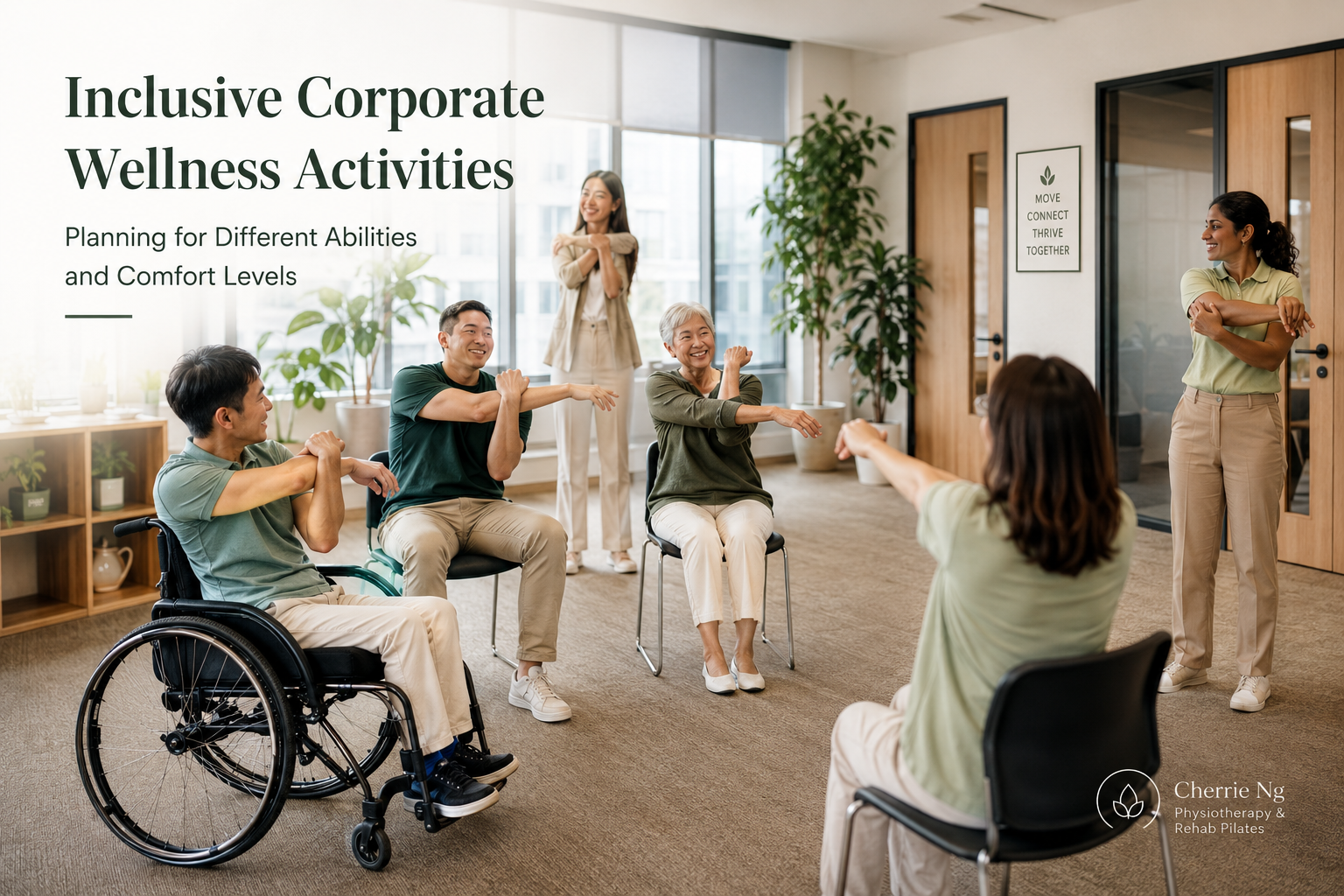
An inclusive corporate wellness activity gives employees meaningful choices without requiring them to explain their body, diagnosis or comfort level in public. Plan access before invitations go out, offer equivalent seated, standing and non-exercise options, make participation voluntary, and create a private way to request support.
Inclusion is not achieved by saying that “everyone can join” while the venue, instructions or activity still suit only one type of participant. HR, managers and the facilitator need to examine physical, communication, scheduling and social barriers together.
Who may need a different way to participate?
Ability and comfort can vary for many reasons, some visible and some not. A workplace group may include people who:
- use a wheelchair, walking aid or other assistive device
- prefer seated activity or need reliable balance support
- have pain, fatigue, a previous injury or current rehabilitation restrictions
- are pregnant, post-natal or returning after illness or surgery
- process verbal instructions, sound, light or crowded spaces differently
- are deaf, hard of hearing, blind or have low vision
- wear work clothing or cultural attire that changes which movements feel practical
- prefer not to exercise in front of colleagues
- are working remotely, on shifts or in customer-facing roles
- simply do not feel comfortable with that activity on that day
HR does not need a list of employees’ diagnoses to plan better. The more useful question is: what could prevent someone from accessing, understanding or comfortably choosing this activity?
The CDC describes disability inclusion as identifying and removing physical, communication and attitudinal barriers, with input from people with disabilities during programme design, implementation, monitoring and evaluation. Its material is US guidance, but these design principles are useful in other workplace contexts. CDC disability inclusion strategies
Seven steps for planning an inclusive wellness activity
1. Ask about barriers before choosing the format
Invite employee input early through an anonymous pulse survey, employee representative or private contact person. Ask about access and preferences, not medical history.
Useful questions include:
- Would seated, standing or non-movement options be useful?
- Is step-free access, nearby parking or lift access required?
- Would captions, written instructions or a quieter space help?
- Are there shift, meeting or caregiving times to avoid?
- Would employees prefer a talk, practical movement session or a combination?
- Is there another barrier HR should consider?
WHO guidance for workplace physical-activity programmes emphasises practical, context-specific planning because workplaces have different needs, resources and limitations. WHO workplace physical-activity guidance for SMEs
Do not promise that every request can be met before checking it. Acknowledge the request privately, clarify what is needed and confirm the arrangement.
2. Audit the whole participant journey
Access begins before the activity room. Check:
- transport, parking and drop-off information
- step-free route from arrival to the room
- lift access and door width where relevant
- clear pathways between chairs and equipment
- accessible toilets
- seating with back support and space for mobility devices
- room temperature, lighting and sound
- a lower-stimulation or private area if available
- emergency routes and procedures that include all participants
Do not move a wheelchair, walking aid or personal item without permission. Arrange the room so a person using mobility equipment can choose a position rather than being placed separately.
Universal design aims to make products, communication and physical environments usable by as many people as possible. CDC examples include clear pathways, perceptible information, flexibility in use and enough space for different body sizes, postures and mobility. CDC disability inclusion strategies
3. Make the invitation accessible and specific
“Suitable for everyone” is too vague. Tell employees what the activity involves so they can decide.
An invitation can state:
- whether it is a talk, seated activity, standing movement or mat-based session
- expected duration and whether breaks are included
- clothing and footwear considerations
- whether chairs, floor work or equipment will be used
- that participation is voluntary
- that employees can sit, stand, observe, pause or leave
- how to request access support privately
- whether slides, captions or written notes will be available
Use clear headings, readable contrast and plain language. Caption videos and provide important instructions in a written form where practical. NIOSH recommends alternative formats, captions, screen-reader-compatible material, high contrast and accessible formatting as part of inclusive workplace communication. NIOSH inclusive communication guidance
4. Design equivalent choices, not a “normal” option and a lesser substitute
For a movement activity, offer choices with a similar purpose rather than assuming standing is the real exercise. For example:
| Activity purpose | Standing choice | Seated or supported choice | Non-exercise choice |
|---|---|---|---|
| Change position | Comfortable walk or weight shift | Adjust sitting position or move the feet | Change to a non-screen task |
| Move shoulders and arms | Gentle reach within comfort | Seated arm or shoulder movement | Observe and note an option for later |
| Join a practical demonstration | Standing version with stable support nearby | Chair-based version with clear space | Listen without demonstrating |
| Reset between topics | Walk to water or change place | Pause, breathe normally and reposition | Take a quiet break |
CDC’s workplace physical-activity guide recommends giving people permission to adapt activities to fit their bodies, including sitting instead of standing, and to choose movements that feel comfortable. CDC Workplace Physical Activity Break Guide
Not every standing movement has a direct seated equivalent, and not every employee needs an exercise alternative. The facilitator can explain the purpose, offer several routes and avoid ranking one as more committed or successful.
5. Brief the facilitator and managers
Before the event, share relevant group-level information with the facilitator:
- room layout and access
- group size and typical work roles
- languages used
- planned seated, standing and observation choices
- known access arrangements, with the employee’s consent where needed
- how private questions will be handled
- who responds if someone feels unwell
Managers should also know that participation is voluntary. They should not call out employees who remain seated, ask why someone stopped or photograph people without appropriate permission.
A facilitator should speak to the whole group in choice-based language: “You may try this seated or standing,” “Choose a comfortable range,” and “Observing is also an option.” This avoids turning an adaptation into a public announcement about one employee.
6. Protect privacy and genuine choice
A voluntary activity stops feeling voluntary when a manager watches attendance, when photographs are unexpected or when employees must disclose a condition to opt out.
Use a private route for access requests and symptom-specific questions. Collect only information needed to arrange the event, restrict who receives it and follow the organisation’s applicable privacy processes. For general feedback, anonymous or aggregated responses are often enough.
Avoid public health screening disguised as a group icebreaker. Questions such as “Who here has back pain?” may pressure employees to reveal information they preferred to keep private.
7. Evaluate inclusion, not just attendance
After the activity, ask whether employees could access and use the format. A short anonymous survey might ask:
- Were the activity and participation choices clear beforehand?
- Could you choose a comfortable level without drawing attention?
- Were the venue and materials accessible to you?
- Did the facilitator treat seated, standing and observing choices respectfully?
- What barrier should be addressed next time?
Break down participation data only when groups are large enough to protect privacy and the comparison answers a useful question. Do not publish small-group health or disability details.
What inclusive facilitation sounds like
Small language choices change the atmosphere.
| Instead of | Try |
|---|---|
| “Everyone stand up.” | “You may stay seated or stand; both options are available.” |
| “This is the easy version.” | “This is another version with the same focus.” |
| “No excuses—keep moving.” | “Pause or change the movement whenever you need.” |
| “Who has an injury?” | “Private questions can be discussed with the facilitator afterwards.” |
| “If you can’t do this, just watch.” | “Observing is one of the participation choices.” |
| “Push through the stretch.” | “Use a comfortable range and stop if it does not feel right.” |
The aim is not to find perfect phrases. It is to communicate choice without making assumptions about what a person can do.
Choosing an activity format
Talk or lunch-and-learn
This may suit a mixed group when practical demonstrations are optional. Check hearing, visual and language access; provide readable materials and avoid relying only on spoken instructions.
Posture or desk-wellbeing workshop
Use examples from different job roles and workstations. Avoid presenting one posture as mandatory for every body. Include task variation and work-system factors, not only individual behaviour.
Guided movement break
Provide seated, standing, supported and observation choices. Clear space, stable chairs and slower demonstrations make options easier to follow.
Corporate Pilates or mat activity
Explain floor work, clothing, equipment and transitions before booking. A chair-based or mixed-format session may be more suitable for some groups. If safe, meaningful options cannot be provided for the planned group and environment, choose another format instead of calling the activity inclusive.
Individual workstation or physiotherapy support
Some concerns need privacy and individual assessment rather than a group modification. A private pathway can sit alongside the general activity without requiring employees to discuss symptoms publicly.
Safety boundaries for group activities
A facilitator can offer general choices, but cannot determine every participant’s medical suitability in a group setting. Employees should follow known medical or rehabilitation restrictions and may need individual advice if they are unsure which activity is appropriate.
Participants should be encouraged to begin gently, use a comfortable option and stop if an activity causes pain, dizziness, breathing difficulty or another concerning response. The CDC workplace activity guide similarly advises choosing appropriate activities, starting gradually and stopping when an activity hurts. CDC Workplace Physical Activity Break Guide
The organisation should also have its usual first-aid and emergency procedures in place. A wellness facilitator does not replace emergency or medical care.
What Cherrie can discuss with HR
For organisations in Kuala Lumpur and selected Selangor areas, Cherrie can discuss an in-person corporate wellness format based on the workforce, venue, group size and intended learning goals. Depending on the agreed brief, this may involve a posture or desk-wellbeing talk, gentle movement options or a beginner-friendly mat activity.
Before confirming the session, HR should share access information, room constraints, typical work roles and the participation choices the organisation wants to support. Cherrie can plan general adaptations within the agreed scope; individual clinical assessment remains separate from the group event. Suitability, location, equipment, duration and availability are confirmed case by case.
Inclusive planning checklist for HR
- Employees had a private way to share access needs or preferences.
- The format was chosen after considering the workforce and work schedule.
- The route, room, seating, toilets and emergency access were checked.
- Invitations explain the activity, clothing, choices and support contact.
- Key communication is available in an accessible format.
- Seated, standing, supported and non-exercise options are planned where relevant.
- The facilitator and managers understand voluntary participation and privacy.
- Photography and recording expectations are clear.
- Individual health questions have a private pathway.
- Feedback asks about barriers and comfort, not only enjoyment.
Related reading
- Corporate Wellness Ideas in KL: 8 Practical Activities for Office Teams
- Office Stretching Routine: Simple Movement Breaks for Desk Workers
- Corporate Pilates in KL: What HR Teams Should Know Before Booking
- How to Build a Workplace Movement-Break Programme Employees Can Actually Use
- How to Measure Corporate Wellness Activities Without Overclaiming ROI
Sources and clinical references
- CDC: Disability Inclusion Strategies
- NIOSH: Creating Inclusive Communication
- WHO: Promotion of Health-Enhancing Physical Activity in Small-to-Medium-Sized Enterprises
- CDC: Workplace Physical Activity Break Guide
Frequently asked questions
Does an inclusive activity need to be suitable for absolutely everyone?
No single activity will suit every person. Inclusive planning means removing avoidable barriers, explaining the format honestly, offering meaningful choices and selecting another format when safe participation cannot be supported.
Should HR ask employees to disclose disabilities before the event?
Ask privately about access needs and useful arrangements, not for a public list of diagnoses. Collect only what is needed to plan the activity and follow the organisation’s privacy processes.
Is a seated version always easier?
No. Seated and standing options place different demands on people. Describe them as equivalent choices and let participants select what feels workable.
Can employees choose to observe?
Yes. Observing, pausing or leaving should be accepted without requiring a public explanation. The invitation and facilitator can make this clear in advance.
Can someone with pain join a corporate movement session?
That depends on the person, symptoms and activity. A general facilitator can offer choices but cannot assess the cause or suitability for every employee. If uncertain, the employee may need private advice from an appropriate healthcare professional.
What if the booked activity cannot be adapted safely?
Change the format. A talk, chair-based session, smaller group or separate individual pathway may be more appropriate than forcing one activity to fit every situation.
Planning an inclusive corporate wellness activity in KL or Selangor? Explore Cherrie’s corporate wellness programmes and WhatsApp your location, group size, venue setup and access priorities to discuss a suitable in-person format.
Foundational clinical sources and further reading
These authoritative sources provide general background relevant to this topic; they are not claim-by-claim citations. This content is educational and does not replace individual assessment, diagnosis or emergency medical care.
- What is physiotherapy? — World Physiotherapy