Corporate Wellness
Office Stretching Routine: Simple Movement Breaks for Desk Workers
A practical office stretching routine with gentle movement-break options for desk workers, plus guidance on timing, comfort and when to get assessed.
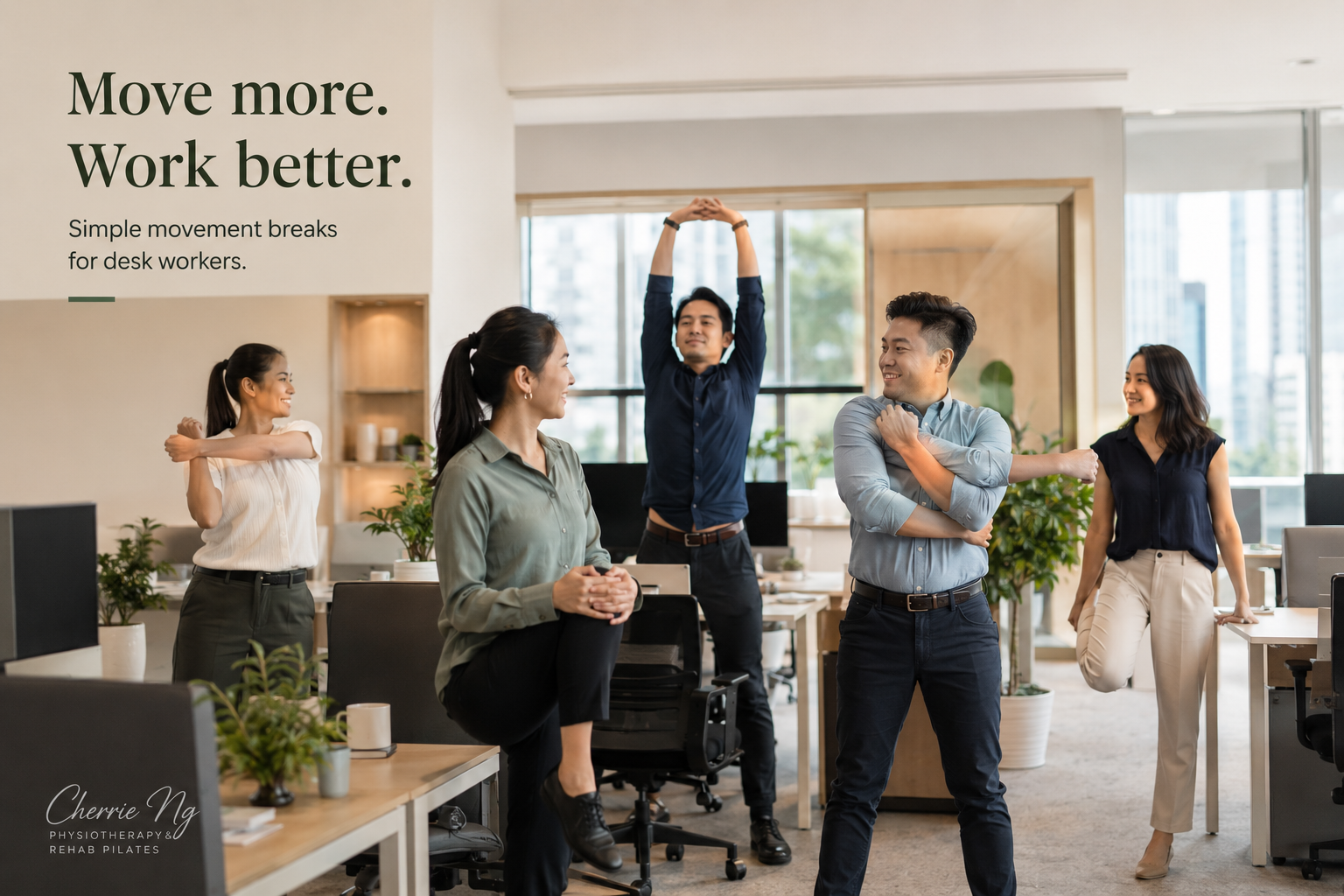
An office stretching routine does not need to be long, intense or identical every time. For desk workers, the most practical movement break is often a small menu: stand up, walk briefly, move the shoulders and upper back, turn the neck gently, open and close the hands, and let the hips and ankles change position.
Choose movements that feel comfortable today. The routine below is general workplace education, not a personal treatment plan, and it should not be forced through pain or used as a substitute for assessment when symptoms persist or worsen.
Why movement breaks matter more than one perfect stretch
The purpose of a movement break is to interrupt one sustained task and give the body and eyes a different demand. It does not have to “correct” your posture or undo an entire day of sitting.
Malaysia’s 2024 Department of Occupational Safety and Health (DOSH) guidance treats frequent breaks as part of managing prolonged display-screen work. The UK Health and Safety Executive (HSE) similarly advises short, frequent breaks or changes of activity that allow workers to move around, stretch or change posture; it also says timing depends on the work rather than one universal interval. DOSH Malaysia 2024 display-screen equipment guideline HSE guidance on display-screen work routines and breaks
This makes a flexible routine more useful than waiting until the end of the day for one long stretch. A phone call, water break, printer trip or change to a non-screen task can also be a movement break.
Before you start
Use these practical checks:
- Clear enough space that you will not hit a chair, drawer or colleague.
- Keep a desk or stable surface nearby if balance is uncertain.
- Move slowly and stay within a comfortable range.
- Breathe normally; do not strain or hold your breath.
- A gentle sense of movement or mild stretch may be reasonable, but sharp pain or worsening symptoms are signals to stop.
- Follow any restrictions given after surgery, injury or medical treatment.
You do not have to complete every movement. Pick the options that match your space, clothing, task and how you feel.
A simple office movement-break routine
1. Leave the chair for a short walk
If possible, stand and walk a comfortable distance—to refill water, speak to a colleague or simply take a brief loop around the room.
Walking changes more than one joint at once and gives the eyes a chance to look away from the usual screen distance. If you cannot leave the workstation, stand behind the chair or alternate small steps on the spot while holding a stable surface if needed.
2. Roll and reach the shoulders
Let the arms rest by your sides. Slowly lift the shoulders, roll them back and let them settle. Change direction if that feels comfortable.
Then reach both hands gently forward as if making space between the shoulder blades. Return to a relaxed position and open the arms slightly to the sides without forcing the chest upward or pinching the shoulders together.
The aim is easy movement, not holding the shoulders “down and back” for the rest of the day.
3. Turn the neck within a comfortable range
Sit or stand tall enough to move freely, while keeping the jaw relaxed. Slowly look towards one side, return to the centre, then look towards the other side.
You can also gently bring one ear towards the same-side shoulder, return to centre and change sides. Keep the shoulder relaxed and stop before the movement becomes painful, dizzying or causes symptoms to travel.
Avoid pulling hard on the head with a hand. A smaller active movement is often easier to control in an office setting.
4. Move the upper back and trunk
Sit with both feet supported or stand with a comfortable stance. Cross the arms loosely over the chest and turn the upper body a small amount to one side, return to the middle, then turn the other way.
For another option, place the hands on the thighs, gently round the upper back, then return to a comfortable upright position. There is no need to push into a large arch.
Let the movement come from a comfortable combination of the upper back, ribs and shoulders rather than forcing the lower back.
5. Reset the hands and wrists
Move the hands away from the keyboard. Open the fingers, make a soft fist, then open them again. Turn the palms up and down, and make small wrist circles in both directions.
Keep these movements light. If keyboard or mouse work repeatedly produces hand pain, numbness, tingling or weakness, stretching harder is not the answer; the task, equipment and symptoms need individual review.
6. Change what the hips, knees and ankles are doing
Choose one option that suits your space:
- Stand up from the chair and sit down again with control.
- Hold a stable desk and slowly raise and lower the heels.
- Alternate lifting one foot, as if marching gently on the spot.
- While seated, straighten one knee comfortably and move the ankle up and down.
The aim is to change position and use the lower body, not turn a work break into a demanding workout.
7. Finish by choosing your next working position
Before returning to the task, decide whether to sit back down, remain standing briefly or adjust the chair and screen. A movement break is more useful when it leads to another workable position instead of returning automatically to the same arrangement.
How long and how often should you move?
There is no single medical schedule that fits every worker. HSE gives 5 to 10 minutes each hour as an example of a short, frequent break pattern, but explicitly says timing depends on the type of work and that natural changes of activity may count. HSE guidance on display-screen work routines and breaks
Use that as work-planning context, not a rule that everyone must follow exactly. A practical approach is to:
- Change position when finishing a call, document or meeting.
- Move before stiffness becomes intense rather than waiting until the end of the day.
- Use shorter options when the workload is busy and a longer walk when there is more time.
- Alternate the movements instead of repeating the same stretch every break.
- Ask the employer for realistic break opportunities if the job provides no natural task changes.
Reminders can help, but an alert that is always dismissed will not change the work routine. Link the movement to an event that already happens during your day.
Will office stretches prevent or fix pain?
No routine can guarantee that. Workplace pain can be influenced by more than time spent sitting, and a general movement break is not the same as a symptom-specific exercise programme.
A 2022 Cochrane review found low-quality evidence that workplace interventions—including education, rest-break advice, relaxed posture and exercise-break components—did not provide more pain relief than no intervention for workers with neck pain. The authors concluded that the evidence neither supported nor ruled out benefits from any specific workplace intervention. Cochrane review of workplace interventions for workers with neck pain
This uncertainty is a reason to keep expectations realistic, not a reason to avoid movement. A short routine may feel refreshing and make movement easier to remember, while persistent symptoms may require a closer look at work demands, equipment, sleep, stress, activity levels, strength and individual health factors.
When should a desk worker get assessed?
Consider individual advice when discomfort keeps returning, is becoming more intense, interferes with work or sleep, or does not respond to reasonable changes in position and workload. Assessment is also appropriate when you are unsure which movements fit a previous injury, surgery or health condition.
During a physiotherapy assessment, Cherrie may ask about symptom behaviour, desk and device use, working hours, usual breaks, movement, strength, sleep and activities outside work. The plan may involve workstation changes, graded mobility or strengthening, task pacing, rehab Pilates principles or referral when the presentation needs another type of care.
A general office routine should not be used to diagnose the cause of pain. If a movement clearly worsens symptoms, stop and seek appropriate advice rather than repeatedly pushing further.
What employers can do
Movement breaks are easier when the work system supports them. Employers can:
- Allow staff to change tasks or leave the screen periodically.
- Avoid treating every brief standing or walking break as lost productivity.
- Provide enough clear space and adjustable equipment.
- Encourage participation without forcing employees to disclose symptoms publicly.
- Include simple movement and workstation education in a broader corporate wellness session.
- Offer a private route for employees who need individual support.
The aim is a workable culture, not a compulsory office performance where everyone must complete the same stretch on command.
Related reading
- Corporate Wellness Lunch and Learn in KL: Practical Posture and Movement Topics
- Inclusive Corporate Wellness Activities: Planning for Different Abilities and Comfort Levels
- How to Build a Workplace Movement-Break Programme Employees Can Actually Use
- Corporate Wellness for Hybrid Teams in Malaysia: Supporting Home and Office Workers
- Corporate Wellness Ideas in KL: 8 Practical Activities for Office Teams
- Corporate Wellness Posture Workshop in KL: What Teams Learn
- Neck and Shoulder Pain from Desk Work: What You Can Do
- Back Pain from Sitting Too Long: A Guide for Office Workers
- Desk Ergonomics in KL: Simple Setup Tips for Neck and Back Strain
Sources and clinical references
- DOSH Malaysia: Guidelines on Occupational Safety and Health for Working with Display Screen Equipment 2024
- HSE guidance on display-screen work routines and breaks
- Cochrane review: Workplace interventions for workers with neck pain
Frequently asked questions
Should I stretch every hour at work?
There is no universal medical rule. HSE uses 5 to 10 minutes each hour as one work-planning example, while emphasising shorter, more frequent breaks and changes of task. Choose a pattern that is realistic for your duties and symptoms.
Should an office stretch feel painful?
No. Keep the movement gentle and within a comfortable range. Stop if pain becomes sharp, symptoms spread or the movement leaves you feeling worse.
Can I do the routine while seated?
Most upper-body and ankle movements can be adapted to sitting. If possible, also include an occasional position change or short walk, because stretching in the chair still leaves you in the same working location.
Is stretching enough for desk-related neck or back pain?
Not always. Workstation setup, task variety, workload, general activity and individual strength or mobility may all be relevant. Recurrent or worsening symptoms deserve assessment rather than an ever-longer list of stretches.
If your KL or Selangor workplace wants a practical movement-break and desk-health session, WhatsApp Cherrie to discuss corporate wellness education for your team.
Foundational clinical sources and further reading
These authoritative sources provide general background relevant to this topic; they are not claim-by-claim citations. This content is educational and does not replace individual assessment, diagnosis or emergency medical care.
- What is physiotherapy? — World Physiotherapy