Corporate Wellness
Corporate Wellness Lunch and Learn in KL: Practical Posture and Movement Topics
Plan a practical corporate wellness lunch and learn in KL with focused posture topics, optional movement, venue checks and useful follow-up.
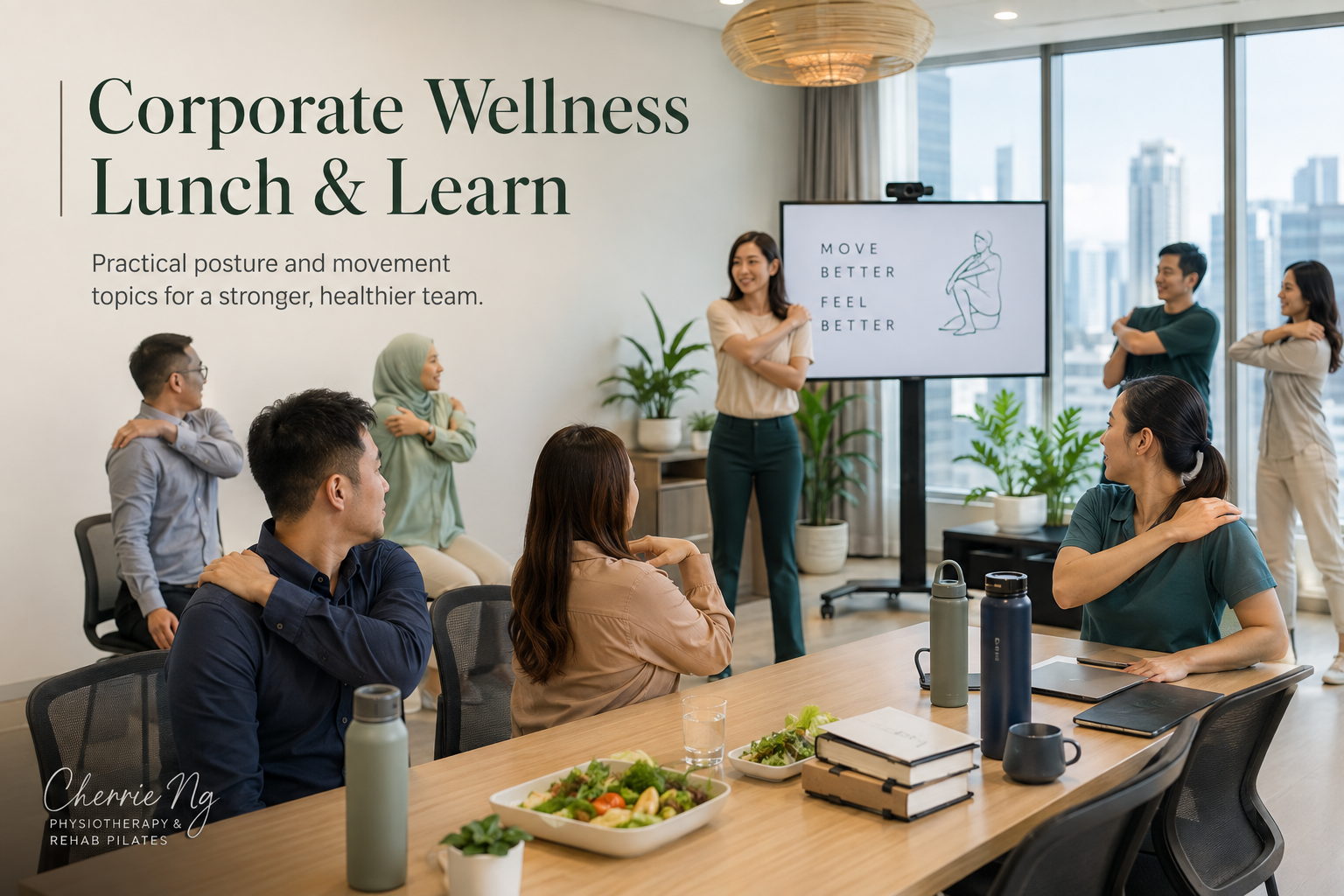
A corporate wellness lunch and learn in KL is a short, focused workplace education session arranged around the lunch period. For posture and movement topics, the most useful format is not a long list of generic health tips. It chooses one or two questions that match the team’s real work, explains them clearly, includes optional practical participation and finishes with a realistic next step.
Employees may eat during the presentation if the venue allows it. Any standing or movement segment is better scheduled after food and hot drinks have been safely set aside. The session provides general education; it is not a public posture inspection, individual diagnosis or substitute for personal physiotherapy or ergonomic assessment.
Why use a lunch-and-learn format?
Lunch and learns fit into a familiar part of the workday and can make a first workplace-wellness activity easier to organise. They work especially well when the goal is narrow: helping laptop users perform a quick setup check, showing a team how to vary screen-based work or explaining the difference between shared education and individual support.
Convenience alone does not make a session useful. The US Centers for Disease Control and Prevention (CDC) recommends assessing employee needs and interests, involving employees early and focusing on a few well-chosen strategies when planning workplace health programmes. It also recommends combining individual actions with organisational or environmental support. CDC strategies for building a workplace health programme
In practice, that means the talk should connect personal suggestions with conditions the employer can influence—for example, adjustable equipment, permission to change tasks, clear follow-up routes and enough space to move safely.
Six practical posture and movement topics
HR teams do not need to fit every topic into one lunch hour. Select the issue employees are most likely to use immediately.
1. Desk posture without the “perfect posture” rule
This topic reframes posture as a position that is supported, comfortable for the current task and able to change. Employees can learn how chair support, foot contact, screen placement and reach affect their setup without being told to hold one rigid pose all day.
A short demonstration may show how to move between upright, slightly reclined and standing work where practical. The takeaway is a simple adjustment process, not a judgement about how someone looks while sitting.
2. Movement breaks and task variation
Employees can identify natural opportunities to leave the screen or change position: a phone call, a discussion with a colleague, filing, refilling water or moving between tasks. Malaysia’s Department of Occupational Safety and Health (DOSH) guidance for display-screen work recommends job variety and rotation to reduce prolonged periods in sustained postures, and describes productive rest tasks away from the display screen. DOSH Malaysia display-screen equipment guidelines 2024
The session should avoid presenting one break schedule as a medical rule for everyone. Work demands vary. As a practical comparison, the UK’s Health and Safety Executive says timing depends on the work and favours short, frequent breaks or changes of activity over less frequent long breaks. This is useful planning guidance, not a statement of Malaysian law. HSE guidance on display-screen work routines and breaks
3. Neck, shoulder and back comfort at work
A general session can explain how sustained screen work, repeated reaching, limited task variation and an unsuitable setup may contribute to discomfort. It may then offer comfortable position changes, desk adjustments and gentle movement choices.
It should not attempt to diagnose why an individual employee has pain in front of colleagues. Persistent, worsening or spreading symptoms, numbness, weakness, a recent injury or other health concerns need an appropriate private assessment.
4. Laptop and hybrid-work self-checks
Laptop users can learn why the joined screen and keyboard limit adjustment during longer work periods. A demonstration may compare a laptop used alone with a stable riser, external keyboard and mouse, while acknowledging that every home, meeting room and hot desk has different constraints.
The goal is to help employees prioritise feasible changes. It is not to imply that everyone must purchase the same equipment after a single talk.
5. Standing desks and position changes
A standing desk is another work position, not a requirement to stand continuously. This topic can show how employees might alternate between supported sitting, standing and brief movement according to the task and personal comfort.
It can also address practical details such as screen height, keyboard reach, footwear, shared desks and how to change position without interrupting essential work.
6. When a workshop is not enough
Employees and managers benefit from knowing the boundary between formats:
- A lunch and learn introduces one focused topic and practical general actions.
- A hands-on workshop provides more time for guided practice and discussion.
- An ergonomic assessment examines tasks, equipment and workplace conditions more closely.
- An individual physiotherapy assessment considers a person’s symptoms, history and movement needs privately.
Making these boundaries clear prevents a general education session from being mistaken for personal treatment.
How to choose the right topic
Start with a short anonymous poll, a few recurring HR questions or an observation about the team’s work—not individual medical details. Useful planning questions include:
- Do most employees use laptops, fixed desktops, multiple screens or hot desks?
- Is the team mainly office-based, hybrid, mobile or customer-facing?
- Are employees asking about setup, movement breaks, common discomfort or equipment?
- What can the organisation realistically change after the talk?
- Should the session be delivered in English, Chinese or a mixed-language format?
- Does anyone need a seated option, more space, captions or another access arrangement?
Choose one primary outcome, such as “employees can perform a basic laptop setup self-check.” A narrow outcome makes the presentation, questions and follow-up easier to evaluate.
Sample 30-, 45- and 60-minute agendas
These are event-planning examples, not fixed packages or prescribed exercise doses.
A focused 30-minute talk
- Five-minute introduction and myth check.
- Fifteen-minute explanation and demonstration of one topic.
- Five-minute optional seated position change or self-check.
- Five-minute questions and one action to try.
An interactive 45-minute session
- Brief introduction linked to the team’s work.
- Twenty-minute topic explanation with a live setup demonstration.
- Ten-minute optional seated or standing practice after food is cleared.
- Ten-minute anonymous or live questions and follow-up guidance.
A practical 60-minute session
- Short presentation on one main topic and one supporting topic.
- Guided workstation self-check or movement practice with alternatives.
- Discussion of barriers employees and managers notice.
- Questions, action summary and explanation of further support.
If the brief requires several workstations to be reviewed or individual recommendations to be made, a longer workshop or separate assessment is usually a clearer format than trying to compress everything into lunch.
Food, room and participation planning
The event should be comfortable for people who came to learn, eat or both. Before the date, confirm:
- whether lunch arrives before or during the talk;
- where food waste, bags and hot drinks will be placed;
- whether tables, chairs and aisles leave a safe demonstration area;
- whether the facilitator has a screen, adapter, microphone and reliable power;
- whether seated and standing options can be shown without moving heavy furniture;
- whether attendance and movement are voluntary;
- whether photography is planned and how consent will be handled; and
- how employees can ask questions without disclosing symptoms publicly.
During the eating portion, the facilitator can explain concepts, use visual examples or demonstrate with their own setup. Employees should put food and hot drinks aside before any optional movement. Comfortable work clothing is usually enough; the booking brief should say in advance if a more active component is planned.
Keep participation inclusive and private
Some employees may be fasting, managing an injury, pregnant, uncomfortable moving in workwear or simply prefer to observe. They should be able to participate without explaining why they choose a seated option or skip an activity.
Useful choices include observing, completing a desk self-check, joining a small comfortable movement or asking a question anonymously. Avoid singling someone out as an example, correcting bodies publicly or turning participation into a competition.
The facilitator can give general safety cues and alternatives, but cannot decide what is clinically appropriate for every person in a group. Anyone who feels unwell or has symptoms that make an activity unsuitable should stop and seek individual guidance when needed.
What should happen after the session?
A lunch and learn is more useful when it leads to one small, supported action. Depending on the topic, follow-up may include:
- a one-page workstation self-check or movement menu;
- a reminder from HR about available equipment or task-change practices;
- a channel for private questions;
- a short employee feedback form;
- a list of workplace barriers for the responsible manager; or
- a separate workshop, ergonomic review or individual referral route where justified.
Measure what the session was designed to change. For a short educational talk, suitable checks may be attendance, usefulness ratings, the proportion of participants who can name or demonstrate the intended action, and requests for follow-up. These measures describe reach and learning; they do not prove that the talk prevented injury, removed pain or produced a financial return.
What to send when requesting a quote
For a corporate wellness lunch and learn in Kuala Lumpur or selected Selangor areas, provide:
- company name and exact office or event location;
- preferred date, start time and available duration;
- estimated participant number and room layout;
- the team’s main jobs, devices and work pattern;
- one priority topic and desired takeaway;
- presentation, sound and furniture available;
- lunch timing and catering arrangement;
- preferred language and accessibility considerations; and
- any requested handout, follow-up or separate assessment scope.
Cherrie can discuss physiotherapist-led posture, desk-wellbeing and gentle movement education for office teams. The final scope, travel, venue needs, group size and availability are confirmed case by case; a lunch and learn remains general group education rather than individual medical care.
Related reading
- Corporate Wellness Workshop Topics in Malaysia: What Will Employees Actually Use?
- Corporate Wellness Posture Workshop in KL: What Teams Learn
- Office Stretching Routine: Simple Movement Breaks for Desk Workers
- How to Choose an Office Wellness Workshop in KL
- Inclusive Corporate Wellness Activities: Planning for Different Abilities and Comfort Levels
- How to Build a Workplace Movement-Break Programme Employees Can Actually Use
- Ergonomics Workshop vs Workstation Assessment: Which Does Your Team Need?
Sources and clinical references
- DOSH Malaysia: Guidelines on Occupational Safety and Health for Working with Display Screen Equipment 2024
- CDC: Strategies for Building a Workplace Health Program
- HSE: Display-screen work routines and breaks
Frequently asked questions
How long should a corporate wellness lunch and learn be?
There is no single ideal duration. A focused 30-minute talk, an interactive 45-minute session or a 60-minute practical format may work depending on the topic, group, venue and question time. Confirm the scope rather than assuming a fixed package.
How many employees can attend?
Suitable group size depends on whether the session is presentation-only or includes workstation checks and movement practice. Send the estimated number and room layout so the format can be planned safely.
Can employees eat during the presentation?
Yes, if the venue and agenda are planned for it. Explanation and visual demonstration can take place while people eat; food and hot drinks should be put aside before any optional movement segment.
Do employees need exercise clothing?
Usually not for a talk with gentle seated or standing options. Comfortable workwear is generally sufficient. HR should tell employees beforehand if a more active session has been requested.
Is movement compulsory?
No. Employees should be able to observe, choose a seated alternative or opt out without disclosing personal health information.
Can employees with pain attend?
They may attend for general education if comfortable, but the session cannot decide what is appropriate for an individual condition. Persistent or concerning symptoms need private, suitable assessment.
Ready to plan a focused session? Explore Cherrie’s corporate wellness programmes and WhatsApp the office location, team size, preferred date and priority topic to discuss a lunch and learn in Kuala Lumpur or selected Selangor areas.
Foundational clinical sources and further reading
These authoritative sources provide general background relevant to this topic; they are not claim-by-claim citations. This content is educational and does not replace individual assessment, diagnosis or emergency medical care.
- What is physiotherapy? — World Physiotherapy