Corporate Wellness
Ergonomics Workshop vs Workstation Assessment: Which Does Your Team Need?
Compare an ergonomics workshop with a workstation assessment, including goals, outputs and when KL employers may need one or both.
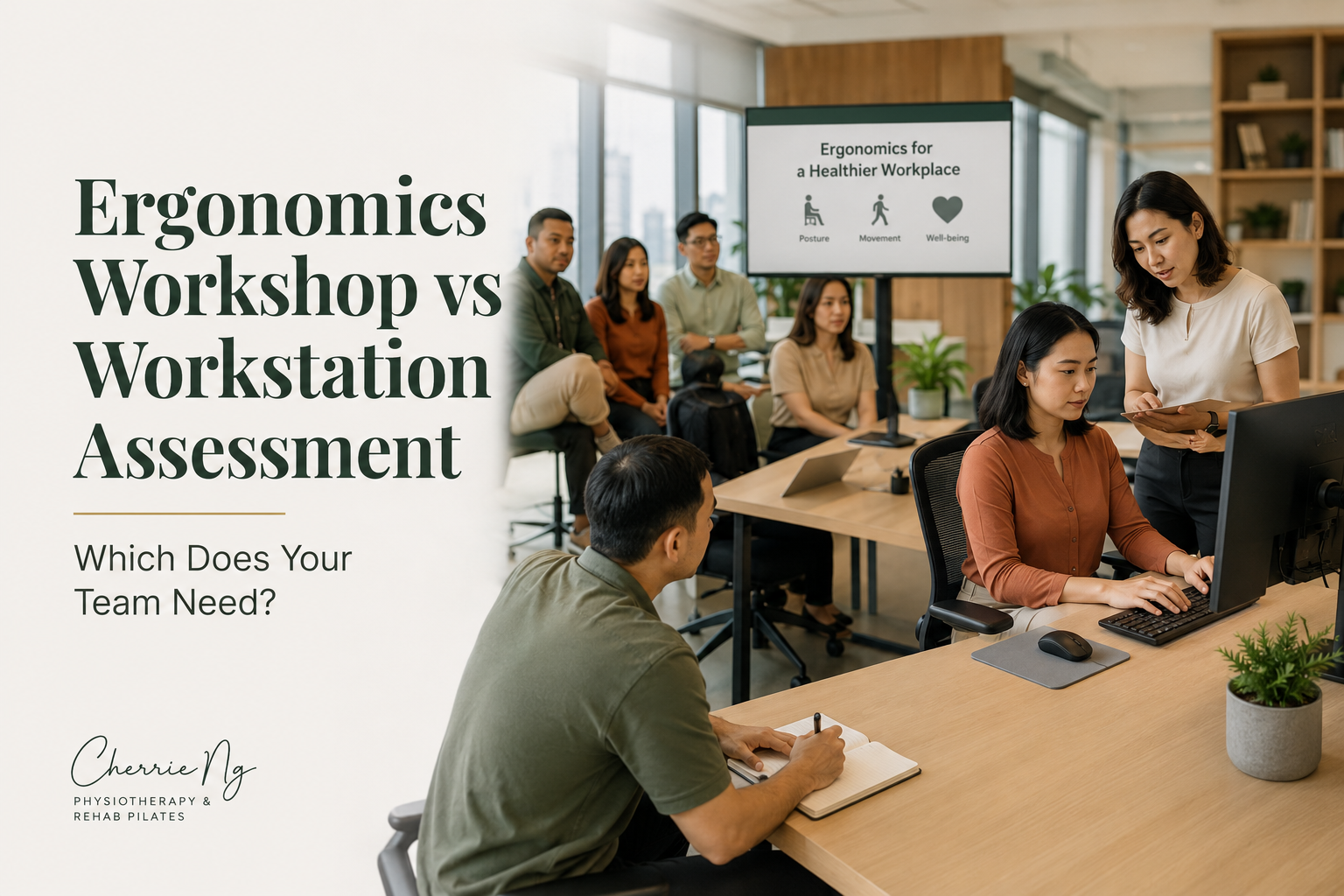
Choose an ergonomics workshop when your team needs shared knowledge and a practical self-check. Choose a workstation assessment when the organisation needs closer observation of real tasks, equipment and workplace constraints, followed by specific actions. Many KL offices benefit from a workshop first and a focused review for selected workstations afterwards.
The names are sometimes used loosely, so confirm the scope and output before booking. In this article, “workstation assessment” means a practical, scoped workplace review. It does not automatically mean a formal statutory ergonomics risk assessment, compliance audit or individual medical assessment.
The difference in one minute
An ergonomics workshop teaches a group
A workshop is primarily educational. It can help employees understand common workstation principles, practise adjusting a demonstration setup, perform a self-check and learn how to report concerns.
The main question is: What should our employees and managers understand and be able to do after the session?
A workstation assessment examines the work more closely
A practical assessment looks at how selected employees perform normal tasks, how equipment and furniture are arranged, what can be adjusted, and which issues need an individual or organisation-level response.
The main question is: What is happening at these workstations, and which actions should the organisation prioritise?
NIOSH distinguishes ergonomics awareness training from training in job analysis and control measures. Awareness training focuses on recognising risk factors, general risk-reduction methods and reporting concerns, while job-analysis training covers analysing work and implementing or evaluating controls. NIOSH guidance on involving and training workers in ergonomics
When an ergonomics workshop is the better starting point
Consider a workshop when:
- many employees need the same introductory guidance;
- staff use similar computers, hot desks or meeting-room setups;
- the organisation is introducing new furniture or a hybrid-work policy;
- employees are asking broad questions about screens, chairs, laptops or movement breaks;
- managers need a shared language for handling common concerns; or
- HR wants a practical, scalable first step before deciding whether closer reviews are needed.
A useful workshop may include:
- a short explanation of adaptable posture rather than one rigid “perfect posture”;
- a live chair, screen, keyboard, mouse and laptop demonstration;
- a repeatable workstation self-check;
- examples for office, hot-desk and home-work situations;
- comfortable movement and task-change ideas;
- guidance on when general education is not enough; and
- a clear route for equipment or private health questions.
The Malaysia Department of Occupational Safety and Health (DOSH) 2024 display-screen guidance covers risk factors, workstation principles, control measures, training and information. Its action-based checklist includes keyboards, mouse, display screens, furniture and the environment. DOSH Malaysia 2024 display-screen equipment guideline
This makes those areas sensible teaching topics. A workshop still cannot confirm that every individual workstation is suitable, because the facilitator has not necessarily observed each employee’s real task and setup.
For a closer look at this format, read what teams learn in a corporate wellness posture workshop.
When a workstation assessment is the better choice
Consider a closer workplace review when:
- employees attended training but cannot apply it to their actual desks;
- several people report the same equipment or layout problem;
- one workstation has been repeatedly changed without a clear plan;
- different roles use different screens, tools, documents or call equipment;
- the organisation is planning an office move or major purchase;
- shared desks do not adjust well for different users;
- home and office setups create different constraints; or
- HR needs a prioritised action list rather than another general presentation.
NIOSH advises using checklists to screen work features, walking through the workplace, observing workers performing normal tasks and interviewing people familiar with the work. It also notes that no checklist fits every situation and that further measurements or data may be needed after initial observations. NIOSH guidance on identifying ergonomics risk factors
A practical review may therefore include:
- An employer brief about roles, equipment and recurring concerns.
- A walkthrough of the workspace and common workstation types.
- Observation of selected employees performing normal tasks.
- Employee input about what is difficult and what has already been tried.
- Immediate low-risk adjustments where appropriate.
- Prioritised recommendations for existing equipment, accessories, procurement or work processes.
- Named owners and a plan for checking whether actions were completed.
DOSH’s action-based display-screen checklist states that items requiring action should be investigated, planned actions recorded and a follow-up assessment used to check whether the action resolved the problem. DOSH Malaysia 2024 display-screen equipment guideline
Read when a KL office may need a practical ergonomic assessment for more detail.
Workshop, assessment or both?
Choose a workshop only when the need is mainly educational
This may suit a team that is new to desk-health guidance, has broadly similar equipment and wants everyone to learn the same self-check. The organisation should still provide a route for problems that cannot be solved during the session.
Choose an assessment only when the question is specific
This may suit a smaller group, a particular work area, a planned purchase or a recurring task-and-equipment issue. Employees outside the reviewed group may still need general guidance later.
Combine both when you need scale and specificity
A practical sequence is:
- gather employee and manager input;
- run a workshop to establish common principles;
- identify workstations or tasks needing closer review;
- complete focused assessments;
- assign and implement actions; and
- share relevant lessons without disclosing private employee details.
The workshop gives the team a shared starting point. The assessment tests how those ideas fit the actual work. Follow-up makes the programme more than a one-off event.
What should HR expect as an output?
Possible workshop outputs
- An agreed topic outline and learning goals.
- A live workstation demonstration.
- A concise employee self-check or educational resource.
- General questions answered within the group scope.
- Themes that HR may need to explore further.
A workshop does not normally produce a detailed recommendation for every employee unless individual reviews are explicitly included.
Possible assessment outputs
- A summary of the workstations and tasks reviewed.
- Common equipment, layout or work-process findings.
- Practical changes using existing equipment where possible.
- Priorities for accessories, maintenance or procurement.
- Issues that need management, occupational-safety or private clinical follow-up.
- An action owner and review point for each agreed priority.
Ask whether the output is verbal guidance, an action summary or a more detailed report. Reporting expectations can materially change the scope, preparation and quote.
What neither format should promise
Neither a workshop nor a workstation review should promise to eliminate pain, prevent every injury or prove a return on investment after one event.
A Cochrane review of 15 trials involving 2,165 office workers found uncertainty and inconsistent evidence across physical, organisational, training and multifaceted ergonomics interventions. The authors concluded that further high-quality research was needed. Cochrane review of ergonomic interventions for office workers
That does not make ergonomics support pointless. Useful workplace outcomes can include better use of existing equipment, clearer reporting routes, more informed purchasing and a prioritised plan. These are practical process outcomes, not guaranteed medical results.
When a different service is needed
Individual physiotherapy assessment
An employee may need private clinical assessment when symptoms keep returning, worsen, spread, affect sleep or daily activity, or make them unsure what movement and work adjustments are appropriate. A group workshop and employer report should not include a personal diagnosis or treatment plan.
Formal ergonomics risk assessment
An organisation that needs a formal ergonomics risk assessment, regulatory documentation or legal compliance advice should confirm the required methodology and provider competence with DOSH or an appropriately qualified occupational-safety professional. A practical corporate wellness review should not be represented as statutory certification unless that formal scope has been established.
Broader organisational action
Some problems cannot be solved by changing a chair or screen. Workload, meeting patterns, task design, equipment maintenance and purchasing policies may require management action. NIOSH notes that ergonomics programmes need management commitment, worker involvement and worker input, and should supplement existing occupational-health and safety systems. NIOSH elements of ergonomics programmes
Questions to answer before requesting a proposal
- Is the goal education, closer investigation or both?
- How many employees and distinct job types are involved?
- Are workstations standard, shared or highly varied?
- Which office, home or hybrid-work patterns matter?
- Has the organisation already tried training or equipment changes?
- Are selected employees reporting private symptoms that need a separate pathway?
- Does HR need an educational handout, action summary or detailed report?
- Who can approve equipment, maintenance or work-process changes?
- Is the request a practical wellness review or a formal occupational-safety requirement?
Clear answers help the provider recommend a suitable format without assuming a fixed package, duration or number of participants.
Related reading
- Corporate Wellness Posture Workshop in KL: What Teams Learn
- Ergonomic Assessment for Offices in KL: When Teams Need Support
- Desk Ergonomics in KL: Simple Setup Tips for Neck and Back Strain
- Corporate Wellness for Hybrid Teams in Malaysia
Sources and clinical references
- DOSH Malaysia: Guidelines on Occupational Safety and Health for Working with Display Screen Equipment 2024
- NIOSH: Involve and Train Management and Workers
- NIOSH: Identify Ergonomics Risk Factors
- NIOSH: Elements of Ergonomics Programs
- Cochrane review: Ergonomic Interventions for Office Workers
Frequently asked questions
Is a workstation self-check the same as an assessment?
No. A self-check helps employees notice common setup questions. An assessment adds closer observation of tasks, equipment and workplace constraints, usually with more specific recommendations and follow-up.
Does every employee need a workstation assessment?
Not always. A workshop and a representative sample may reveal shared issues, while selected workstations need closer review. The appropriate scope depends on task variation, the organisation’s goal and whether concerns remain unresolved.
Should the company buy ergonomic chairs before the workshop or assessment?
It is usually more useful to clarify users, tasks, existing adjustment problems and purchasing requirements first. A product labelled “ergonomic” is not automatically suitable for every desk or employee.
Can an ergonomics workshop diagnose employees with neck or back problems?
No. It provides general workplace education. Employees who need symptom-specific advice should have a private route to appropriate individual assessment.
Can a workshop and workstation assessment happen on the same day?
They may be combined if the scope, schedule, workstations and expected outputs are agreed in advance. Do not assume a group booking automatically includes individual reviews or a written report.
Comparing ergonomics support for your KL workplace? Explore Cherrie’s corporate wellness programmes and WhatsApp the office location, team size, work types and desired output to discuss whether a workshop, practical workstation review or combined format may fit.
Foundational clinical sources and further reading
These authoritative sources provide general background relevant to this topic; they are not claim-by-claim citations. This content is educational and does not replace individual assessment, diagnosis or emergency medical care.
- What is physiotherapy? — World Physiotherapy