Corporate Wellness
Corporate Wellness for Hybrid Teams in Malaysia: Supporting Home and Office Workers
Practical corporate wellness planning for hybrid teams in Malaysia, covering home and office ergonomics, movement, participation and follow-up.
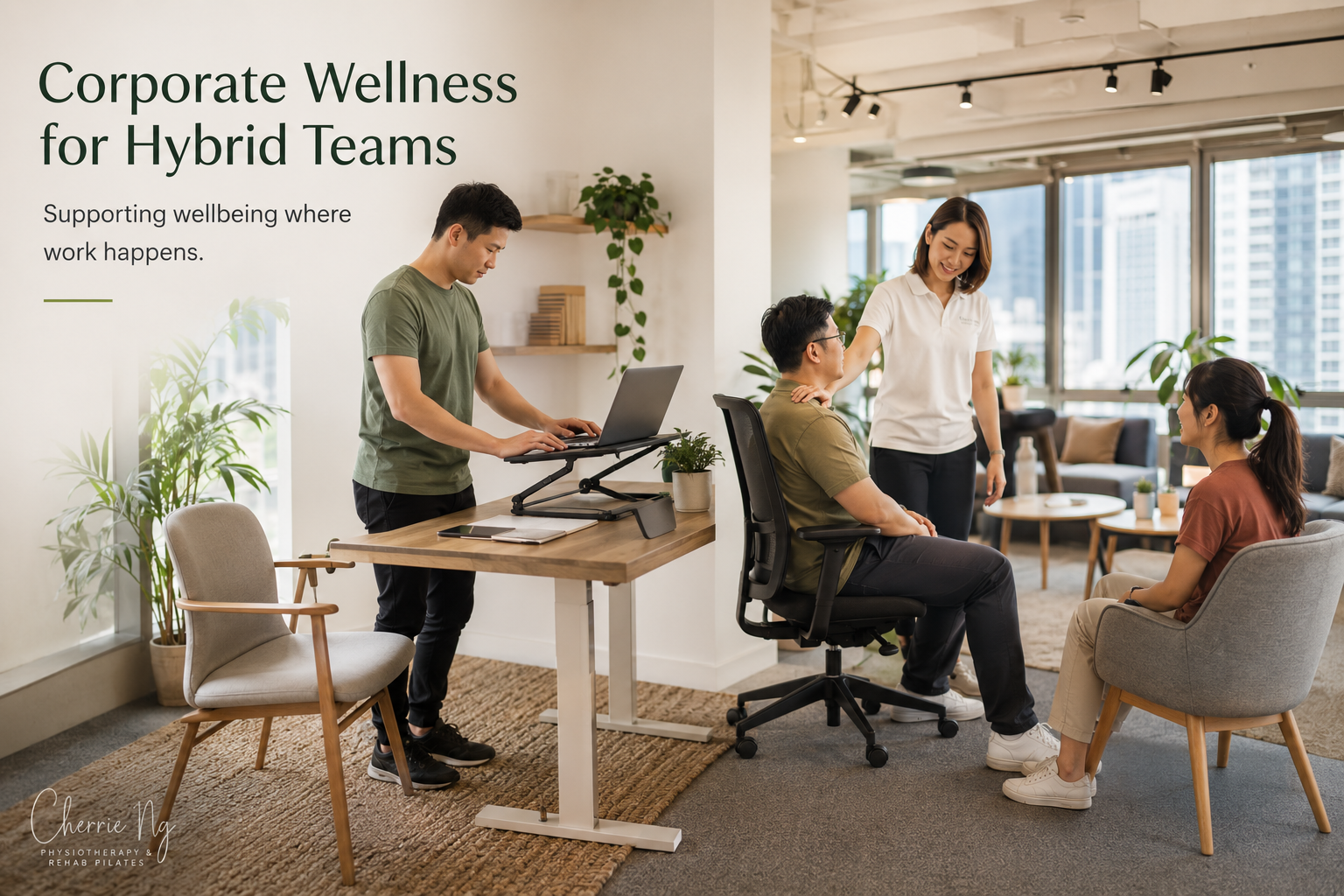
Corporate wellness for hybrid teams in Malaysia should give home and office workers the same core knowledge and support without assuming that their workspaces, schedules or barriers are identical. Start with one shared goal, offer location-specific workstation and movement options, keep participation voluntary, and follow up on practical equipment or work-process concerns.
This guide helps HR teams plan a consistent programme across different work settings. Cherrie’s bookable corporate wellness activities are described here as in-person sessions for organisations in Kuala Lumpur and selected Selangor areas; a hybrid workforce does not automatically mean the provider delivers a virtual programme.
Why a hybrid team needs more than one generic wellness activity
Hybrid employees may perform the same job in very different environments. One person may use an adjustable office desk and monitor, while another works with a laptop at a dining table or moves between shared spaces. Office days may include long meetings and commuting; home days may involve fewer natural transitions between tasks.
The aim is not to make every workspace look the same. It is to help employees recognise a workable setup, change position, organise tasks and know how to raise a concern wherever they work.
The joint WHO and International Labour Organization technical brief on healthy telework recommends combining work organisation, suitable information and communication systems, adequate equipment, and ergonomic and psychosocial support. It also highlights clear priorities, agreed availability and sufficient rest as organisational responsibilities—not matters of individual posture alone. WHO and ILO healthy and safe telework technical brief
A practical hybrid-team wellness framework
1. Map how the team actually works
Before choosing a talk or activity, ask employees about work patterns rather than diagnoses. A brief privacy-conscious survey can cover:
- how many days are usually spent at home and in the office;
- whether employees use laptops, external screens, hot desks or shared workstations;
- common tasks such as calls, detailed screen work, writing or travel;
- equipment and space constraints;
- when long meetings or uninterrupted screen periods tend to occur;
- accessibility and language needs; and
- topics employees want help understanding.
The CDC workplace-health planning model recommends assessing the specific employee population, physical environment and organisational practices, then involving employees early. CDC strategies for building a workplace health programme
Do not ask staff to upload photographs of their homes or disclose personal health details unless there is a clear, voluntary and privacy-appropriate process.
2. Give both groups the same learning goal
A fair programme does not require identical furniture or identical activities. It requires comparable access to useful guidance.
For example, one shared goal might be: “Help employees complete a repeatable workstation self-check and identify two realistic ways to vary their workday.” Office employees can practise at a demonstration station, while home workers receive the same self-check for their own next home-working day.
Keep the core messages, terminology and follow-up route consistent so location does not determine who receives the useful part of the programme.
3. Teach principles that travel between workspaces
Avoid presenting one expensive workstation as the only correct answer. A practical self-check can ask whether:
- the main screen is readable without repeated leaning;
- the keyboard and mouse can stay close during frequent use;
- the chair and feet feel supported;
- shoulders and arms can remain reasonably relaxed;
- glare, small text or screen position changes viewing posture;
- frequently used items are within comfortable reach; and
- the employee has opportunities to change task or position.
Malaysia’s Department of Occupational Safety and Health publishes 2024 guidance for display-screen work covering monitors, laptops, input devices, seating, work environments and work organisation. DOSH Malaysia display-screen equipment guidance
The checklist is a starting point, not a diagnosis and not proof that one position causes an employee’s pain. For more detail, read desk ergonomics in KL: practical setup tips.
4. Plan movement around tasks, not only the clock
A hybrid programme can connect movement with moments that already happen in the day:
- change position after completing a suitable task;
- stand or walk during an appropriate audio-only call;
- move briefly before the next meeting begins;
- alternate screen work with another duty where possible;
- place water or routine items where a short walk is needed; or
- use a few comfortable movements taught during an in-person session.
There is no single break or stretching schedule that suits every role and every person. Workload, meetings, space, symptoms and job responsibilities all affect what is realistic. The office stretching and movement-break guide offers adaptable examples rather than a compulsory routine.
5. Include manager and team norms
Wellness education is difficult to use when employees feel they must remain visibly online at all times. Managers can support the programme by clarifying priorities, respecting agreed availability, allowing reasonable task changes and modelling comfortable breaks.
NIOSH describes a Total Worker Health approach as voluntary and participatory, with attention to policies, working conditions and healthier environments. It specifically distinguishes this from adding wellness activities while leaving harmful work organisation unaddressed. NIOSH Total Worker Health frequently asked questions
This does not mean every team needs the same rule. It means the organisation should examine whether meeting patterns, response expectations or workload make its wellness advice impossible to follow.
6. Keep participation private and inclusive
Employees should not need to demonstrate flexibility, disclose pain or show their home environment to take part. Offer educational choices such as seated and standing movement, an anonymous question route and a private pathway for individual concerns.
For an in-person movement or mat Pilates activity, explain the level, clothing, equipment and readiness process before the session. Participation should be voluntary, with comfortable variations. A general group session cannot determine what is suitable for an employee’s specific symptom, previous surgery or health condition.
7. Use an in-person anchor event well
A hybrid workforce can still benefit from a well-planned in-person event on a day when the intended group is onsite. Possible components include:
- posture and desk-wellbeing education;
- a practical workstation demonstration;
- a beginner-friendly movement session;
- mat-based corporate Pilates; and
- a shared self-check or follow-up resource for later home and office use.
The invitation should clearly state that the event itself is in person. HR can choose an attendance plan that fits its workforce and make the educational takeaway available fairly to employees who work in different locations, subject to the organisation’s internal arrangements and the provider’s agreed scope.
For more options, see eight practical corporate wellness ideas for KL teams.
8. Separate group education from individual support
A workplace talk or movement session provides general education. It should not be used to diagnose an employee, assess a private home environment publicly or recommend personal treatment in front of colleagues.
An individual physiotherapy assessment may be more appropriate when discomfort keeps returning, becomes more intense, affects sleep or daily activity, or leaves the person unsure which movement or setup changes are suitable. Assessment may consider symptoms, work tasks, movement, mobility, strength, activity, sleep and personal goals before discussing possible next steps.
Urgent health concerns should be handled through the organisation’s emergency process and appropriate individual medical care, not a group wellness programme.
9. Follow up by location without creating two programmes
Use a small number of questions after the activity:
- Was the guidance usable at home, in the office, or both?
- Which setup or workflow barrier appeared most often in each setting?
- Could employees use the suggested movement options during real work?
- Did everyone know how to raise an equipment or individual health concern?
- What should the organisation change before the next activity?
The CDC model includes evaluation so programme findings can guide improvement. Compare experiences by work setting when useful, but avoid claiming that one session reduced pain, injury, absence or healthcare costs without suitable data and evaluation design. CDC strategies for building a workplace health programme
A simple HR checklist for hybrid wellness planning
- Define one shared goal for home and office staff.
- Ask employees about tasks, equipment and barriers without requesting diagnoses.
- Choose guidance that works across more than one type of workspace.
- Decide which parts require an in-person demonstration or activity.
- Confirm the provider, venue, group size, floor space and equipment.
- State clearly how participation, privacy and accessibility will be handled.
- Brief managers on the work practices that support the message.
- Give employees one concise resource they can use in either location.
- Provide a private route for equipment and symptom-specific concerns.
- Evaluate relevance separately for home and office work, then assign follow-up owners.
What Cherrie can contribute to an in-person programme
Depending on the brief, Cherrie’s corporate wellness scope may include posture and desk-wellbeing education, workstation demonstrations, comfortable movement activities and mat-based corporate Pilates. Content can use examples relevant to employees who alternate between home and office, while the booked session itself remains an agreed in-person format.
When requesting a proposal, share the office location, preferred date, estimated group size, typical home and office work patterns, available room and equipment, preferred topic, accessibility needs and the outcome HR wants employees to take away. Final scope, duration, venue, travel and availability are confirmed case by case for Kuala Lumpur and selected Selangor areas.
Related reading
- Office Stretching Routine: Simple Movement Breaks for Desk Workers
- Desk Ergonomics in KL: Simple Setup Tips for Neck and Back Strain
- Corporate Wellness Ideas in KL: 8 Practical Activities for Office Teams
- How to Plan an Employee Wellness Day in KL: An HR Checklist
Sources and clinical references
- WHO and ILO: Healthy and Safe Telework Technical Brief
- DOSH Malaysia: Guidelines on Occupational Safety and Health for Working with Display Screen Equipment 2024
- CDC: Strategies for Building a Workplace Health Program
- NIOSH: Total Worker Health Frequently Asked Questions
Frequently asked questions
Should home and office employees receive identical equipment?
Not necessarily. Tasks, available space and existing furniture may differ. The organisation should use an appropriate process to identify what each setting requires rather than assuming one product or allowance suits everyone.
Does a hybrid workforce need a virtual wellness session?
No. “Hybrid” describes where employees work; it does not automatically define how the wellness activity must be delivered. A company may organise an in-person session and use consistent internal resources or follow-up for employees across work locations. Confirm the provider’s actual delivery scope before announcing the event.
Can HR ask employees to submit home-workstation photos?
Only through a clear, voluntary and privacy-appropriate process. A self-check that does not require showing the home may be a better first step. Explain who can view any submitted material, why it is needed and how it will be handled.
Is a workstation workshop the same as an ergonomic assessment?
No. A workshop provides shared principles and practice. An ergonomic assessment examines tasks, equipment and the work setup more closely. Repeated or complex concerns may need a more structured assessment pathway.
Can an in-person corporate Pilates class support a hybrid team?
It can provide a shared movement experience and ideas employees may later adapt, but it does not replace suitable work design, equipment or individual assessment. The class format, readiness process, venue and follow-up should be agreed for the organisation.
Supporting a hybrid team in Malaysia? Explore Cherrie’s in-person corporate wellness programmes and WhatsApp the KL or Selangor office location, preferred date, group size and programme goal to discuss a suitable scope.
Foundational clinical sources and further reading
These authoritative sources provide general background relevant to this topic; they are not claim-by-claim citations. This content is educational and does not replace individual assessment, diagnosis or emergency medical care.
- What is physiotherapy? — World Physiotherapy