Corporate Wellness
How to Plan an Employee Wellness Day in KL: An HR Checklist
An HR checklist for planning an employee wellness day in KL, covering goals, activities, providers, accessibility, logistics and follow-up.
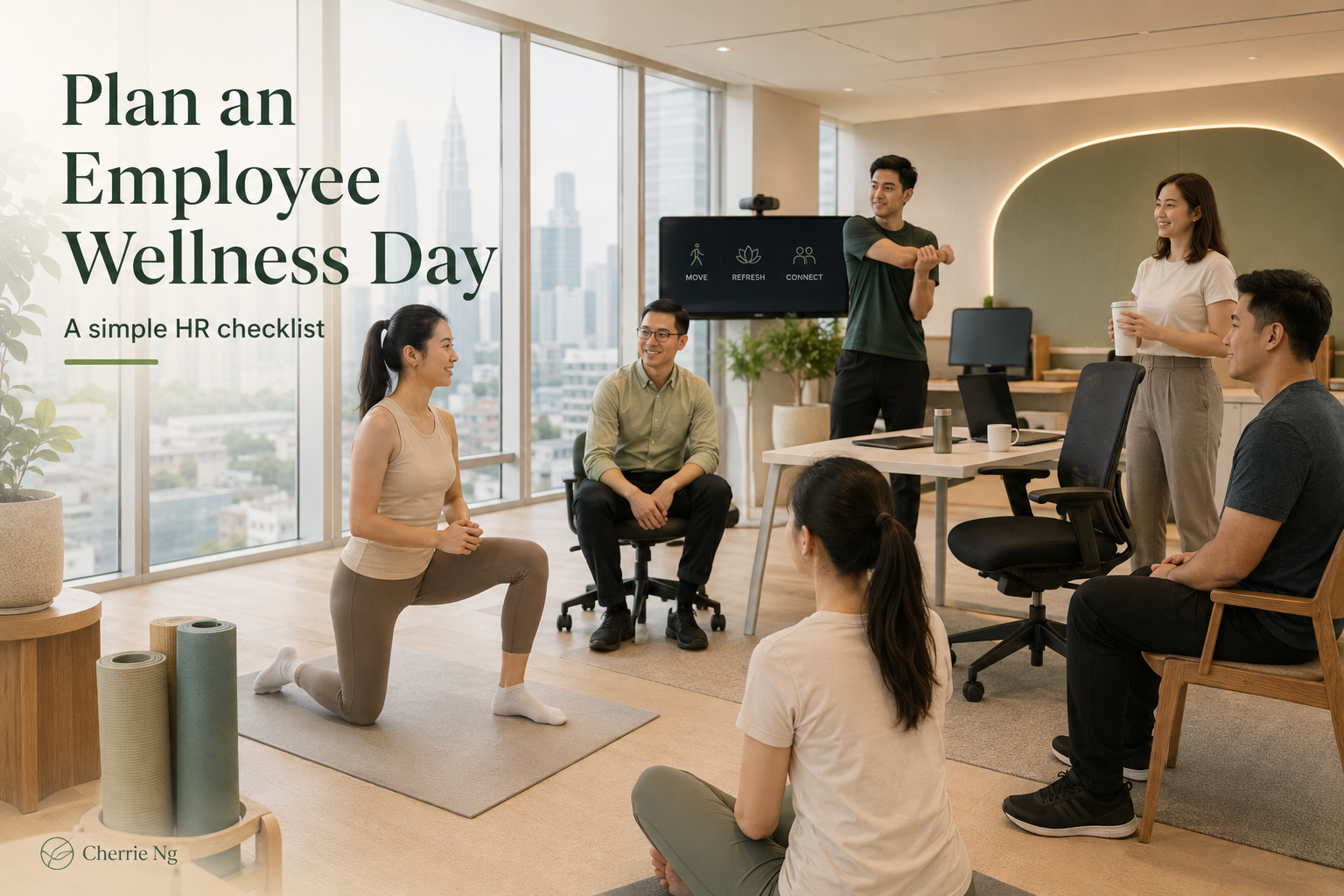
To plan an employee wellness day in KL, begin with one or two clear goals, ask employees what would be useful, choose a small number of suitable activities, and confirm the venue, participation process, accessibility, provider scope and follow-up before promoting the event. A focused plan is usually more useful than a crowded schedule of disconnected activities.
This HR checklist is designed for in-person workplace events in Kuala Lumpur and selected Selangor areas. It covers general planning and physiotherapist-led activity options; it is not a substitute for occupational safety processes or individual medical care. You can also review Cherrie’s physiotherapist-led corporate wellness programmes in Kuala Lumpur.
What should an employee wellness day achieve?
An employee wellness day is a coordinated workplace event that gives staff practical opportunities to learn, move or reflect on healthier ways of working. It may include a talk, workstation demonstration, gentle movement session, mat-based corporate Pilates or another activity that fits the team.
The event should answer a defined workplace question. For example:
- How can desk-based employees adjust their setup and vary their position?
- How can staff add comfortable movement to a busy workday?
- What can managers and employees do after the event to support healthier routines?
- Which questions require group education, and which need a private individual pathway?
The CDC workplace-health model recommends assessing the employee population and work environment, involving employees early and focusing on a few well-chosen strategies. It also treats evaluation as part of the programme rather than an afterthought. CDC strategies for building a workplace health programme
The HR planning checklist
1. Define the goal before choosing activities
Write one sentence describing what the event should help employees understand or do. “Support desk-based staff with practical workstation and movement ideas” is clearer than “improve wellness.”
Keep the goal realistic. A single event can introduce useful skills and highlight workplace barriers, but it cannot prove that injuries, pain, absence or healthcare costs have fallen.
2. Ask employees what would be useful
Use a short anonymous poll, speak with team representatives or review recurring non-confidential workplace questions. Ask about work tasks, preferred topics, accessibility, language and barriers to participating—not diagnoses or personal medical histories.
NIOSH describes worker-wellbeing programmes as stronger when they are voluntary, participatory and connected to safe, healthy working conditions. That means employee voice and organisational follow-through matter alongside the activities themselves. NIOSH Total Worker Health frequently asked questions
3. Choose a small, connected activity mix
Select activities that support the same goal. A practical combination might be:
- a short posture and workstation education segment;
- a live desk-setup demonstration;
- a beginner-friendly movement or mat Pilates activity; and
- a take-home self-check or movement reminder.
Avoid adding activities only to make the programme look full. WHO guidance for small and medium-sized enterprises emphasises practical, context-specific physical-activity planning because workplaces have different needs and constraints. WHO guidance on workplace physical activity in small and medium-sized enterprises
If you are still comparing options, see these eight practical corporate wellness ideas for KL offices.
4. Set the event scope and budget
Record the estimated group size, date range, venue, available time, desired activity format and budget approval process. Ask each provider what is included in the proposal, what equipment is needed and what would change the quote.
Do not assume that every provider includes mats, audiovisual equipment, individual assessments, printed materials, travel or follow-up. Scope and availability should be confirmed in writing for the specific event.
5. Brief providers on the real workplace
Tell the facilitator about common roles and devices, whether employees mainly sit or stand, the room layout, dress expectations, language preferences and any known accessibility requirements. A useful brief helps the provider choose examples that match the team instead of delivering a generic presentation.
For a movement session, confirm the facilitator’s professional scope, the level of exercise, how variations will be offered and what the session is not intended to assess or treat. Learn what makes a physiotherapist-led corporate wellness approach different.
6. Check the venue from a participant’s point of view
Before the day, confirm:
- clear floor space and safe walkways;
- seating and seated participation options;
- ventilation, lighting and room temperature;
- screen, sound and electrical access;
- privacy for personal questions;
- accessible entry and washroom routes;
- mat or equipment storage, if relevant; and
- a backup plan if the original room becomes unavailable.
For workstation education, arrange a realistic chair, desk, screen or laptop setup for the demonstration. For mat-based activity, confirm the usable floor space after furniture is moved—not only the room’s stated capacity.
7. Build a schedule with transitions and choices
Allow time for arrival, instructions, moving between stations, equipment changes, questions and room reset. Do not schedule every minute as active participation.
Two simple structures are:
- Focused learning format: welcome, practical talk, workstation demonstration, questions and one follow-up action.
- Movement-focused format: welcome and readiness instructions, beginner-friendly movement or mat Pilates, comfortable alternatives, cool-down and private question route.
If the event has several providers, name one HR coordinator who owns the running order and knows who makes day-of decisions.
8. Make participation inclusive and voluntary
State in the invitation that movement participation is optional. Explain what employees should wear or bring, whether seated options are available and how someone can ask a question privately.
If active exercise is included, agree on an appropriate readiness process with the qualified provider. The Canadian Society for Exercise Physiology describes evidence-based pre-screening as one step in helping people decide whether they need further advice before becoming more active; it does not replace professional judgement or individual care. CSEP Get Active Questionnaire guidance
Employees should not be asked to explain a diagnosis in front of colleagues. Someone with new, severe, rapidly worsening or otherwise concerning symptoms should follow workplace emergency procedures and seek appropriate individual medical care rather than relying on the group event.
9. Communicate exactly what the event is
A clear invitation should include:
- the event goal and activity description;
- date, venue and registration process;
- whether participation is voluntary;
- clothing, mat or equipment guidance;
- accessibility and language information;
- who will facilitate the session; and
- where private questions can be directed.
Avoid promising that the day will “fix posture,” prevent every injury or eliminate pain. Accurate wording builds trust and helps employees decide whether the activity is relevant to them.
10. Prepare the day-of roles
Assign responsibility for registration, room access, provider arrival, equipment, timekeeping, photography consent, refreshments and feedback collection. The facilitator should know the event contact and the organisation’s emergency process.
If photographs are planned, obtain appropriate permission and provide a practical way for employees to opt out without excluding them from the event.
11. Decide the follow-up before the event
Choose a few useful evaluation questions, such as:
- Was the content relevant to employees’ work?
- Did participants understand one action they can try?
- Were the venue and activity options accessible?
- Which equipment, workflow or policy barriers appeared repeatedly?
- What should be continued, changed or explored next?
Share agreed resources soon after the event and assign an owner to any organisational action. A wellness day is more credible when it leads to a realistic next step rather than ending with attendance numbers alone.
A simple event brief to send a provider
HR can use the following details when requesting a proposal:
- organisation and office location;
- preferred date or date range;
- estimated number of participants;
- event goal and preferred topics;
- typical work roles, tasks and devices;
- room dimensions, furniture and presentation equipment;
- whether a talk, practical workshop, mat activity or combined format is preferred;
- language and accessibility considerations;
- internal schedule constraints; and
- desired resources or follow-up.
Cherrie’s corporate wellness activities may include posture and desk-wellbeing education, practical workstation demonstrations, comfortable movement activities and mat-based corporate Pilates. Final scope, duration, equipment, venue and group arrangement are confirmed case by case for organisations in Kuala Lumpur and selected Selangor areas.
Common planning mistakes to avoid
- Choosing activities before defining the workplace need.
- Making movement compulsory or using public health disclosures.
- Booking a room based only on headcount, without checking usable space.
- Treating a group wellness activity as individual assessment or treatment.
- Filling the schedule without transition or question time.
- Promising health, injury or ROI outcomes that one event cannot establish.
- Collecting feedback without assigning a person to act on it.
Related reading
- What to Include in a Corporate Wellness Proposal Request: An HR Checklist
- How to Measure Corporate Wellness Activities Without Overclaiming ROI
- Corporate Wellness Ideas in KL: 8 Practical Activities for Office Teams
- How to Choose an Office Wellness Workshop in KL
- Corporate Pilates in KL: What HR Teams Should Know Before Booking
- Corporate Wellness Programme Cost in KL: What Affects a Quote?
Sources and clinical references
- CDC: Strategies for Building a Workplace Health Program
- NIOSH: Total Worker Health Frequently Asked Questions
- WHO: Promotion of Health-Enhancing Physical Activity in Small-to-Medium-Sized Enterprises
- Canadian Society for Exercise Physiology: Get Active Questionnaire
Frequently asked questions
How many activities should an employee wellness day include?
There is no ideal number. Choose a small set that supports the event goal and leaves enough time for instructions, transitions, questions and comfortable participation. A focused workshop plus one practical activity may be more useful than many unrelated stations.
Should employee wellness activities be compulsory?
Movement and personal-health activities should be voluntary. Give employees enough information to make a choice, offer suitable alternatives where feasible and protect personal health information.
Can a small company organise a useful wellness day?
Yes. A smaller organisation can begin with one well-scoped talk, workstation demonstration or movement activity. The format should match the team’s needs, room and available resources rather than imitate a large expo.
Can employees with pain join a movement session?
A general group session cannot decide what is suitable for a specific symptom. Participation should be voluntary, with comfortable options and a private route for questions. An individual assessment may be more appropriate when symptom-specific advice is needed.
How early should HR start planning?
Begin early enough to secure internal approval, a suitable provider and venue, collect employee input and communicate the event clearly. The required lead time varies with the date, group size, activity mix and procurement process, so confirm availability before announcing the programme.
Planning an employee wellness day in KL? Explore Cherrie’s corporate wellness programmes and WhatsApp the office location, preferred date, estimated group size and event goal to discuss a suitable in-person format.
Foundational clinical sources and further reading
These authoritative sources provide general background relevant to this topic; they are not claim-by-claim citations. This content is educational and does not replace individual assessment, diagnosis or emergency medical care.
- What is physiotherapy? — World Physiotherapy