Corporate Wellness
Corporate Pilates vs an Office Fitness Class: Which Format Fits Your Team?
Compare corporate Pilates and office fitness classes by goals, pace, accessibility, space, screening and facilitator scope before booking.
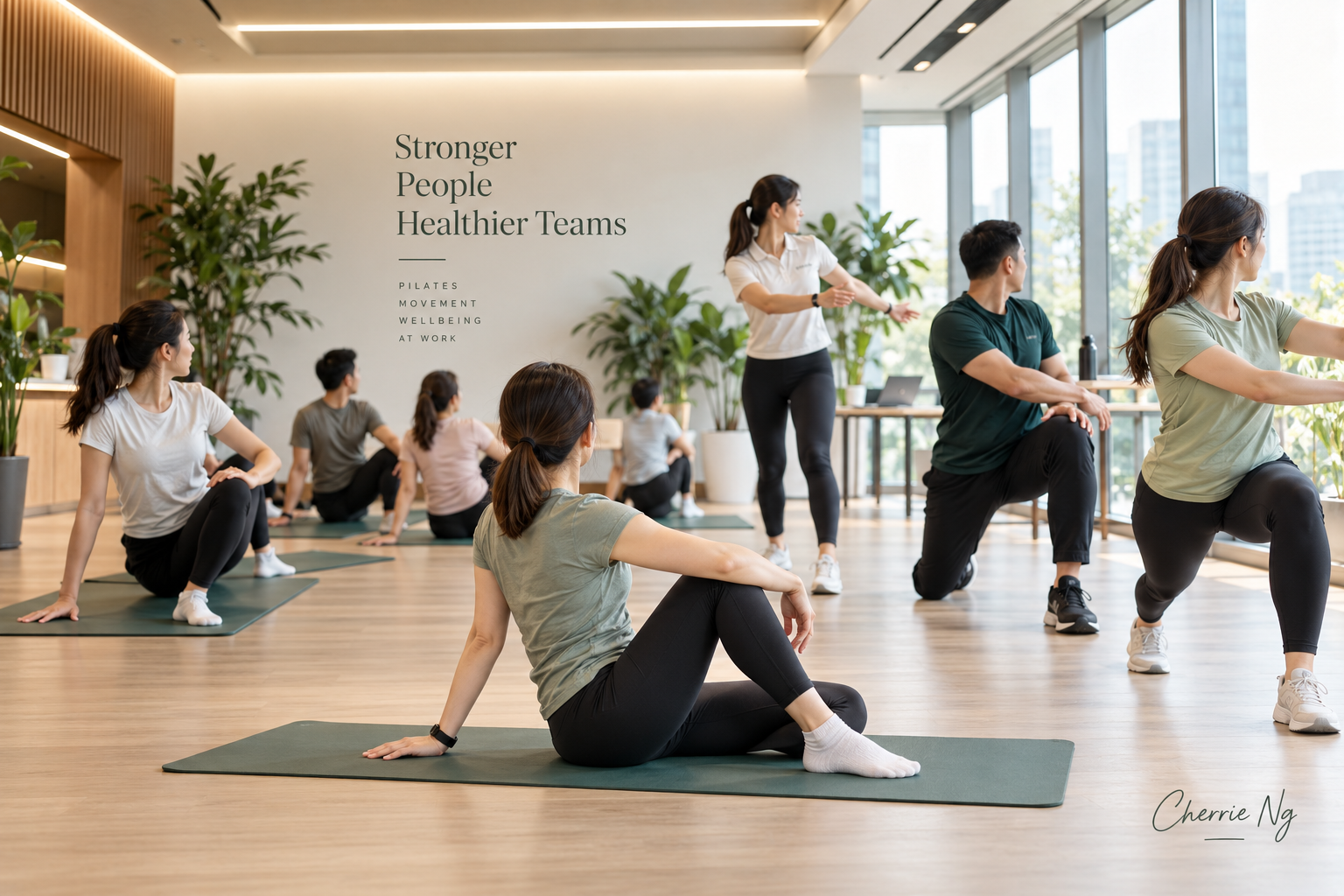
Choose corporate Pilates when your team wants a structured, technique-led introduction to controlled mat movement, breathing, mobility and trunk control. Choose a general office fitness class when the main goal is broader whole-body activity, a more energetic group experience or a format such as low-impact circuits or dance-style movement. Neither option is automatically better: the right choice depends on the goal, participants, facilitator, room and how safely the class can be adapted.
For Cherrie’s Kuala Lumpur and selected Selangor corporate wellness work, corporate Pilates refers to an adaptable, beginner-friendly mat-based group format—not reformer Pilates and not individual rehabilitation. An office fitness class is a wider category, so HR must ask the provider to describe the exact activity rather than relying on the label alone.
Corporate Pilates and office fitness at a glance
| Question | Corporate Pilates | General office fitness class |
|---|---|---|
| Main experience | Controlled, technique-focused mat movement | Broader activity that may feel more energetic or continuous |
| Common emphasis | Breathing, body awareness, mobility, alignment and trunk control | General conditioning, coordination, cardiovascular movement or team energy |
| Typical positions | Standing, seated and mat-based positions | Often mainly standing, but depends on the class |
| Pace | Usually measured, with time for movement cues | Can range from gentle to vigorous; must be confirmed |
| Equipment | Mats and sometimes small props | May use no equipment or items such as bands, steps or light weights |
| Workplace clothing | May require comfortable clothing suitable for floor positions | Some low-impact formats can remain standing, but clothing needs vary |
| Individual clinical care | Not included in a corporate group class | Not included in a general group class |
These are planning distinctions, not universal definitions. The actual proposal should state the movements, intensity, positions, equipment, alternatives and facilitator scope.
What is corporate Pilates?
Corporate Pilates is a workplace group class built around Pilates-informed movement. A beginner-friendly session may include breathing cues, gentle mobility, controlled trunk and hip work, balance, posture awareness and transitions between standing, seated or mat positions.
The class can introduce employees to movement without becoming a studio performance. Participants should be able to make a movement smaller, use support, choose a different position, observe or stop.
Cherrie’s workplace format is mat-based and may be adapted around the team and venue. It is a general wellness experience. It does not diagnose pain, prescribe a personal rehabilitation programme or provide the same individual decision-making as rehab Pilates.
What is an office fitness class?
“Office fitness class” can describe many activities: low-impact aerobic movement, dance fitness, bodyweight circuits, resistance-band work, mobility, team challenges or another instructor-led workout. That flexibility can be useful, but it makes the name alone too vague for booking.
HR should ask:
- What movements will employees perform?
- Is the class low, moderate or higher intensity?
- Will participants jump, kneel, lie on the floor or move quickly between stations?
- What equipment and floor space are required?
- What alternatives will be available?
- Who is the instructor, and what is their relevant scope and experience?
A well-designed low-impact fitness session may suit a mixed office team. A boot-camp-style class may suit a different voluntary audience with suitable facilities. The provider should not treat them as the same product.
Choose the goal before the class name
The CDC workplace-health model recommends selecting programmes that fit the employee population, work environment, employee needs and organisational goals. It also recommends involving employees early and focusing on a few well-chosen strategies. CDC strategies for building a workplace health programme
WHO guidance similarly emphasises practical, context-specific workplace physical-activity planning because organisations have different needs and constraints. WHO guidance on workplace physical activity for small and medium-sized enterprises
Before requesting a quote, write one primary outcome:
- “Introduce complete beginners to controlled Pilates-based movement.”
- “Offer an upbeat, low-impact team activity during our wellness day.”
- “Provide a standing class because floor exercise does not suit the venue.”
- “Give employees movement choices that can be adapted to different comfort levels.”
- “Pilot one class and collect feedback before planning a series.”
This makes it easier to choose the format and measure whether the event delivered what was promised.
When corporate Pilates may fit better
Corporate Pilates may be the clearer option when the organisation wants:
A calm, technique-led experience
The slower pace can allow time to explain setup, breathing and movement control. This may suit a wellness event that prioritises learning a movement method rather than maximising workout intensity.
An introduction to Pilates
Employees who are curious about Pilates can experience an accessible mat-based version without needing reformer machines. The invitation should still explain that floor positions may be included.
A connection with posture and body awareness
A Pilates-informed class can pair naturally with a posture or desk-wellbeing talk. The facilitator can connect general movement cues to comfortable position changes without claiming to correct every employee’s posture or treat pain.
A physiotherapist-led group format
A physiotherapist can bring movement, function and rehabilitation knowledge to class planning while keeping clear boundaries between general group education and individual clinical care. World Physiotherapy describes physiotherapists as professionals who assess individuals or client groups, use clinical judgement within their expertise and recognise when referral is needed. World Physiotherapy: What is physiotherapy?
“Physiotherapist-led” does not mean every participant receives an assessment. It should mean the agreed group experience is planned with appropriate movement options, communication and referral boundaries.
When an office fitness class may fit better
A general fitness class may be the clearer choice when the organisation wants:
More continuous, whole-body activity
Some teams specifically want an energetic session with music, coordinated movement or a circuit format. Ask the provider to confirm intensity and whether lower-impact options remain available.
A standing-only format
Standing movement may be easier when employees cannot change clothes, the floor is unsuitable for mats or the schedule is very short. “Standing” does not automatically mean accessible to everyone, so stable support and seated options may still be needed.
A broader range of fitness themes
A fitness provider may offer dance, cardio, strength, mobility or team-based formats. This can suit a wellness programme seeking variety across several dates.
A social, high-energy event atmosphere
For some voluntary groups, shared rhythm and a livelier pace are central to the experience. Avoid making intensity, speed or competition the only way to participate.
Neither format is personal rehabilitation
A corporate Pilates class and a general office fitness class are both group activities. Neither can determine why one employee has pain, decide whether a particular movement is medically suitable for that person or create an individual recovery plan during the event.
An employee may need a separate physiotherapy or appropriate medical assessment when they have symptoms or a health history requiring individual advice. Rehab Pilates is also different: it begins with more personal assessment and exercise selection around one person’s needs, rather than a shared corporate class plan.
The safest marketing language is proportionate. A class can offer guided activity, education and a positive group experience. It should not guarantee pain relief, injury prevention, lower absence or improved productivity.
Compare accessibility, not just intensity
Mixed office teams may include people who are new to exercise, uncomfortable on the floor, fasting, pregnant, managing a health condition, returning after injury or simply uninterested in public exercise. HR does not need their diagnoses to plan respectfully.
Ask each provider how participants can:
- choose a seated, standing or floor-based option;
- make a movement smaller or slower;
- use stable support;
- observe without being singled out;
- ask a question privately; and
- stop without pressure.
NIOSH describes programmes aligned with its Total Worker Health approach as voluntary and participatory, giving workers a voice in workplace offerings. NIOSH Total Worker Health frequently asked questions
An “easy” class is not automatically inclusive. Inclusion comes from the invitation, venue, choices, facilitator behaviour and ability to opt out.
Screening and exercise readiness
Both formats need an appropriate pre-class process. Employees should know the planned activity, intensity, positions, clothing, equipment and how to raise a private concern before the event.
The Canadian Society for Exercise Physiology describes its self-administered Get Active Questionnaire as one step in pre-participation screening that can help people decide whether to seek further advice before becoming more active. It is not a diagnosis or complete assessment. CSEP Get Active Questionnaire guidance
The organiser should ask the provider which readiness process fits the class and what happens when a participant is advised to seek individual input. HR should not collect and circulate detailed employee medical histories as a substitute for a suitable process.
Compare the venue requirements
Corporate Pilates
Confirm:
- clear mat-sized floor space for every participant;
- a clean, level and non-slip surface;
- enough space to reach without touching another person or furniture;
- visibility of the facilitator from floor level;
- mat supply, transport and cleaning;
- practical clothing and changing arrangements; and
- alternatives for employees who prefer not to use the floor.
Office fitness
Confirm:
- the exact movement footprint, including side steps or stations;
- ceiling, floor and ventilation suitability;
- whether jumping or rapid changes of direction are included;
- equipment placement and trip hazards;
- sound-system requirements; and
- a lower-impact or seated participation route.
For either format, calculate capacity from usable activity space after furniture and equipment are placed—not the room’s normal seated capacity.
Compare the facilitator, not only the activity title
Ask who will actually teach the class and whether their relevant experience matches the proposed audience and format. Useful questions include:
- How will the class be adjusted for complete beginners?
- What positions and intensity should employees expect?
- What screening or readiness information will be used?
- How will private questions be handled?
- Which alternatives can be offered without disrupting the group?
- What is outside the facilitator’s scope?
- What venue and equipment are required?
- What happens if the group size or room changes?
Professional background matters, but the session still needs a clear plan, realistic boundaries and appropriate communication.
Can a company offer both formats?
Yes. A larger wellness programme could offer Pilates on one date and a different low-impact fitness format on another, or give employees a choice between parallel activities when logistics allow.
Do not present the options as “beginner versus fit” or “rehab versus normal.” Describe what each class involves so employees can choose without being labelled. Use feedback about relevance, comfort, clarity and preferred future formats rather than treating attendance as a test of commitment to wellness.
A simple HR decision checklist
Choose corporate Pilates if most answers point to:
- a controlled, technique-led class;
- interest in Pilates-informed movement;
- suitable mat space and clothing arrangements;
- a measured pace with floor, seated or standing options; and
- a clear boundary between the group session and individual rehab.
Choose a general office fitness class if most answers point to:
- broader conditioning or higher team energy;
- a named activity such as low-impact cardio, dance or circuits;
- a standing-focused format or different equipment plan;
- an audience comfortable with the proposed pace; and
- an instructor whose scope matches that exact activity.
Choose a talk or movement workshop instead if the room cannot safely support a class, employees mainly want education, or the audience needs more flexible participation than the proposed exercise format allows.
Information to send when requesting a quote
Include:
- company and exact KL or Selangor location;
- preferred date, total time window and alternative dates;
- estimated participant range;
- primary goal and preferred atmosphere;
- employee experience and work-clothing considerations;
- preferred Pilates or named fitness format;
- room measurements, photographs and floor type;
- available mats, audiovisual equipment and changing facilities;
- language and accessibility considerations;
- whether the activity is voluntary and how registration works; and
- requested handouts, feedback or follow-up.
Cherrie’s corporate Pilates is an adaptable, beginner-friendly mat-based option for organisations in Kuala Lumpur and selected Selangor areas, subject to the brief, venue, travel and availability. She can also discuss whether a posture talk or movement workshop fits better. A different general fitness format may require a provider whose specific training and offer match that activity.
Related reading
- Corporate Pilates in KL: What HR Teams Should Know Before Booking
- Physiotherapist-Led Corporate Wellness: What Makes the Approach Different?
- What Is Rehab Pilates and How Is It Different from Regular Pilates?
- Inclusive Corporate Wellness Activities: Planning for Different Abilities and Comfort Levels
- How to Choose an Office Wellness Workshop in KL
Sources and clinical references
- CDC: Strategies for Building a Workplace Health Program
- WHO: Promotion of Health-Enhancing Physical Activity in Small-to-Medium-Sized Enterprises
- World Physiotherapy: What is physiotherapy?
- NIOSH: Total Worker Health Frequently Asked Questions
- Canadian Society for Exercise Physiology: Get Active Questionnaire
Frequently asked questions
Is corporate Pilates easier than an office fitness class?
Not necessarily. Pilates is often more measured, but controlled movement can still be challenging. Fitness classes vary widely. Ask about the actual pace, positions and alternatives instead of judging by the name.
Does corporate Pilates use reformer machines?
Cherrie’s corporate format is mat-based. Reformer Pilates should not be advertised unless machines, venue and appropriate delivery have been specifically confirmed.
Which format is better for complete beginners?
Either can be planned for beginners. The better choice is the one with a suitable pace, clear teaching, realistic alternatives, appropriate screening and a venue that supports the planned movement.
Can employees with pain attend?
A group class cannot determine what is appropriate for a specific symptom. Employees should follow the readiness process and existing professional advice, and seek private assessment when individual guidance is needed.
What if our office has no mat space?
Consider a standing or chair-supported movement workshop, a focused wellness talk or a suitably planned standing fitness class. Do not squeeze a floor class into an unsafe room.
Comparing workplace movement options? Explore Cherrie’s corporate wellness programmes and WhatsApp the location, date, group size, room and goal to discuss whether corporate Pilates fits your team.
Foundational clinical sources and further reading
These authoritative sources provide general background relevant to this topic; they are not claim-by-claim citations. This content is educational and does not replace individual assessment, diagnosis or emergency medical care.
- What is physiotherapy? — World Physiotherapy
- WHO guidelines on physical activity and sedentary behaviour — World Health Organization