Corporate Wellness
Corporate Wellness for SMEs in Malaysia: A Practical Starting Plan
A practical 90-day corporate wellness starting plan for Malaysian SMEs, covering priorities, budget, staff input, pilots and honest evaluation.
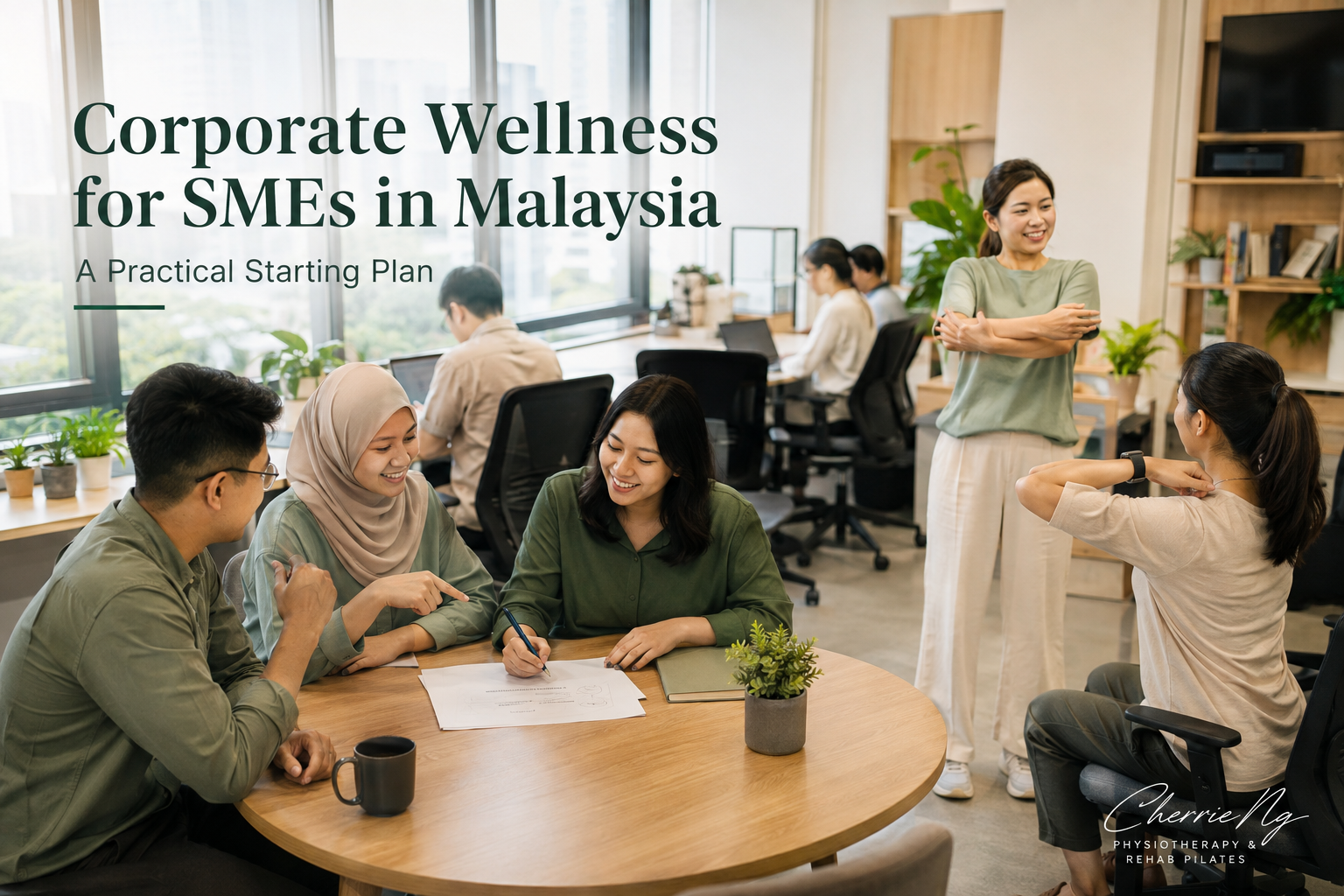
A Malaysian SME does not need a year-long calendar of wellness events to begin. Start with one owner, one workforce priority, one small organisational change and one activity that employees can realistically use. Pilot the plan for about 90 days, review a few honest measures, then decide whether to continue, adapt or expand it.
The starting point should be the work itself—not a catalogue of trendy activities. A small business may have limited time and budget, but its short decision paths can also make practical changes easier when leaders and employees work on the plan together.
Why SMEs need a different approach
Malaysia’s Department of Occupational Safety and Health (DOSH) reports that SMEs represented 96.9% of Malaysian business establishments in 2023. Its SME resources focus on foundational occupational safety and health (OSH) practices, including the work environment, ergonomics, risk management and safe procedures. DOSH Malaysia SME and OSH resources
That distinction matters. A wellness talk, stretching session or corporate Pilates activity should not be used to distract from a hazard, unsafe process, excessive work demand or unmet OSH responsibility. Keep statutory OSH management and optional corporate wellness clearly scoped, even when they support the same broader aim of worker wellbeing.
WHO guidance written for small and medium-sized enterprises also notes that workplace physical-activity programmes must fit different needs, resources and constraints; there is no single format for every SME. WHO workplace physical-activity guidance for SMEs
A practical 90-day starting plan
Step 1: Name one accountable owner
Choose one person who can coordinate the pilot. In a small organisation, this may be an owner, operations manager, HR generalist, OSH coordinator or interested employee with management support.
The role is not to become the office health expert. The owner should:
- keep the scope and timeline clear
- gather employee input
- coordinate the facilitator or internal activity
- confirm access, privacy and safety arrangements
- record agreed costs and actions
- schedule the review
Leadership should also state why the organisation is doing this and what employees are free to choose. CDC’s small-business-oriented Work@Health curriculum treats leadership support, worksite assessment, communication, evaluation and sustainable implementation as connected parts of programme development. The curriculum is a US resource, not a Malaysian standard, but the sequence is useful for planning. CDC Work@Health employer curriculum
Step 2: Ask employees three short questions
Avoid a long health questionnaire at the beginning. A short anonymous survey or small-group discussion can ask:
- What part of the working day makes it hardest to feel comfortable or take a useful break?
- Which practical change or learning topic would help most?
- What timing, access, privacy or participation barrier should we consider?
Ask about work patterns and preferences rather than diagnoses. Employees should have a private contact if they need an access arrangement.
Combine their answers with what the business already knows: shift patterns, recurring equipment questions, long meetings, customer-facing periods, home-working arrangements and existing OSH observations.
Step 3: Choose one priority
Group the responses, then select one issue using four filters:
| Filter | Question |
|---|---|
| Relevance | Does this affect a meaningful part of the team or an important workflow? |
| Actionability | Can the SME change something within the next 90 days? |
| Inclusion | Can different roles, abilities and comfort levels use the proposed approach? |
| Scope | Is this an organisational issue, general education need or individual clinical concern? |
Examples of focused priorities include:
- making movement and task changes more usable during screen-based work
- helping managers understand practical break and participation expectations
- answering repeated desk-setup questions
- giving employees a beginner-friendly movement experience
- improving the pathway for private symptom-specific support
Do not combine posture, nutrition, stress, sleep, fitness, screening and team building into the first pilot. A narrow priority is easier to communicate and evaluate.
Step 4: Pair one organisational change with one activity
An activity is easier to use when the work system supports it. NIOSH’s Total Worker Health hierarchy recommends prioritising organisational and environmental conditions before relying mainly on education or individual behaviour prompts. NIOSH Total Worker Health hierarchy of controls
For example:
| Priority | Small organisational change | Supporting activity |
|---|---|---|
| Long screen-based tasks | Managers allow a workable task change after defined work points | Short movement-break and desk-health session |
| Repeated workstation questions | Create a private route for equipment concerns and assign follow-up ownership | Posture and desk-wellbeing workshop |
| Long internal meetings | Add a planned pause and seated/standing choices | Facilitated movement demonstration |
| Team wants a shared activity | Protect voluntary participation and explain the format in advance | Beginner-friendly corporate Pilates or movement session |
| Different home and office setups | Use one shared self-check framework with location-specific choices | Hybrid-work desk and movement education resource |
The activity teaches or introduces an experience. The organisational change makes it possible to use afterwards.
Step 5: Write a one-page pilot brief
Keep it short:
- Priority: the one work or learning need selected
- Audience: which employees or work pattern the pilot serves
- Objective: what should be delivered, understood or made easier
- Activity: format, facilitator, duration and location
- Organisational action: what the business will change or follow up
- Participation: voluntary choices and access arrangements
- Owner: who coordinates and who approves decisions
- Budget: direct costs and internal time
- Measures: how delivery, reach, usefulness and follow-through will be reviewed
- Decision date: when the business will continue, adapt, expand or stop
A useful objective might be: “Introduce three workable task-change options and identify one manager-supported routine for the pilot team.” Avoid promising to eliminate back pain, reduce sick leave or produce a guaranteed financial return after one event.
Step 6: Set a realistic budget
The budget may include:
- facilitator preparation and delivery
- travel and venue requirements
- equipment or printed materials
- paid employee participation time
- internal coordination and communication
- accessibility arrangements
- follow-up resources or a second session
Ask vendors to define what is included rather than comparing only the headline fee. A lower-cost option that does not fit the space, staff roles or objective can create more internal work later.
Do not assume a programme is claimable, tax-deductible or covered by a particular scheme unless the relevant current requirements and provider status have been verified separately. The article offers planning guidance, not tax, grant or legal advice.
Step 7: Pilot with one workable group
Choose a team, location or work pattern where the priority is clear and management can support the change. A pilot is not a quiet launch with no explanation. Tell employees:
- why this priority was selected
- what the activity includes
- what is voluntary
- which alternatives are available
- how to ask private questions
- what the organisation will change afterwards
- when feedback will be requested
If the business has very few employees, the whole company may still be the pilot. The key is keeping the scope and review period defined.
Step 8: Measure only what supports a decision
Start with proportionate indicators:
- Was the activity delivered as agreed?
- Did the intended employees have a reasonable opportunity to attend?
- Was it relevant, clear, comfortable and accessible?
- What did employees learn or intend to try?
- Did the organisation complete its promised action?
- What barrier should change before the next cycle?
NIOSH’s current Total Worker Health toolkit describes assessment, baseline information and progress monitoring as tools for choosing and adjusting workplace actions. NIOSH Total Worker Health toolkits
Attendance and positive comments are useful process information, but they are not proof of improved health, productivity or return on investment. Longer-term organisational claims require more time, consistent definitions and stronger evaluation.
Step 9: Make one clear decision
At the end of the pilot, choose:
- Continue: the format worked and still matches the priority.
- Adapt: change the timing, communication, access, facilitator brief or organisational action.
- Expand: test the refined approach with another team or location.
- Stop: the activity was not usable or no longer addresses the priority.
Document why. Stopping an unsuitable activity can be a good programme decision; it is not automatically a failure.
A sample 90-day timeline
| Period | SME action |
|---|---|
| Weeks 1–2 | Name the owner, review existing OSH/workplace information and ask employees three questions |
| Weeks 3–4 | Choose one priority, define the objective and request a scoped proposal if external support is needed |
| Weeks 5–6 | Confirm budget, venue, access, communication and the organisational change |
| Weeks 7–8 | Deliver the activity and collect brief feedback |
| Weeks 9–11 | Complete the workplace follow-up action and note barriers |
| Week 12 | Review findings and decide whether to continue, adapt, expand or stop |
The dates can change with the business cycle. Avoid launching during a predictable peak period if employees and managers cannot give the pilot genuine attention.
Low-complexity starting options
A focused lunch-and-learn
Suitable when the main need is shared education and space is limited. Keep demonstrations optional and include one follow-up action.
A posture and desk-wellbeing workshop
Useful for teams with recurring screen, laptop or workstation questions. It should teach a self-check framework and explain when an individual review may be needed, rather than promising one perfect posture.
A guided movement-break session
Useful when the organisation is also prepared to make movement or task changes acceptable during the workday. Offer seated, standing and observing choices.
Beginner-friendly corporate Pilates
Potentially suitable when employees want a shared practical activity and the venue, clothing, equipment and participation options have been confirmed. Group Pilates is not an employee physiotherapy assessment.
A small ergonomic pilot
Useful when the problem appears connected to a particular workstation type or workflow. Decide first whether the team needs general education, a self-check campaign or individual workstation assessment.
Mistakes that waste a small budget
- Booking an activity before asking what the team needs
- Expecting one event to correct an organisational problem
- Choosing the broadest package instead of one priority
- Scheduling during a peak work period
- Making participation or symptom disclosure feel compulsory
- Buying equipment before understanding the task or workspace
- Promising pain reduction, productivity or ROI without suitable evidence
- Collecting feedback but assigning nobody to the follow-up
- Treating a wellness event as a substitute for OSH risk management
When an SME needs outside support
External support may be useful when the business needs a facilitator, a structured learning session, help distinguishing a workshop from a workstation assessment, or safe general movement choices for a mixed group.
For SMEs in Kuala Lumpur and selected Selangor areas, Cherrie can discuss an in-person corporate wellness activity based on the team’s work pattern, venue, group size and objective. Depending on the agreed scope, this may include a posture or desk-wellbeing talk, practical movement education or a beginner-friendly mat session.
The SME remains responsible for its workplace systems, OSH duties, employee privacy and internal follow-through. Cherrie’s group activity provides general education and movement experience; individual symptoms require a separate private assessment pathway. Format, travel, equipment, duration, cost and availability are confirmed case by case.
Related reading
- Corporate Wellness Ideas in KL: 8 Practical Activities for Office Teams
- Corporate Wellness Programme Cost in KL: What Affects a Quote?
- How to Choose an Office Wellness Workshop in KL
- How to Measure Corporate Wellness Activities Without Overclaiming ROI
- Inclusive Corporate Wellness Activities: Planning for Different Abilities and Comfort Levels
Sources and clinical references
- DOSH Malaysia: Small and Medium Industries and Other Sectors
- WHO: Promotion of Health-Enhancing Physical Activity in Small-to-Medium-Sized Enterprises
- CDC: Work@Health Employer Training Curriculum
- NIOSH: Hierarchy of Controls Applied to Total Worker Health
- NIOSH: Total Worker Health Toolkits
Frequently asked questions
How should a small company start corporate wellness?
Name one owner, ask employees a few practical questions, choose one priority, pair a small workplace change with one activity, then run a defined pilot and review it.
Does an SME need a wellness committee?
Not necessarily. A small business may begin with one accountable coordinator, management support and a simple way for employees to contribute. The governance should match the organisation’s size without leaving ownership unclear.
What is a realistic first corporate wellness activity?
A focused talk, desk-wellbeing workshop or guided movement session can be a manageable start when it answers a specific need and includes a workplace follow-up action.
How much should an SME budget?
There is no universal amount. The quote depends on format, preparation, duration, group size, location, travel, equipment, access and follow-up. Also count paid employee time and internal coordination.
Should participation be compulsory?
No. Explain the purpose and encourage access, but allow employees to sit, stand, modify, observe or opt out without public disclosure of a health concern.
How will an SME know whether the pilot worked?
Check delivery, employee reach, relevance, comfort, learning and organisational follow-through. Use those findings to make the next decision without claiming that one short event caused a health or financial outcome.
Ready to plan a focused SME wellness activity in KL or Selangor? Explore Cherrie’s corporate wellness programmes and WhatsApp your location, team size, work pattern, priority and available space to discuss a suitable in-person format.
Foundational clinical sources and further reading
These authoritative sources provide general background relevant to this topic; they are not claim-by-claim citations. This content is educational and does not replace individual assessment, diagnosis or emergency medical care.
- What is physiotherapy? — World Physiotherapy