Posture
Posture Assessment in KL: What Physiotherapists Look For
Learn what a physiotherapy posture assessment in KL may include, why posture photos are only one part, and when pain needs further review.
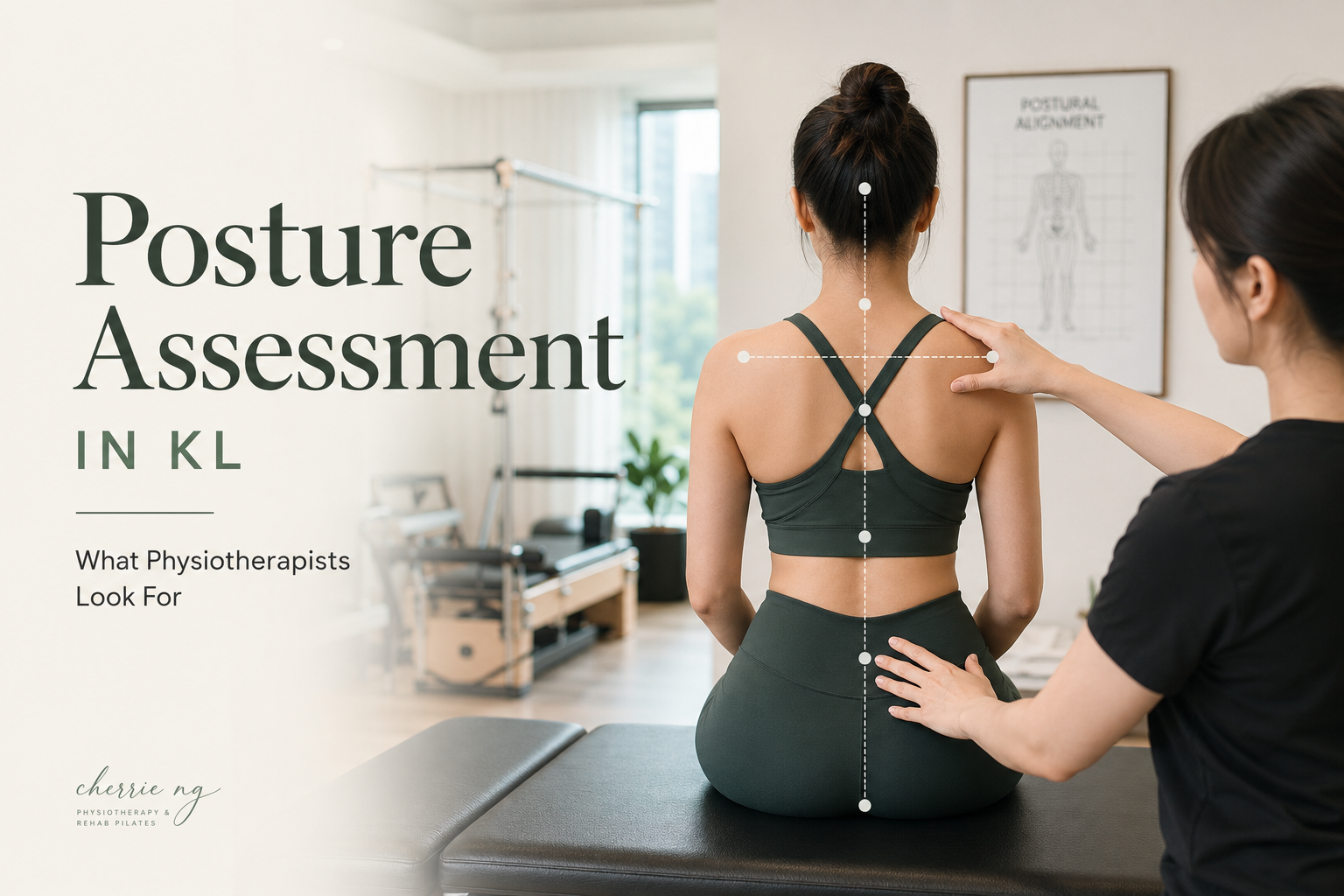
A physiotherapy posture assessment in KL should look beyond whether you appear straight in a photo. It may consider your symptoms, daily positions, movement options, strength, mobility, breathing, work setup and how your body manages tasks such as sitting, standing, reaching or lifting.
Posture can provide useful clues, but it is not a diagnosis by itself. The aim is to understand which findings are relevant to your comfort and function, not to label every asymmetry as a problem or promise one permanently “correct” position.
What does posture mean?
Posture is the position and organisation of the body at a particular moment. It changes when you sit, stand, walk, use a phone, work at a laptop, exercise or rest.
There is no single ideal posture that everyone must hold all day. Body proportions, habits, work demands, injury history, fatigue, confidence and health conditions all influence how a person stands and moves.
A useful assessment therefore asks more than “Are the shoulders level?” It asks:
- Can you change position comfortably?
- How long can you tolerate the task?
- Does a position reproduce or ease symptoms?
- Do movement, load or rest change the problem?
- Is the posture a flexible habit or a fixed structural feature?
- What does the person want to return to doing?
Why might someone book a posture assessment?
People often seek an assessment because of pain, fatigue, visible asymmetry or uncertainty about exercise. Common concerns include:
- Neck or shoulder tension during desk work
- Back discomfort after sitting or standing
- A forward head or rounded shoulder appearance
- One shoulder, hip or side of the waist looking different
- Uneven shoe wear or questions about foot posture
- Feeling stiff when trying to sit upright
- Repeated discomfort during gym training or Pilates
- Changes noticed after pregnancy, injury or surgery
- Concern about scoliosis or another structural condition
Not every visible difference needs correction. An assessment can help separate normal variation from a finding that may influence a specific task, and identify when medical review is more appropriate.
What happens during a physiotherapy posture assessment?
Cherrie may begin with a conversation about the main concern, symptom history, work and home routines, exercise, sleep, stress, previous injuries, medical conditions and goals. This context often matters more than a posture score alone.
The physical assessment may include several parts.
Standing and sitting observation
The physiotherapist may observe the head, rib cage, spine, shoulders, pelvis, knees and feet from different views. She may compare a relaxed position with a deliberately adjusted one.
The purpose is to identify patterns for further testing. Observation alone cannot establish which tissue causes pain or whether a spinal curve meets a medical definition.
Movement and mobility
You may be asked to turn the neck, raise the arms, bend, rotate, squat or change sitting position. This helps show whether an apparent posture is flexible, whether movement is limited, and which actions reproduce or ease symptoms.
Strength and control
Testing may look at the trunk, hips, legs, upper back or shoulders. A person can look slouched yet have adequate strength, while someone who appears upright may still tire quickly during work or lifting. Function needs to be tested rather than guessed from appearance.
Symptom response
The assessment may compare symptoms before and after changing a position, taking a movement break or performing a task. A temporary change can guide practical advice, but it does not prove that the original posture was the sole cause.
Work, exercise and daily tasks
If the problem happens at a desk, the assessment may consider screen height, keyboard and mouse reach, chair support and how often you move. For gym, Pilates or household concerns, Cherrie may observe the relevant lift, reach, carry, step or exercise.
Balance, walking and foot position
When relevant, the physiotherapist may assess balance, walking, lower-limb alignment, footwear and how the feet respond under load. Static foot shape alone does not determine whether an insole or exercise is needed.
Are posture photos or angle measurements useful?
Photos may help document a starting position, explain an observation or compare the same task over time. They should be taken only with consent and handled appropriately.
Measurement quality varies by method. A systematic review of non-radiographic forward-head posture measurements found moderate-to-excellent reliability across methods, with the strongest reliability evidence for classic photogrammetry, while validity remained inconclusive.
This means a photo or angle can describe one aspect of posture, but it should not be treated as a complete diagnosis, a pain score or proof that treatment is required.
Does posture cause pain?
The relationship is not simple. Some postural measures differ between groups with and without pain, but this does not show that posture alone caused the symptoms.
For example, a systematic review and meta-analysis of head and neck posture found differences in one common neck angle and correlations with pain measures, while evidence for other measures was less clear. Age and sex also influenced measurements.
Pain can involve workload, time in one position, movement variety, strength, sleep, stress, previous injury, general health and tissue sensitivity. A posture finding becomes more useful when it connects consistently with the person’s symptoms or task limitations.
What may happen after the assessment?
The plan should respond to what the assessment finds. It may include:
- Education about comfortable posture variation
- Short movement breaks during desk or driving time
- Changes to screen, keyboard, chair or task setup
- Mobility for the neck, upper back, shoulders, hips or ankles
- Progressive strength and endurance
- Practice of sitting, standing, lifting or exercise positions
- Breathing and relaxation strategies when tension is relevant
- Rehab Pilates for movement awareness and graded control
- Referral for medical assessment when symptoms or structural concerns require it
The goal is usually better tolerance, movement options and confidence. It is not to hold the body rigidly or make every landmark perfectly symmetrical.
How long does posture correction take?
There is no universal timeline because the target should be clearly defined first. A desk setup can sometimes be adjusted immediately, while strength, endurance, movement confidence and symptom tolerance develop gradually.
Visible posture may or may not change. Progress can also mean sitting longer with fewer symptoms, taking breaks before pain builds, lifting with more confidence or returning to exercise.
If a plan only asks you to squeeze the shoulder blades back or brace the core all day, it may create more fatigue. Useful posture support should be adaptable enough for real work and daily life.
When is imaging or medical review needed?
Routine posture assessment does not require an X-ray. Imaging decisions should be made with a doctor when the history, examination or suspected condition makes the result relevant to care.
Medical review is important for a newly noticed or rapidly changing spinal shape, significant loss of height, symptoms after major trauma, persistent night pain, unexplained weight loss, fever, progressive weakness or numbness, worsening balance, or pain that is severe and unusual.
Seek urgent medical care for loss of bladder or bowel control, numbness around the groin or anus, sudden major weakness, chest pain, unusual shortness of breath, or other alarming symptoms.
Related reading
- Posture Correction in KL: Assessment, Exercises and Realistic Expectations
- Pilates for Posture Correction: What It Can and Cannot Do
- Neck and Shoulder Pain from Desk Work: What You Can Do
- Scoliosis Physiotherapy in Malaysia: What Adults Should Know
- Upper Crossed Syndrome: Is It Really the Cause of Your Pain?
- Posture Correction Myths: What Patients Should Know
Frequently asked questions
Do I need to wear specific clothing?
Comfortable clothing that allows you to sit, stand and move is helpful. Depending on the concern, the physiotherapist may need to observe relevant body areas, but this should be explained and consented to.
Can a posture assessment diagnose scoliosis?
A physiotherapist can screen for asymmetry and decide whether medical review may be useful. Scoliosis and its Cobb angle are confirmed using medical assessment and standing X-rays, not a posture photo alone.
Will I be told to sit straight all day?
Usually, no. Constantly holding one rigid position can become tiring. Advice often focuses on comfortable setup, regular position changes and enough strength and movement capacity for your day.
Can posture assessment be combined with rehab Pilates?
It may help guide exercise selection when Pilates is appropriate. The programme should reflect your symptoms, movement options and goals rather than applying the same “correction” exercises to everyone.
If posture, desk strain or movement asymmetry is affecting your comfort or confidence in Kuala Lumpur or Selangor, you can WhatsApp Cherrie to ask whether a physiotherapy or rehab Pilates assessment may be suitable.
Foundational clinical sources and further reading
These authoritative sources provide general background relevant to this topic; they are not claim-by-claim citations. This content is educational and does not replace individual assessment, diagnosis or emergency medical care.
- What is physiotherapy? — World Physiotherapy
- Musculoskeletal health — World Health Organization
- WHO guidelines on physical activity and sedentary behaviour — World Health Organization