Posture
Upper Crossed Syndrome: Is It Really the Cause of Your Pain?
Learn what upper crossed syndrome means, why posture alone cannot explain neck or shoulder pain, and what a physiotherapy assessment may check.
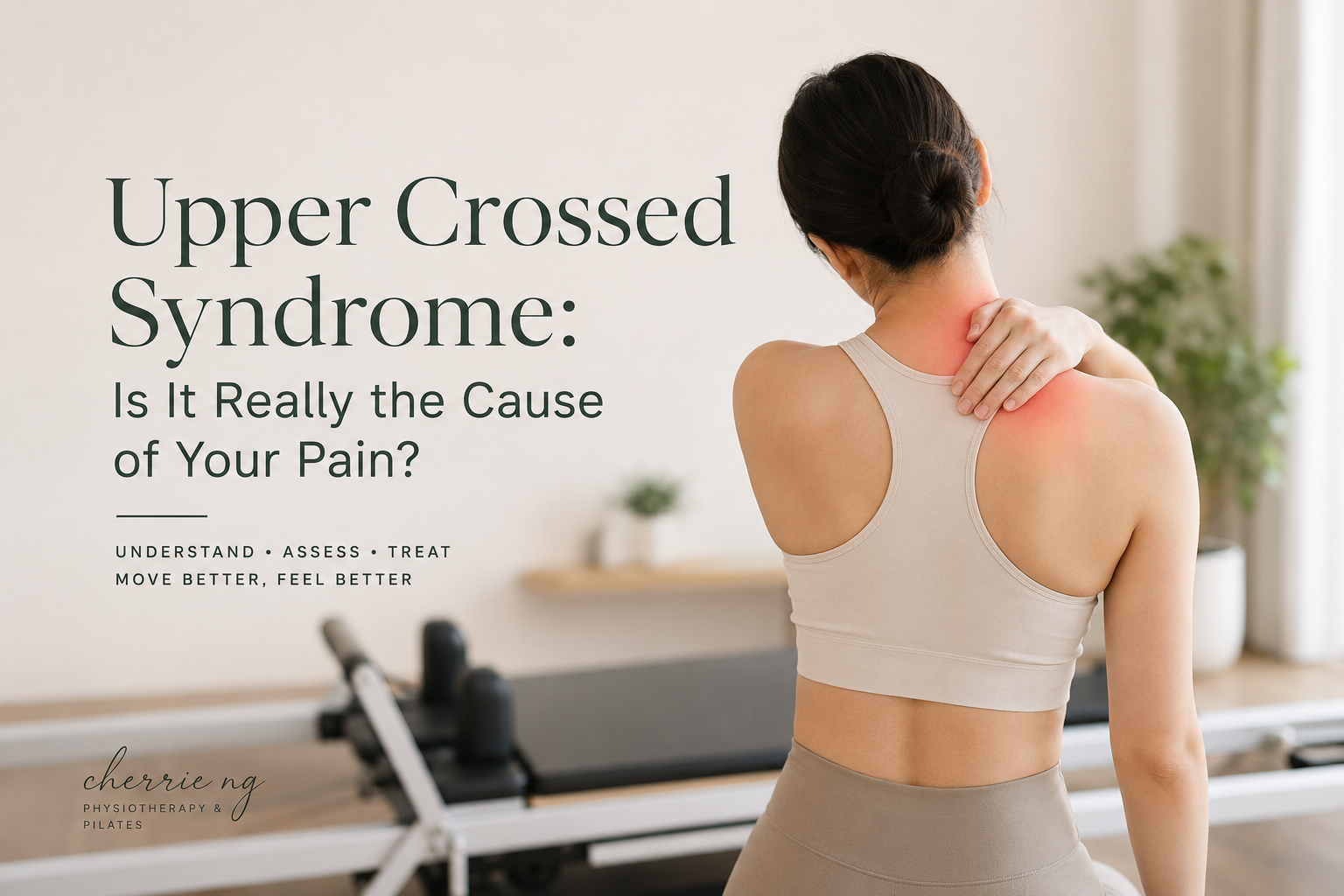
Upper crossed syndrome is a label for a pattern that may include a forward head position, rounded shoulders and a more curved upper back. It can be a useful starting point for observing posture, but it does not prove why your neck or shoulders hurt, which muscles are “weak” or “tight,” or which treatment you need.
If the pattern concerns you, a physiotherapy assessment in Kuala Lumpur or Selangor can look beyond appearance. The more useful questions are whether you have pain, stiffness, weakness or nerve symptoms; which tasks bring them on; whether your posture changes; and what affects your ability to work, train, sleep or move comfortably.
What does upper crossed syndrome mean?
The term is commonly used for a cluster of upper-body findings:
- The head rests farther forward
- The shoulders appear rounded or sit forward
- The upper back looks more curved
- Some neck, chest or shoulder muscles are described as relatively overactive or short
- Other neck and shoulder-blade muscles are described as relatively underactive
Research articles do not use one completely uniform definition or assessment method. A systematic review of physiotherapy interventions noted variation in how upper crossed syndrome was measured and managed across studies. This is one reason the label should be treated as a descriptive model rather than a complete explanation for an individual’s symptoms. Systematic review of physiotherapeutic interventions for upper crossed syndrome
Is upper crossed syndrome the cause of neck or shoulder pain?
Not necessarily. Posture and pain can be related in some people, but a relationship does not show which came first or whether posture is the main cause.
A 2023 systematic review and meta-analysis found that evidence linking thoracic posture measurements with non-traumatic neck pain was limited and mostly of very low-to-low certainty. The authors concluded that existing evidence was insufficient to prove more than a minor association between thoracic posture and neck pain. Systematic review of thoracic posture and non-traumatic neck pain
This matters because two people may look similar but feel completely different. One may work, exercise and sleep without symptoms. The other may have pain influenced by long periods in one position, a sudden increase in training, limited shoulder capacity, stress, poor sleep, a previous injury or nerve irritation.
Your posture is therefore one clue among many—not a diagnosis and not a verdict that your body is damaged.
Why can the label feel convincing?
The pattern is easy to see in a side-view photo, and the words “tight” and “weak” offer a simple story. That story can sometimes guide further testing, but appearance alone cannot confirm how a muscle behaves during real tasks.
For example:
- A rounded resting position may change easily when you reach overhead
- A person who looks upright may still fatigue during desk work
- A muscle may feel tight because it is sensitive or working hard, not because it is physically shortened
- Shoulder or arm symptoms may involve the neck, shoulder, nerves or another structure
- Pain may alter posture rather than posture being the original cause
The assessment should test these possibilities instead of assuming them from a photograph.
What might a physiotherapy assessment look at?
Cherrie may first ask about symptom onset, work and phone use, driving, sleep, stress, gym or Pilates training, previous injury, medical history and the activities you want to manage better.
The physical assessment may then consider:
- Comfortable neck, upper-back and shoulder movement
- Whether symptoms change with movement or position
- Shoulder-blade movement during reaching or lifting
- Neck, shoulder and upper-back strength or endurance
- Whether a forward or rounded posture is flexible
- Desk, laptop or phone setup when it matches the problem
- Sensation, strength or reflexes when nerve symptoms are suspected
- A relevant task, such as typing, driving, lifting or an exercise
The goal is not to score how “bad” your posture looks. It is to identify findings that connect with your symptoms and goals, and to screen for reasons that need medical review.
Do upper crossed syndrome exercises help?
Exercise may improve measured posture angles. A 2024 systematic review and meta-analysis reported improvements in forward-head posture, rounded shoulders and thoracic kyphosis after therapeutic exercise programmes. The included programmes varied and used combinations of strengthening, stretching, shoulder-focused and more comprehensive exercises. BMC systematic review and meta-analysis of therapeutic exercise
That finding does not mean everyone needs to “correct” their appearance, or that changing an angle will automatically remove pain. A useful programme should be chosen around the person’s symptoms, function and goals.
Depending on the assessment, a plan may include:
- Neck and upper-back movement practice
- Progressive shoulder and upper-back strengthening
- Exercise for neck or shoulder endurance
- Reaching, lifting or overhead control
- Movement breaks and changes to demanding work positions
- Gradual return to gym, sport or daily tasks
- Rehab Pilates for adaptable movement, breathing and control
Stretching the chest and squeezing the shoulder blades may feel useful, but they are not a universal solution. Constantly pulling the shoulders back can also become tiring. The aim is to build comfortable options and capacity, not hold one rigid pose all day.
What can you try if symptoms are mild?
If there was no major injury and symptoms are mild, stable and not spreading, you could begin with simple changes:
- Change position regularly instead of waiting for tension to build
- Move the neck, upper back and shoulders gently through comfortable ranges
- Bring frequently used work items within easy reach
- Support the forearms if holding them up increases shoulder tension
- Reduce or modify an exercise that repeatedly worsens symptoms
- Keep general activity and strength work within a tolerable level
Stop and seek assessment if an exercise produces sharp pain, worsening numbness, noticeable weakness, dizziness or symptoms that continue to escalate afterwards.
When should you get assessed or seek medical care?
Consider a physiotherapy assessment when neck or shoulder symptoms keep returning, affect sleep or work, limit turning or reaching, spread into the arm, or leave you unsure how to exercise safely. An assessment is also useful when a visible posture change is new, fixed or progressing.
Seek medical care promptly when neck pain follows significant trauma or comes with new or worsening arm or leg weakness, numbness, loss of bladder or bowel control, severe worsening or night pain, fever, unexplained weight loss, a cancer history, or worsening balance. These warning signs need medical evaluation rather than a posture-correction routine. Indian Council of Medical Research neck-pain treatment workflow
Related reading
- Neck and Shoulder Pain from Desk Work: What You Can Do
- Neck Pain Physiotherapy in KL: Why It Happens and What Helps
- Posture Assessment in KL: What Physiotherapists Look For
- Forward Head Posture Exercises: What Actually Helps?
- Posture Correction Myths: What Patients Should Know
Sources and clinical references
- Physiotherapeutic interventions for upper crossed syndrome: systematic review and meta-analysis
- Relationship of sagittal thoracic posture with non-traumatic neck pain: systematic review and meta-analysis
- Effect of therapeutic exercises on upper crossed syndrome posture: systematic review and meta-analysis
- Indian Council of Medical Research standard treatment workflow for neck pain
Frequently asked questions
Is upper crossed syndrome a permanent condition?
The label describes a pattern seen at one point in time. Posture can vary with position, task, fatigue and habit, and measured angles may change with exercise. More importantly, comfort and function can improve even when appearance does not change dramatically.
Do I need to stretch every “tight” muscle and strengthen every “weak” one?
Not automatically. Muscle length, strength, endurance and symptom response should be assessed rather than guessed from appearance. Your programme may need only a few priorities.
Is forward head posture always harmful?
No single position is automatically harmful. It becomes more relevant when it is difficult to change, consistently reproduces symptoms, or forms part of a task you cannot tolerate well.
Can rehab Pilates help?
Rehab Pilates may support upper-back movement, shoulder strength, breathing, trunk control and confidence when it is adapted to the assessment. It should not be presented as a guaranteed way to “fix” posture or pain.
If neck, shoulder or posture concerns are affecting your work or exercise in Kuala Lumpur or Selangor, you can WhatsApp Cherrie to ask whether physiotherapy or rehab Pilates assessment may be suitable.
Foundational clinical sources and further reading
These authoritative sources provide general background relevant to this topic; they are not claim-by-claim citations. This content is educational and does not replace individual assessment, diagnosis or emergency medical care.
- What is physiotherapy? — World Physiotherapy
- Musculoskeletal health — World Health Organization
- WHO guidelines on physical activity and sedentary behaviour — World Health Organization