Posture
Scoliosis Physiotherapy in Malaysia: What Adults Should Know
Learn what adult scoliosis physiotherapy may address, what assessment involves, realistic exercise goals, and when specialist review is important.
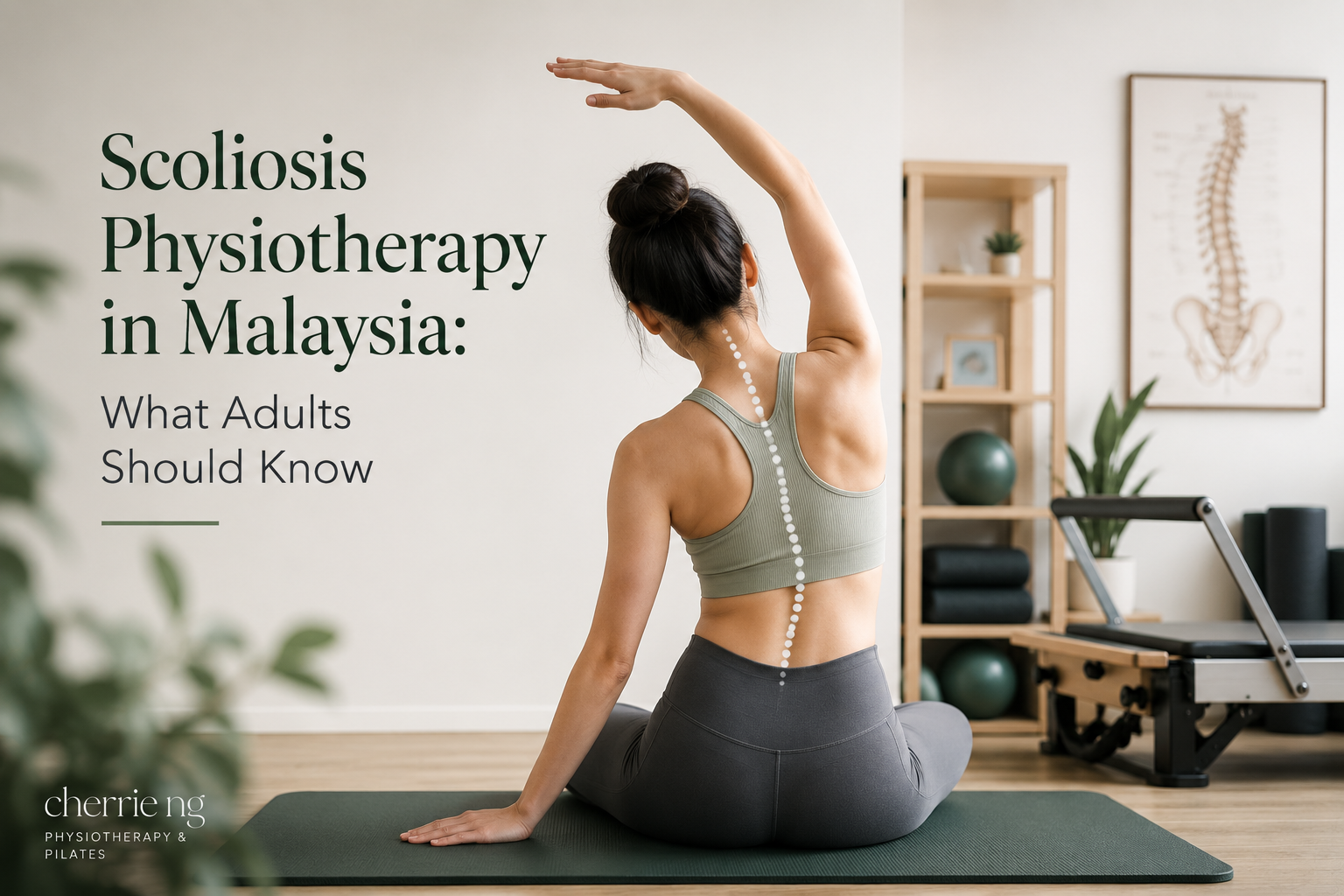
Scoliosis physiotherapy for adults may help with pain, stiffness, strength, balance, walking tolerance and confidence in daily activity. It should not be promised to straighten a structural curve or replace medical assessment when the curve, symptoms or function are changing.
Adults in Malaysia may have a curve that began during adolescence or one that developed later alongside age-related changes in the spine. These situations can look similar but may create different symptoms and treatment priorities. Physiotherapy should therefore begin with the person’s history, current function and medical context rather than posture alone.
What is adult scoliosis?
Scoliosis is a three-dimensional spinal condition involving a sideways curve and vertebral rotation. On an X-ray, a Cobb angle greater than 10 degrees is generally used to define scoliosis. A physiotherapist can screen posture and movement, but cannot confirm a Cobb angle by looking at the back.
Adult scoliosis broadly includes:
- Adult idiopathic scoliosis: a curve that began earlier in life and remains present after growth
- Adult degenerative scoliosis: a curve that develops later as discs, joints and other spinal structures change unevenly
Some adults know about their curve from childhood. Others first learn about it after an X-ray for back or leg symptoms. Many people with scoliosis remain active and may have few or no symptoms, so the curve should not automatically be blamed for every ache.
What symptoms may bring an adult to physiotherapy?
Adults often seek physiotherapy because something is affecting daily life rather than because of the curve alone. Concerns may include:
- Back pain or stiffness during sitting, standing or lifting
- Fatigue on one side of the trunk
- Reduced tolerance for walking or standing
- Hip, buttock or leg symptoms
- Numbness, tingling or weakness that needs screening
- Balance changes or reduced confidence on stairs
- Difficulty returning to gym, Pilates or sport
- Worry about visible asymmetry or curve progression
- Questions after spinal surgery or a new medical diagnosis
Pain severity does not always match curve size. Symptoms may also involve spinal stenosis, joint or disc changes, muscle sensitivity, reduced conditioning, osteoporosis, sleep, stress or another condition. Assessment helps decide which factors are most relevant.
Can physiotherapy reduce the curve?
Physiotherapy should not guarantee a smaller Cobb angle in an adult. Research specifically on adult exercise is limited. A systematic review of stabilisation exercise in adults with scoliosis found only one eligible controlled study, highlighting how little high-quality evidence is available for this population.
Exercise can still have worthwhile goals. Improving walking tolerance, strength, balance, sleep, work capacity or confidence may matter greatly even when spinal structure does not change.
The Scoliosis Research Society also notes that physical therapy may be prescribed to address specific problems such as back pain. This is a more realistic role than promising that hands-on treatment or exercise will reposition the spine permanently.
What a physiotherapy assessment may look at
Cherrie may begin by asking how and when scoliosis was diagnosed, whether imaging or specialist advice is available, and whether the curve or symptoms have changed. She may also ask about falls, bone health, menopause, medication, previous surgery, other medical conditions and current exercise.
The movement assessment may consider:
- Back, rib-cage, shoulder and hip movement
- Trunk, hip and leg strength
- Balance and walking pattern
- Sitting, standing and walking tolerance
- Bending, lifting, carrying and stair tasks
- Breathing during rest and effort
- Symptoms travelling into the leg or arm
- Recovery after exercise or a busy day
The aim is not to make both sides look identical. It is to identify what limits function, what movement is safe and useful, and whether medical review is needed before exercise progresses.
Does every adult need a new X-ray?
Not necessarily. Imaging decisions should be made with a doctor based on the history, symptoms, previous records and whether the result would change care. Repeating X-rays simply to check posture after every short exercise programme is not usually a physiotherapy goal.
Medical review may be more relevant when scoliosis is newly suspected, the body shape appears to be changing, pain or walking ability is worsening, neurological symptoms are present, or previous imaging is old and treatment decisions depend on current information.
If earlier reports or images are available, bringing them to an assessment can help establish context. The physiotherapist can then work within the medical plan rather than guessing the curve type or size.
What physiotherapy may include
The programme should reflect the person’s symptoms, health and goals. It may include several elements.
Education and activity planning
Understanding that movement is generally valuable can reduce unnecessary fear. Advice may cover pacing, changing position, planning walking breaks, managing flare-ups and gradually returning to meaningful activities.
Mobility where it is useful
Some spinal, rib-cage, shoulder or hip movements may feel restricted. Gentle mobility can help the person access a comfortable range, but forcing every stiff area or repeatedly pushing toward visual symmetry is not the goal.
Progressive strength and endurance
Training may include the trunk, hips and legs, then connect to squats, steps, carries, pushing, pulling and lifting. General strength matters because daily life does not happen only in corrected positions.
Balance and walking capacity
For adults who feel less steady or tire when walking, the plan may include balance practice, lower-limb strength and progressively longer or more varied walking tasks.
Symptom-specific strategies
If leg symptoms suggest nerve involvement or spinal stenosis, exercise positions and walking plans may need modification. Manual therapy may provide short-term comfort for some people, but it should not be described as physically straightening the curve.
General exercise versus scoliosis-specific exercise
General exercise can build strength, fitness, balance and confidence. Physiotherapeutic scoliosis-specific exercises, or PSSE, use three-dimensional self-correction and tasks chosen around an individual’s curve pattern.
Most PSSE research involves adolescents rather than adults. A method should not be called scoliosis-specific simply because it includes breathing, side-bending or one-sided exercise. Relevant training, curve information and an individual assessment are needed.
An adult may benefit from general physiotherapy, PSSE, rehab Pilates or a combination. The best fit depends on the problem being addressed, the clinician’s scope and the person’s preferences.
Should one side be stretched and the other strengthened?
Not as a universal rule. The visible curve does not reveal exactly which muscles are short, weak or responsible for pain. Both sides may need strength, and the side that feels tight may actually be working hard rather than lacking length.
Symmetrical exercises can build overall capacity. Asymmetrical exercises may be useful when they serve a specific movement goal. The decision should be based on assessment and response, not a simple picture of the curve.
Exercising with degenerative scoliosis
Degenerative scoliosis may occur alongside osteoarthritis, spinal stenosis, reduced bone density or other age-related changes. This does not mean exercise must stop, but the plan may need to account for standing and walking symptoms, balance, recovery and fracture risk.
Someone with osteoporosis, a recent compression fracture, rapidly increasing pain or significant loss of height should seek medical guidance before using forceful spinal loading or repeated end-range bending. Appropriate resistance training may still be valuable once the health context is clear.
After scoliosis surgery or spinal fusion
Physiotherapy after fusion should respect healing, the operated levels, the surgeon’s advice and current symptoms. The spine may move differently, so mobility work usually focuses on safe available regions rather than trying to force movement through fused segments.
The plan may progress walking, hip and leg strength, balance, lifting confidence and return to work or exercise. Medical clearance should come before new high-load, impact or extreme-range training.
When specialist or urgent care matters
Arrange medical or spine-specialist review for a newly noticed or rapidly changing deformity, progressive loss of height, worsening walking tolerance, persistent night pain, unexplained weight loss, or new neurological symptoms. An adult with known scoliosis may still develop a separate condition that needs investigation.
Seek urgent medical care for new or worsening leg or arm weakness, loss of balance, numbness around the groin or anus, loss of bladder or bowel control, severe pain after trauma, fever with severe back pain, chest pain, unusual shortness of breath, or symptoms that feel alarming or unusual.
Related reading
- Pilates for Scoliosis in Malaysia: Supportive Movement, Not a Quick Fix
- Pilates for Posture Correction: What It Can and Cannot Do
- Lower Back Pain Physiotherapy in KL: Common Causes and Next Steps
- Posture Assessment in KL: What Physiotherapists Look For
Frequently asked questions
Can adult scoliosis get worse?
Some curves remain stable while others may progress, particularly with larger curves or degenerative changes. A doctor can advise whether clinical follow-up or updated imaging is appropriate for your situation.
Is scoliosis the reason for all my back pain?
Not necessarily. Pain can involve many factors, including load, strength, sleep, stress, joints, discs or nerves. Assessment should consider the whole picture rather than assuming the curve is the only cause.
Is it safe to lift weights with scoliosis?
Many adults can resistance train with suitable technique, load and progression. Individual advice is important after surgery, with osteoporosis, neurological symptoms or pain that is new or worsening.
Is Schroth therapy the same as general physiotherapy?
Schroth is one form of scoliosis-specific exercise. General physiotherapy may use broader strength, mobility, balance and functional training. The appropriate approach depends on your curve information, symptoms, goals and access to suitably trained care.
If you are in Kuala Lumpur or Selangor and adult scoliosis is affecting comfort, walking or confidence with exercise, you can WhatsApp Cherrie to ask whether physiotherapy or rehab Pilates assessment may be suitable.
Foundational clinical sources and further reading
These authoritative sources provide general background relevant to this topic; they are not claim-by-claim citations. This content is educational and does not replace individual assessment, diagnosis or emergency medical care.
- What is physiotherapy? — World Physiotherapy
- Musculoskeletal health — World Health Organization
- WHO guidelines on physical activity and sedentary behaviour — World Health Organization