Rehab Pilates
Pilates for Scoliosis in Malaysia: Supportive Movement, Not a Quick Fix
Learn how Pilates may support strength and movement with scoliosis, what it cannot promise, and when medical or physiotherapy assessment comes first.
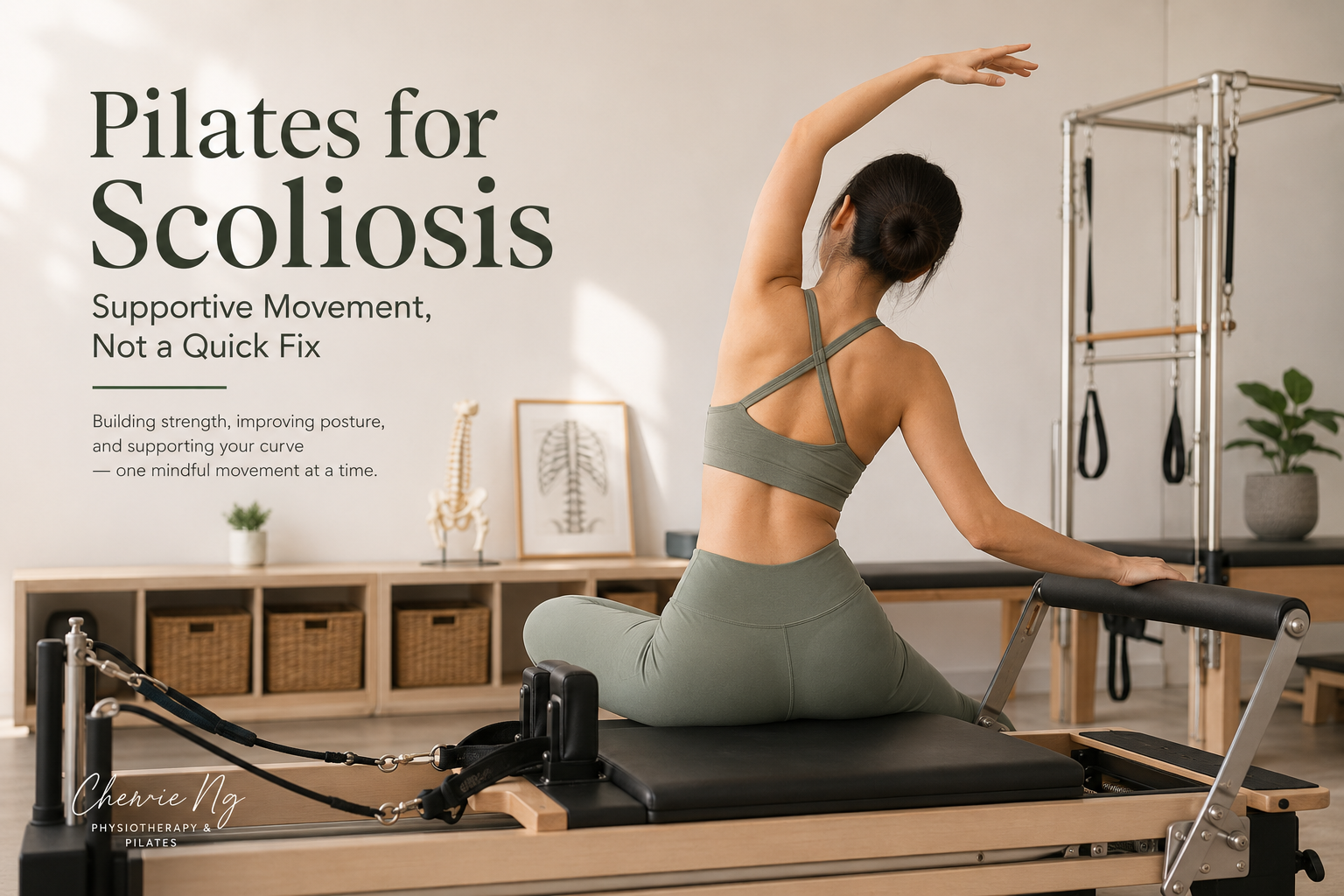
Pilates may support strength, mobility, breathing, balance and movement confidence for some people with scoliosis. It should not be presented as a quick way to straighten the spine, reverse a structural curve or replace medical monitoring, bracing or scoliosis-specific care when those are recommended.
In Malaysia, the right starting point depends on age, whether growth is complete, the type and size of the curve, symptoms, previous treatment and current goals. An adult with a stable curve and stiffness has different needs from an adolescent whose curve may still be progressing. This article is general education, not an individual diagnosis or exercise prescription.
What scoliosis actually means
Scoliosis is more than looking uneven from the front or having one shoulder higher. It involves a three-dimensional change in the spine, including sideways curvature and vertebral rotation. A medical diagnosis usually considers clinical examination and standing X-rays, with the Cobb angle used to describe curve size.
Posture, muscle tightness or the way someone stands cannot confirm scoliosis on their own. Small body asymmetries are also common in people without scoliosis.
The reason for the curve matters. Adolescent idiopathic scoliosis, adult degenerative scoliosis, congenital scoliosis and curves related to another health condition are not managed in exactly the same way. Exercise guidance should therefore begin with enough context.
Can Pilates correct a scoliosis curve?
Pilates cannot reliably be promised to correct a structural curve. A review of Pilates for idiopathic scoliosis found that the evidence relating Pilates to changes in scoliosis deformity was very limited. Another meta-analysis reported possible benefits but also described the available evidence as poor quality.
That does not make Pilates useless. Exercise can have meaningful goals even when an X-ray does not change. A person may value better strength, movement options, breathing comfort, exercise confidence or tolerance for work, caring duties and sport.
Progress should be judged against the goal. Improved function is worthwhile, but it should not be described as proof that a curve has straightened.
Pilates and scoliosis-specific exercise are not the same
General Pilates uses principles such as control, breathing, mobility and progressive resistance. A rehab-focused session can adapt these principles around symptoms and movement needs.
Physiotherapeutic scoliosis-specific exercises, often shortened to PSSE, are a separate category. They are selected according to the individual’s curve pattern and may include three-dimensional self-correction, breathing and integration into daily tasks. SOSORT guidance discusses PSSE as part of conservative care for idiopathic scoliosis during growth.
Adding a few asymmetric Pilates exercises does not automatically make a programme scoliosis-specific. Children and adolescents who need curve-management advice should be assessed by clinicians with relevant scoliosis expertise and should continue any recommended orthopaedic follow-up.
What Pilates may focus on
For a medically stable person, Pilates-based rehab may support several practical areas.
Comfortable spinal and rib-cage movement
Some regions may feel stiff while others move easily. Training can explore flexion, extension, rotation and side movement within an appropriate range rather than forcing the spine to look symmetrical.
Trunk, hip and shoulder capacity
Strength is useful for daily tasks, not just posture. Exercises may progress toward pushing, pulling, carrying, squatting, stepping and lifting so the programme connects to life outside the studio.
Breathing and endurance
Scoliosis can affect rib-cage shape, but not everyone has a breathing limitation. Pilates breathing cues may help someone notice rib movement and avoid unnecessary breath-holding. Significant shortness of breath needs medical assessment rather than a generic breathing drill.
Balance and confidence
Supported mat or Reformer exercises may provide a manageable starting point. Over time, standing balance, variable resistance and more functional tasks can help the person feel capable across different positions.
Should every exercise be symmetrical?
Not necessarily. Symmetrical exercises can build general strength, while carefully chosen asymmetric exercises may address a specific movement goal. Neither approach is automatically correct for every curve.
Trying to push the body into visual symmetry can cause unnecessary tension or discomfort. The visible side of a curve does not tell you by itself which muscles are weak, tight or need stretching. Curve location, rotation, symptoms and the person’s response to movement all matter.
A useful exercise should have a clear purpose. “Your right side is tight, so stretch it” is usually not enough reasoning for a scoliosis plan.
Is Reformer Pilates better for scoliosis?
The Reformer is a way to provide support and resistance; it is not a curve-correction machine. Springs can make an exercise easier, harder or simply different.
Reformer work may be useful when someone benefits from:
- Support while exploring spinal or hip movement
- Adjustable resistance for pushing and pulling
- Feedback from the carriage, straps or footbar
- Gradual progression from lying to kneeling or standing
- Variety that helps exercise feel more manageable
Mat exercises, conventional strength training, walking, swimming or another enjoyable activity may also belong in the plan. The equipment matters less than whether the programme matches the person’s needs and progresses sensibly.
What an assessment may look at
Cherrie may ask how scoliosis was diagnosed, whether recent imaging or specialist advice exists, and what symptoms or activities are important to you. For an adolescent, growth stage, curve monitoring, bracing and orthopaedic recommendations are especially relevant. For an adult, assessment may also consider degenerative changes, bone health, previous surgery and general exercise tolerance.
Movement assessment may look at:
- Comfortable spinal, rib-cage, shoulder and hip movement
- Strength, balance and endurance
- Breathing during rest and effort
- Pain behaviour and recovery after activity
- Walking, lifting, sitting, standing or sport-related tasks
- Numbness, weakness or symptoms travelling into a limb
- How support, range, position and resistance change the movement
A physiotherapist does not need to make every side look identical. The findings should guide a plan that is safe, understandable and connected to the person’s goals.
Special considerations for adolescents and adults
Adolescents who are still growing
Pilates should not replace monitoring by an orthopaedic or scoliosis team when a curve may progress. A brace should not be stopped or changed because an exercise programme feels helpful. Any Pilates work should fit around the established care plan.
Adults with a stable or degenerative curve
Adults may seek help for back pain, stiffness, fatigue, balance or confidence rather than curve correction. Exercise can be adapted around these goals, while new neurological symptoms or rapid functional change should be assessed medically.
People after spinal fusion
Exercise needs to respect the surgical level, healing stage, surgeon’s restrictions and any ongoing symptoms. Medical clearance and individual physiotherapy guidance should come before joining a general class.
When to seek medical review
Arrange medical or specialist review if a child or adolescent appears to have a changing spinal curve, uneven trunk shape or rapid asymmetry during growth. Adults should seek assessment for new or quickly changing deformity, increasing pain, reduced walking tolerance or unexplained functional decline.
Seek urgent medical care for new leg or arm weakness, worsening numbness, loss of balance, loss of bladder or bowel control, numbness around the groin or anus, severe pain after trauma, fever with severe back pain, chest pain, unusual shortness of breath, or symptoms that feel alarming or unusual.
Related reading
- Scoliosis Physiotherapy in Malaysia: What Adults Should Know
- Pilates for Posture Correction: What It Can and Cannot Do
- Physiotherapist-Led Pilates in KL: Who Is It Suitable For?
- What Is Rehab Pilates and How Is It Different from Regular Pilates?
Frequently asked questions
Can Pilates straighten scoliosis?
Pilates should not be promised to straighten a structural scoliosis curve. It may support strength, movement and confidence, while curve monitoring and treatment decisions require appropriate clinical care.
Are twisting and side-bending exercises unsafe?
Not automatically. Suitability depends on the curve, symptoms, bone health, surgery history, control and load. Blanket restrictions can be as unhelpful as forcing a painful range.
Can a teenager with scoliosis join a normal Pilates class?
It depends on growth stage, curve status and the medical plan. A general class does not replace orthopaedic monitoring or scoliosis-specific physiotherapy. Individual assessment is a sensible first step.
If you are in Kuala Lumpur or Selangor and want exercise guidance that considers scoliosis, symptoms and your daily goals, you can WhatsApp Cherrie to ask whether physiotherapy or rehab Pilates assessment may be suitable.
Foundational clinical sources and further reading
These authoritative sources provide general background relevant to this topic; they are not claim-by-claim citations. This content is educational and does not replace individual assessment, diagnosis or emergency medical care.
- What is physiotherapy? — World Physiotherapy
- WHO guidelines on physical activity and sedentary behaviour — World Health Organization