Rehab Pilates
Pilates for Back Pain in KL: When It Helps and When to Get Assessed
A careful guide to when Pilates may help back pain, what physiotherapy assessment looks at, and when to seek care in Kuala Lumpur.
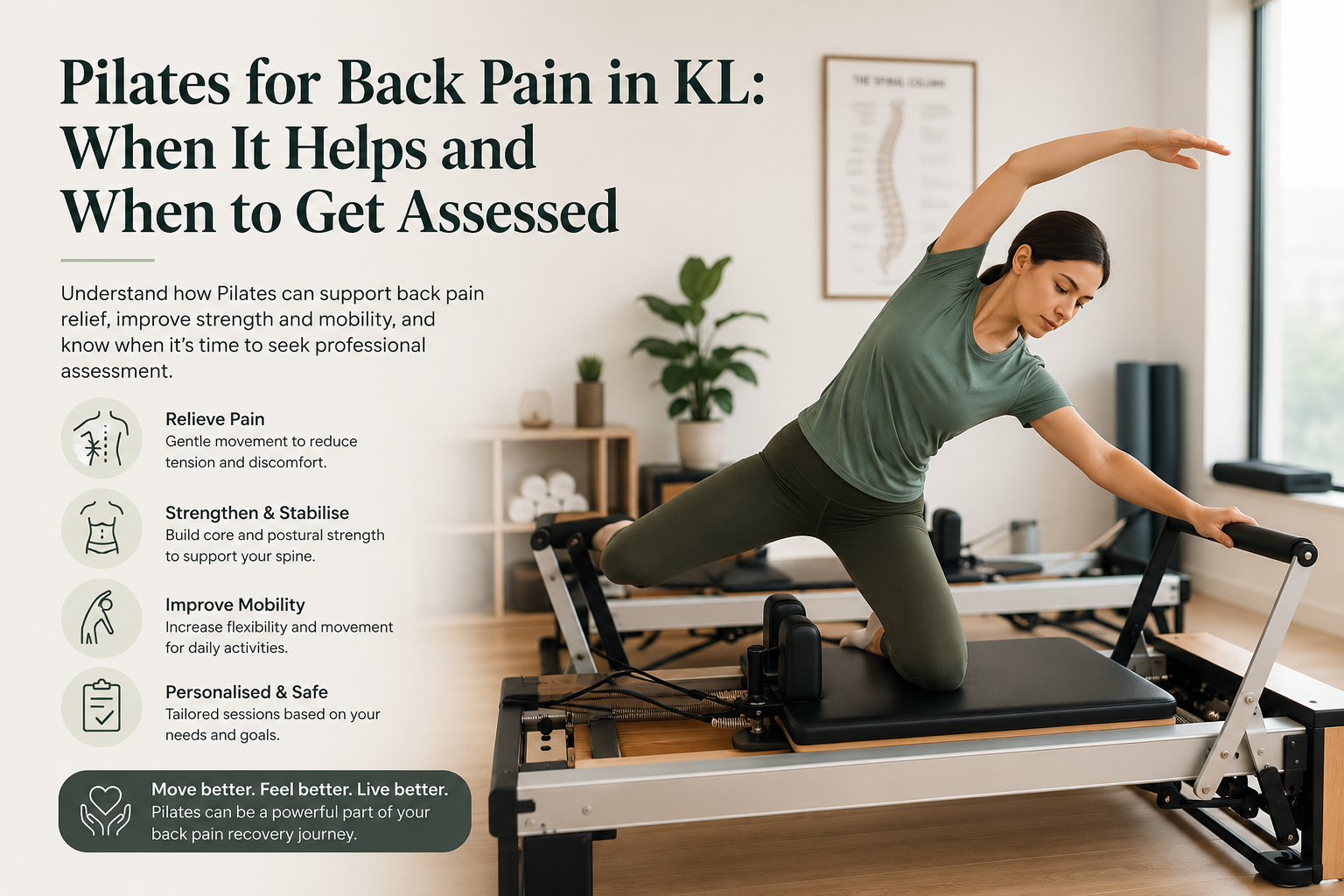
Pilates may help some people with back pain when the exercises are matched to their symptoms, strength, mobility and confidence with movement. In Kuala Lumpur, rehab Pilates can be especially useful when you want guided exercise but are unsure which movements are appropriate for your back.
It is not a quick fix for every type of back pain. If symptoms are new, worsening, spreading down the leg or affecting daily life, a physiotherapy assessment should usually come first.
When Pilates may help back pain
Pilates-based rehab may support back pain recovery by improving movement control, breathing, hip and trunk strength, posture awareness and confidence with bending, sitting or daily activities.
It may be suitable when:
- Your back pain is mild to moderate and not rapidly worsening
- You feel stiff or guarded after a flare-up
- Sitting, standing or lifting habits seem to trigger symptoms
- You want to rebuild core and hip strength gradually
- You need guided exercise after a physiotherapy assessment
- You feel unsure how to move without provoking pain
The goal is not to force a perfect posture or brace your core all day. The goal is to help your body tolerate useful movement again.
When Pilates may not be the first step
Pilates may not be the best first step if your symptoms need clearer screening. Back pain can come from many factors, including joint irritation, muscle sensitivity, nerve involvement, recovery after injury, load changes, stress, sleep and general health.
If pain is sharp, severe, spreading, associated with numbness or weakness, or linked to a fall or accident, it is safer to start with assessment rather than joining a general class.
This does not mean exercise is unsafe. It means the exercise should be chosen with enough context.
What a physiotherapy or rehab Pilates assessment may look at
A physiotherapy-led session may look at your pain history, daily routine, sitting and lifting habits, walking, spinal movement, hip mobility, strength, balance, breathing pattern and what movements feel worrying.
Cherrie may also ask what you want to return to, such as desk work, carrying a child, gym training, housework, sport or sleeping more comfortably.
From there, Pilates exercises can be adapted. Some people may begin with gentle breathing, pelvic control and supported movements. Others may progress to reformer-based resistance, hip strengthening, balance tasks or more functional loading.
What may help you start safely
Start with exercises that feel manageable and repeatable. Mild muscle effort or gentle stretch can be normal, but sharp pain, spreading leg symptoms, increasing numbness or a strong flare-up are signs to pause and seek advice.
Useful early focuses may include:
- Comfortable breathing and rib cage movement
- Gentle spinal mobility within a tolerable range
- Hip and glute strength
- Gradual core control without excessive bracing
- Short movement breaks during long sitting periods
- Pacing activities instead of doing everything on a good day
Progress should be based on how your back responds during the session and over the next 24 hours.
When to get assessed
Consider a physiotherapy assessment if your back pain lasts more than a few days, keeps returning, limits work or sleep, affects walking, or makes you unsure which exercises are safe.
Seek medical care promptly if pain follows major trauma, worsens quickly, comes with fever, unexplained weight loss, new numbness or weakness, loss of bladder or bowel control, chest pain, or symptoms that feel unusual for you.
Related reading
- Back Pain After Pregnancy: Why It Happens and What Helps
- Core Strength for Back Pain: What People Often Get Wrong
- Is Walking Good for Lower Back Pain?
- Deep Core vs Six-Pack Abs: Why Rehab Pilates Focuses on Control
- What Is Rehab Pilates and How Is It Different from Regular Pilates?
- Lower Back Pain Physiotherapy in KL: Common Causes and Next Steps
- Physiotherapist-Led Pilates in KL: Who Is It Suitable For?
- When Should You See a Physiotherapist in Kuala Lumpur?
- Post-Natal Physiotherapy in KL: A Gentle Return to Movement
If you are in Kuala Lumpur or Selangor and want to know whether Pilates is suitable for your back pain, you can WhatsApp Cherrie to ask about physiotherapy, rehab Pilates or a home-based assessment.
Foundational clinical sources and further reading
These authoritative sources provide general background relevant to this topic; they are not claim-by-claim citations. This content is educational and does not replace individual assessment, diagnosis or emergency medical care.
- What is physiotherapy? — World Physiotherapy
- WHO guidelines on physical activity and sedentary behaviour — World Health Organization