Rehab Pilates
Deep Core vs Six-Pack Abs: Why Rehab Pilates Focuses on Control
Learn how deep-core control differs from visible abs and why rehab Pilates prioritises breathing, coordination, strength and useful movement.
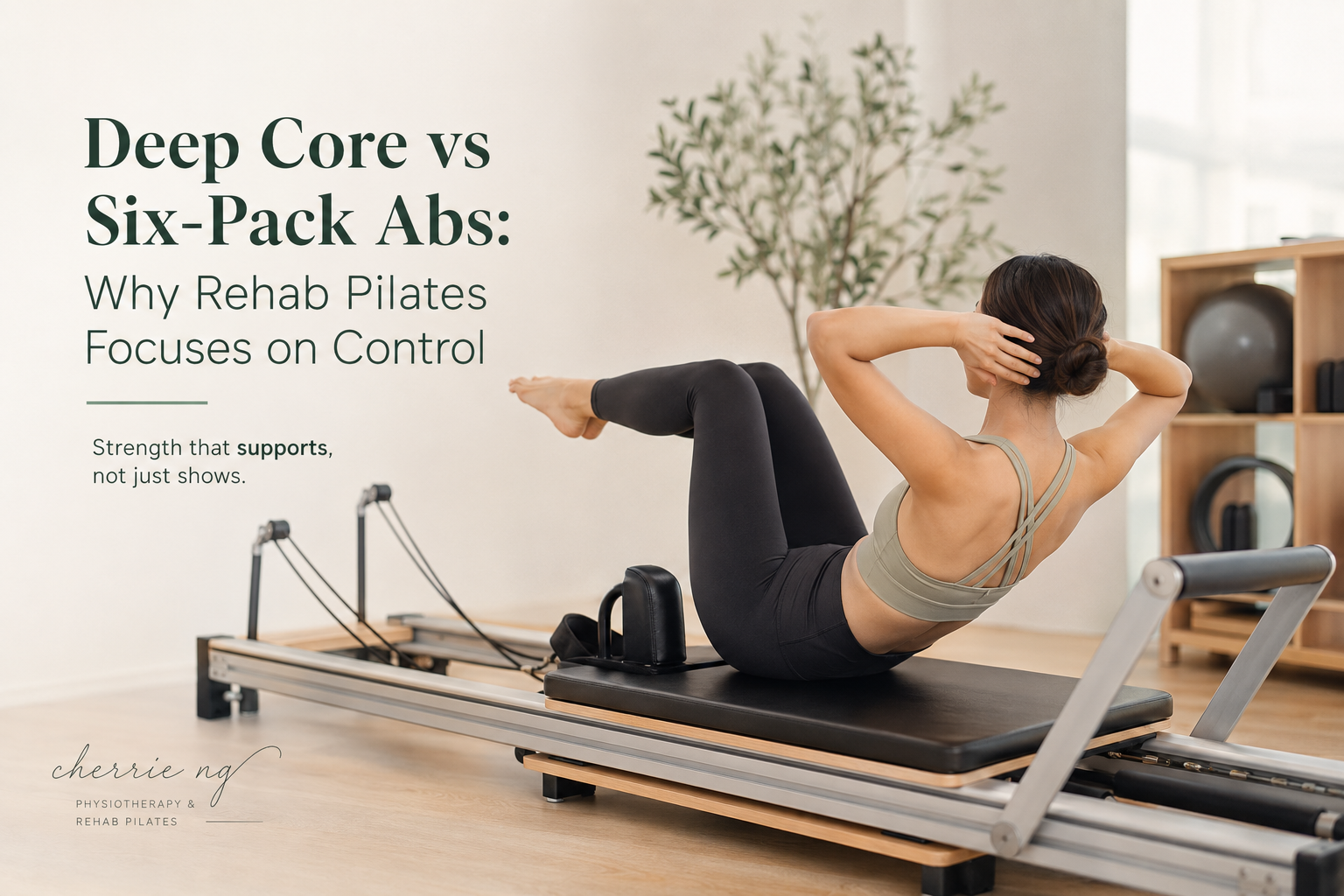
A visible six-pack and good core control are not the same thing. The “six-pack” is mainly the rectus abdominis muscle and its appearance is strongly influenced by body composition and individual anatomy. Core control describes how the abdominal wall, back muscles, hips and breathing system coordinate to manage movement and load.
Rehab Pilates does not ignore the six-pack muscles or treat one “deep” muscle as a magic switch. It usually places more attention on breathing, control and progressive strength because these qualities can be adapted to a person’s symptoms and connected to everyday tasks. This article provides general education rather than an individual exercise prescription.
What are six-pack abs?
The rectus abdominis runs down the front of the abdomen. It helps bend the trunk and contributes to managing pressure and resisting movement. Sit-ups, roll-ups and many other exercises can train it.
How clearly this muscle is visible does not show how well someone lifts, runs, balances or manages back pain. A person may have defined abdominal muscles but limited trunk endurance or poor confidence after injury. Another person may have no visible six-pack and still be strong, coordinated and physically capable.
For rehabilitation, appearance is therefore a poor progress measure. Symptoms, movement quality, strength, tolerance and return to meaningful activities are usually more useful.
What do people mean by the “deep core”?
Deep core is an informal term rather than one precisely defined structure. It often refers to muscles such as the transversus abdominis and multifidus, working alongside the diaphragm, pelvic floor, obliques and other trunk and hip muscles.
These structures do not work in isolation during real movement. Their contribution changes when you breathe, reach, walk, carry, cough, lift or respond to an unexpected load. This is why rehab should not be reduced to repeatedly pulling the belly button inward or trying to feel one muscle contract.
Awareness of a gentle abdominal contraction can be useful when learning a movement, but it is a starting tool, not the final goal. Over time, control should become adaptable enough for breathing and whole-body movement to continue naturally.
Why rehab Pilates focuses on control
Control means being able to organise a movement with an appropriate amount of effort. It does not mean keeping the spine perfectly still or bracing as hard as possible.
In rehab Pilates, control may involve learning to:
- Breathe without constantly holding your breath
- Adjust trunk tension to suit a light or demanding task
- Move the arms and legs while managing the trunk and pelvis
- Use the hips and legs rather than asking the back to do everything
- Slow down, reduce range or add support when symptoms are sensitive
- Progress toward resistance, balance and more functional movement
A Cochrane review of motor-control exercise found that this approach can be more helpful than minimal intervention for some people with persistent nonspecific low back pain, but it was not clearly better than every other form of exercise. The practical message is that control work can be useful without being the only valid way to build strength or manage symptoms.
Drawing in and bracing are tools, not rules for the whole day
“Drawing in” usually describes a gentle narrowing of the lower abdomen. “Bracing” usually involves creating broader tension around the trunk. Either strategy may be useful for a particular exercise or heavier task.
Neither needs to be held all day. Constantly gripping the abdomen may make breathing and movement feel more rigid, and it does not guarantee protection from pain or injury. The required effort should change with the task: getting out of bed does not need the same trunk tension as a heavy lift.
A useful cue should improve the movement without causing breath-holding, bearing down, neck tension, pain or fear. If a cue makes the exercise worse, it may need to be changed.
What a rehab assessment may look at
Cherrie may ask about symptoms, injury or surgery history, current exercise, work demands and the activities you want to return to. Assessment is not based on whether the stomach looks flat.
It may consider:
- Breathing and rib-cage movement during effort
- Trunk, hip and shoulder coordination
- Strength and endurance at an appropriate level
- Balance and control in standing or on one leg
- How symptoms respond to bending, lifting, carrying or rotation
- Whether reducing range, changing position or adding support helps
- Confidence with movement and recovery after exercise
If pain, post-surgery restrictions or post-natal concerns are involved, the starting point may need additional screening or medical clearance. The plan should reflect the individual rather than a generic “deep-core activation” sequence.
How core training can progress
Early work may use supported positions because they make it easier to notice breathing and control. Depending on the assessment, examples may include heel slides, small dead bug variations, bridges, side-lying work or quadruped arm and leg movements.
Progress should not stop on the mat. It may move toward:
- Stronger resistance and longer lever positions
- Squats, hinges, steps and loaded carries
- Reaching or rotating with control
- Balance and single-leg tasks
- Gym, running or sport-specific demands
- Daily activities such as lifting, pushing or carrying a child
The aim is not to keep every movement slow forever. Once a person has enough control and tolerance, speed, load and complexity can gradually increase.
Are sit-ups, planks or roll-ups bad?
No exercise is automatically good or bad for everyone. Sit-ups and roll-ups challenge trunk flexion, while planks challenge the ability to resist movement. They may be appropriate when they match the person’s goals and current capacity.
They may need to be modified if they cause sharp pain, spreading symptoms, excessive breath-holding or a flare that does not settle. A different range, position, load or exercise may allow training to continue more comfortably.
Rehab Pilates is not defined by avoiding difficult abdominal exercises. It is defined more by selecting and progressing exercises with a clear reason.
When to pause and seek advice
Pause exercise and seek assessment if you develop sharp or rapidly worsening pain, new numbness, persistent pins and needles, unexplained weakness, dizziness, marked abdominal or pelvic pressure, or symptoms that repeatedly worsen after training.
Seek prompt medical care for symptoms following major trauma, chest pain, unusual shortness of breath, fever with severe pain, loss of bladder or bowel control, numbness around the groin or anus, or other symptoms that feel unusual or concerning.
Related reading
- Postnatal Pilates in KL: How to Restart Safely After Birth
- Why Breathing Matters in Pilates-Based Rehab
- Core Strength for Back Pain: What People Often Get Wrong
- Pilates for Back Pain in KL: When It Helps and When to Get Assessed
- What Is Rehab Pilates and How Is It Different from Regular Pilates?
Frequently asked questions
Do I need a flat stomach to have a strong core?
No. Abdominal appearance is not a reliable measure of trunk strength, coordination or physical function. Rehab progress is better judged by what you can do, how symptoms respond and how well you tolerate increasing demands.
Should I pull my belly button in all day?
Usually not. A gentle drawing-in cue may help with a specific exercise, but normal daily movement needs adaptable tension and free breathing. Constant gripping is not the goal.
Is Pilates enough to build core strength?
Pilates can develop useful trunk control and strength when exercises are progressively challenging. Some goals may also require walking, resistance training, impact preparation or sport-specific work. The best combination depends on your symptoms and activities.
If you are in Kuala Lumpur or Selangor and want help choosing core exercises that match your symptoms and goals, you can WhatsApp Cherrie to ask whether physiotherapy or rehab Pilates assessment may be suitable.
Foundational clinical sources and further reading
These authoritative sources provide general background relevant to this topic; they are not claim-by-claim citations. This content is educational and does not replace individual assessment, diagnosis or emergency medical care.
- What is physiotherapy? — World Physiotherapy
- WHO guidelines on physical activity and sedentary behaviour — World Health Organization