Rehab Pilates
Why Breathing Matters in Pilates-Based Rehab
Learn how breathing supports trunk control and movement in rehab Pilates, why cues should be adaptable, and when breathlessness needs assessment.
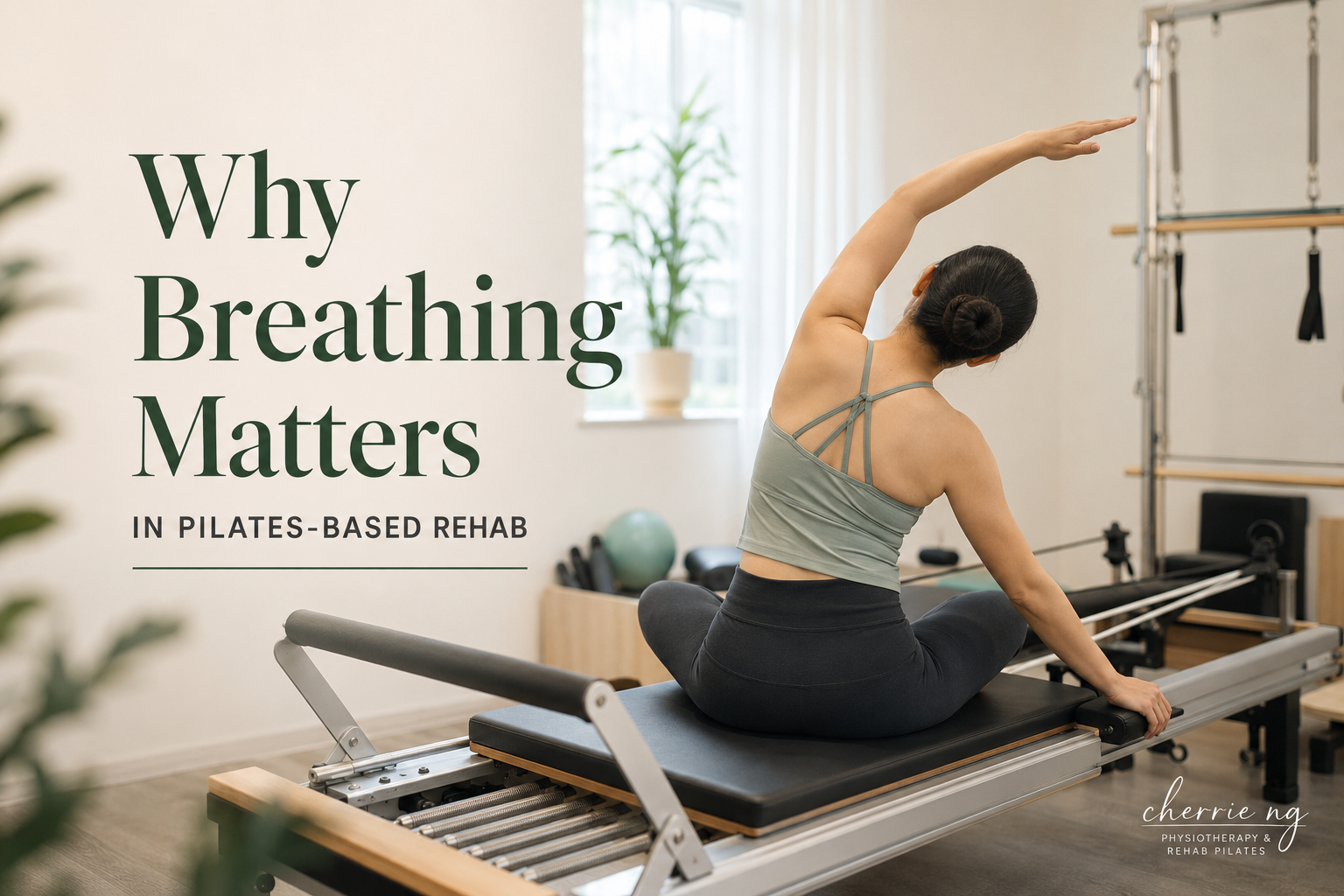
Breathing matters in Pilates-based rehab because it happens alongside every movement. A useful breathing strategy can help you regulate effort, coordinate the ribs and trunk, and avoid unnecessary breath-holding. It is not a special technique that automatically switches on the core, corrects posture or removes pain.
In rehab Pilates, the goal is usually adaptable breathing rather than one rigid pattern. You may exhale during a challenging part of an exercise, breathe steadily through a hold, or use a different rhythm when the movement becomes faster or heavier. The best cue is the one that supports the task without causing dizziness, strain or fear.
What happens when you breathe during movement?
The diaphragm is the main muscle of breathing. When you inhale, it contracts and moves downward while the rib cage and abdomen adapt to the change in pressure. When you exhale, it relaxes upward and the abdominal muscles may contribute more, especially during forceful breathing or exercise.
The diaphragm also works with other trunk muscles during postural tasks. Research using dynamic imaging has shown that it responds when the arms or legs work against resistance, supporting the idea that breathing and trunk control are coordinated rather than separate systems.
This does not mean every breath must be large or directed into one exact area. Quiet breathing, a wider rib-cage expansion, a longer exhale or a stronger breath may each suit different tasks.
Why Pilates often coordinates breath with exercise
Pilates commonly uses breath as a timing cue. An instructor may ask you to inhale while preparing or opening a movement and exhale during the more demanding phase. This can make a sequence easier to follow and may help some people reduce excessive tension.
Coordinating breath may help you:
- Notice when effort is becoming too high
- Move the ribs, trunk and limbs with better timing
- Reduce unnecessary gripping in the jaw, neck or shoulders
- Maintain a steady rhythm during repeated exercise
- Use an exhale to support abdominal effort when appropriate
- Feel more confident during a new or sensitive movement
The cue is a guide, not a rule that determines whether an exercise is correct. If matching every breath makes you tense or confused, it may be better to keep breathing comfortably first and refine the timing later.
Is diaphragmatic breathing the same as Pilates breathing?
Not exactly. Diaphragmatic breathing focuses on allowing the diaphragm to move effectively, often with the lower ribs and abdomen expanding during inhalation. Pilates teaching may emphasise expansion around the sides and back of the ribs so the abdomen does not push forward excessively during an exercise.
These descriptions overlap, and neither should require forcing the belly flat. The ribs, abdomen and pelvic region normally respond together as pressure changes. A person should also not be told that chest movement is always wrong, because the upper ribs naturally contribute when breathing demand increases.
The useful question is not “Am I breathing into the perfect place?” It is “Can I breathe comfortably while controlling this movement at the effort it requires?”
Why exhaling on effort can be useful
Exhaling during the demanding part of a movement can make it easier to avoid accidental breath-holding. It may also provide a clear rhythm for actions such as lifting a leg, pressing a reformer carriage or rising from a bridge.
An exhale does not need to be forceful. Blowing out too hard, pulling the abdomen in aggressively or trying to empty every bit of air may create more tension than the task needs. The amount of breath should match the effort.
Breath-holding is not automatically dangerous or incorrect. People naturally use brief breath holds during heavy or sudden efforts to create trunk pressure. However, it may not be the right default for early rehab, longer holds or people with certain cardiovascular, respiratory, abdominal or pelvic health concerns. Those situations deserve individual guidance.
Can breathing exercises help back pain?
Breathing exercise may be one useful part of a broader programme, but it should not be presented as a cure. In a small randomized trial of 22 people, adding diaphragmatic breathing to core-stabilisation exercise changed some measured outcomes in people with chronic low-back pain. The sample was small, and most outcomes did not show a clear difference between groups, so the result should be interpreted cautiously.
For someone with back pain, breathing practice may help reduce excessive bracing, improve awareness or make an exercise easier to coordinate. Other people may need more emphasis on general strength, mobility, walking, sleep, load management or confidence with movement.
What a rehab Pilates assessment may look at
Cherrie may ask whether you become breathless, hold your breath, feel dizzy, tense your neck or experience pain or pressure during exercise. She may also consider injury history, medical conditions, current activity and what you want to return to.
Assessment may look at:
- Whether breathing feels comfortable at rest and during movement
- Rib-cage and abdominal movement without demanding a perfect pattern
- How breathing changes as resistance or balance demands increase
- Trunk, hip and shoulder coordination
- Symptoms such as pain, wheezing, dizziness or pelvic pressure
- Whether a simpler position, smaller range or lighter resistance helps
- Recovery during and after an exercise set
Breathing observations are only one part of assessment. They should be interpreted alongside strength, mobility, symptoms and functional goals.
How breathing can progress in rehab Pilates
Early practice may begin in a supported sitting or lying position. You might notice a quiet inhale, allow the lower ribs to widen and use a relaxed exhale without pushing or gripping.
The next step is to keep breathing while movement becomes more demanding. Progressions may include:
- Moving one arm or leg while maintaining an easy rhythm
- Exhaling during a press, bridge or controlled curl
- Breathing steadily through an isometric hold
- Adding reformer resistance without neck or jaw tension
- Coordinating breath during squats, hinges or loaded carries
- Recovering your breathing between faster or sport-related tasks
The final goal is not to think about every breath forever. It is to develop enough control that breathing can adapt naturally when the task, speed and load change.
When breathing cues should be changed
A cue needs adjustment if it repeatedly causes dizziness, tingling, panic, breathlessness, pain, bearing down, pelvic heaviness or excessive tension. Slowing the exercise, returning to normal breathing or reducing the load may help.
People with known heart or lung conditions, recent chest or abdominal surgery, pregnancy-related concerns, or pelvic-floor symptoms may need advice from an appropriate healthcare professional before using forceful breathing or breath-holding strategies.
Seek urgent medical care for new or severe shortness of breath at rest, chest pain, fainting, blue or grey lips, confusion, coughing blood, or breathing difficulty that is rapidly worsening. These symptoms should not be treated as a Pilates technique problem.
Related reading
- Postnatal Pilates in KL: How to Restart Safely After Birth
- Deep Core vs Six-Pack Abs: Why Rehab Pilates Focuses on Control
- What Is Rehab Pilates and How Is It Different from Regular Pilates?
- Beginner Pilates After Injury: How to Start Safely with Rehab-Focused Guidance
Frequently asked questions
Should I inhale through my nose and exhale through my mouth?
That is a common Pilates cue and can be useful, but it is not compulsory for every exercise. Comfort, exercise intensity, nasal congestion and individual health all affect the most practical breathing route.
Should I exhale every time I lift or push?
Exhaling on effort is a helpful starting cue, especially in early rehab. More demanding exercise may use different breathing strategies, so the pattern should match the task and the person.
Why do I feel dizzy when practising deep breathing?
You may be breathing more quickly or deeply than needed. Stop, return to normal breathing and sit or lie safely. Seek assessment if dizziness is severe, recurrent, unexplained or accompanied by chest pain, fainting or unusual breathlessness.
If you are in Kuala Lumpur or Selangor and find yourself holding your breath, straining or feeling uncomfortable during exercise, you can WhatsApp Cherrie to ask whether a physiotherapy or rehab Pilates assessment may be suitable.
Foundational clinical sources and further reading
These authoritative sources provide general background relevant to this topic; they are not claim-by-claim citations. This content is educational and does not replace individual assessment, diagnosis or emergency medical care.
- What is physiotherapy? — World Physiotherapy
- WHO guidelines on physical activity and sedentary behaviour — World Health Organization