Post-Surgery
Knee Replacement Physiotherapy in KL: Mobility, Strength and Confidence
A practical guide to knee replacement physiotherapy in KL, from early walking and knee movement to strength, stairs and home recovery.
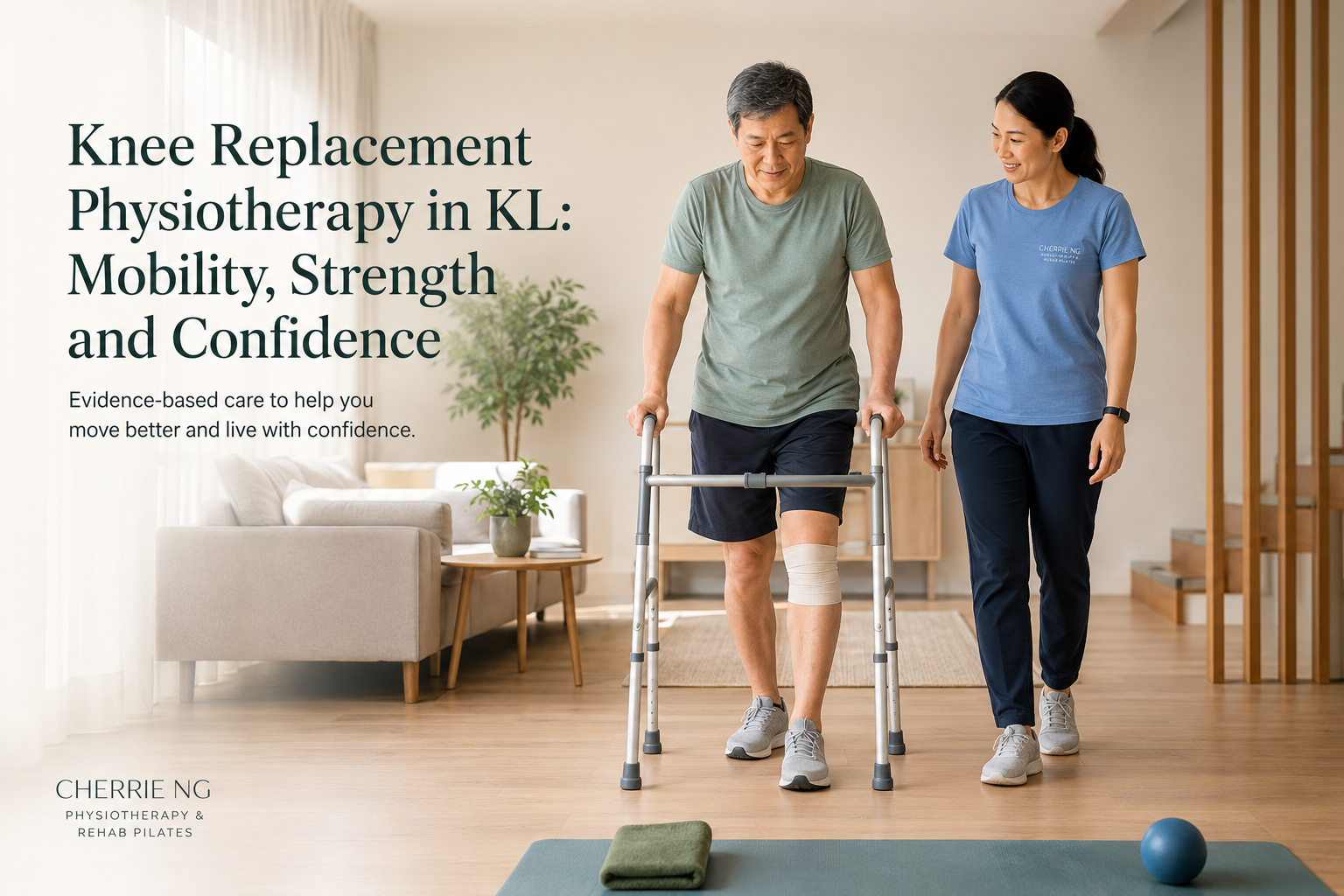
Knee replacement physiotherapy usually starts in hospital and continues through a home programme, outpatient rehabilitation or supervised home visits. Early priorities are safe transfers and walking, controlling the exercise dose, restoring useful knee movement and reconnecting the thigh muscles. Later rehabilitation builds strength, balance, stairs, endurance and confidence for daily life.
There is no single exercise list or recovery deadline for everyone. A partial or total knee replacement, the surgeon’s instructions, wound status, pain and swelling, previous mobility, other health conditions, home layout and personal goals all shape the plan. This article provides general education and does not replace your surgical team’s protocol.
When does physiotherapy begin after knee replacement?
For an uncomplicated primary joint replacement, rehabilitation normally begins very early. The NICE joint-replacement guideline recommends that physiotherapy or occupational therapy be offered on the day of surgery when possible and no later than 24 hours afterward. It should include advice for daily activities, a home exercise programme and mobilisation after knee replacement.
The updated 2026 clinical practice guideline for physical therapist management after total knee arthroplasty likewise recommends starting physical therapy, including early mobilisation, within 24 hours in the hospital pathway.
This does not mean every patient should do the same amount. In hospital, “physiotherapy” may begin with:
- Getting in and out of bed or a chair safely
- Standing with the correct walking aid
- Walking a short, supervised distance
- Following the surgeon’s weight-bearing instructions
- Practising stairs if needed for discharge
- Beginning the specific knee and circulation exercises taught by the hospital team
- Learning how to manage essential daily activities at home
If the operation was complex or there are medical complications, the hospital team may change this sequence.
The AAOS total knee replacement exercise guide similarly presents early movement and walking as a supervised programme chosen with the orthopaedic surgeon and physical therapist, rather than a generic routine to copy without clearance.
What are the main goals of knee replacement rehab?
1. Safe mobility
At first, a walking frame or crutches can provide support while you learn how much weight to place through the operated leg. The NHS knee-replacement recovery guide notes that hospital nurses and physiotherapists help people start walking soon after the operation and that a walking frame or crutches are commonly needed initially.
The goal is not to stop using the aid as quickly as possible. It is to walk safely and with enough control. Progression to fewer aids should consider the surgeon’s instructions, balance, confidence, leg control, pain, fatigue and whether walking becomes more uneven without support.
2. Useful knee movement
Early rehabilitation often includes active, assisted and comfortable knee-bending and straightening work. The 2026 clinical practice guideline recommends including passive, active-assisted and active range-of-motion exercises to support functional recovery after total knee arthroplasty. 2026 TKA rehabilitation guideline
Range should not become a daily contest or be forced against severe guarding. A physiotherapist can look at how the knee responds during the session and later that day, then adjust position, frequency, effort and recovery strategies. Function matters alongside the number on a measuring tool.
3. Thigh and whole-leg strength
The quadriceps may be difficult to recruit immediately after surgery, but rehabilitation eventually needs more than squeezing the thigh in bed. The current guideline strongly recommends progressive strengthening in the early post-acute period, using appropriate progression criteria so exercise does not create excessive swelling, pain or prolonged soreness. 2026 TKA rehabilitation guideline
Depending on the stage, strength work may progress from supported muscle activation and sit-to-stand practice towards step-ups, squats to a chair, calf work, hip strengthening and increasingly demanding functional tasks. The exact exercise, resistance and timing should come from assessment rather than a generic calendar.
4. Balance, walking and everyday function
Knee movement alone does not show whether someone can get out of a chair, walk outdoors or manage stairs. The 2026 guideline strongly recommends motor-function training, which may include balance, gait retraining, movement feedback, sit-to-stand tasks and stair negotiation. 2026 TKA rehabilitation guideline
Useful goals can include reaching the bathroom safely, moving around the kitchen, entering a car, managing the front step, shopping, returning to work or walking in the community. Rehabilitation should connect clinic exercises to these real tasks.
What might a physiotherapy assessment in KL look at?
After hospital discharge and medical clearance, Cherrie may review:
- The discharge summary and operation date
- Whether the replacement was partial or total
- Weight-bearing, movement and wound-related instructions
- Pain, swelling and changes since discharge
- Knee bending and straightening within allowed limits
- Thigh activation and leg strength
- Bed mobility, transfers, walking and stair safety
- Walking-frame, crutch or stick height and technique
- Balance, fatigue and confidence
- The layout of your home and help available from family
- Goals such as independent self-care, work, driving or community walking
This helps decide whether the session should prioritise basic safety, knee movement, strength, walking quality, stairs, pacing or referral back to the surgical team.
Cherrie’s community physiotherapy does not replace acute hospital rehabilitation, surgeon follow-up, wound care or emergency assessment. She should work within the written surgical plan and seek clarification when restrictions or symptoms are unclear.
Can home physiotherapy help after knee replacement?
A home visit may be practical when transport is difficult, stairs or building access are part of the problem, or the person is not yet confident leaving home. It also allows assessment of the actual chair, bed, bathroom route, floor surfaces and steps used each day.
Home physiotherapy is not automatically the best setting for everyone. The 2026 guideline recommends supervised physiotherapist management and says the setting should be chosen around safety, mobility, environmental and personal factors. It also notes that outpatient care may be appropriate when possible, although the evidence comparing settings is less certain. 2026 TKA rehabilitation guideline
Before arranging a visit in Kuala Lumpur or Selangor, share the surgery date, current walking aid, suburb, building access, surgeon’s protocol and whether a caregiver will be present.
How hard should the exercises feel?
The NHS knee-replacement recovery guide notes that the knee will be sore after the operation and includes swelling-management advice. This does not mean more pain is automatically more progress; the exercise dose should leave you able to continue essential movement and the next planned session.
The 2026 guideline cautions that overly aggressive progression without appropriate criteria can worsen pain and swelling. It recommends basing physical-activity progression on safety, functional tolerance, physiological response and shared goals. 2026 TKA rehabilitation guideline
Tell your physiotherapist if:
- Pain rises sharply rather than feeling like manageable effort
- Swelling keeps increasing after the programme
- Soreness does not settle before the next planned session
- Walking quality becomes worse as exercises progress
- You feel faint, unusually breathless or unwell
- You are avoiding sleep, meals or necessary activity because of the programme
Do not compare your knee angle, walking-aid timeline or exercise resistance with someone else’s. Recovery should be adjusted to your response and the surgical team’s expectations.
What about machines, massage and scar work?
Exercise and functional practice are central parts of rehabilitation. The 2026 guideline strongly advises against routine continuous passive motion machines after an uncomplicated primary total knee replacement because they do not add enough benefit to standard care. 2026 TKA rehabilitation guideline
Hands-on techniques may sometimes be used alongside active exercise, but they should not replace walking, movement practice and progressive strength. As a scope and safety boundary, Cherrie would not provide scar work over an unhealed wound or without appropriate surgical clearance; a draining or increasingly red wound should be reported to the surgical team.
When should you contact the surgical team urgently?
After a recent knee replacement, seek urgent medical advice for throbbing or cramping leg pain, fever or chills, pus or oozing from the wound, or knee redness, tenderness, swelling or pain that is worsening rather than improving. These may be signs of infection or a blood clot. NHS knee-replacement complications guidance
If leg pain or swelling occurs with difficulty breathing or chest pain, seek emergency care because this may indicate a blood clot in the lungs. NHS knee-replacement complications guidance
Follow the urgent-contact directions in your own discharge instructions for any other unexpected change, including a fall onto the operated leg, a wound that opens, unexpected bleeding or sudden loss of function.
Frequently asked questions
How long does physiotherapy take after knee replacement?
There is no fixed duration for everyone. Hospital discharge, independent walking and return to higher-demand activities happen at different stages. Your surgeon and physiotherapist should use function, symptoms, strength, movement, safety and goals to guide progression.
Should I force my knee to bend?
Rehabilitation normally includes working on knee bend, but severe force is not the same as effective training. The movement strategy and dose should be adjusted if it causes excessive pain, swelling, guarding or loss of function afterward.
When can I stop using the walker or crutches?
Do so when the surgical team or physiotherapist agrees that your weight-bearing status, balance, leg control and walking safety are ready. Removing the aid early is not useful if it creates a marked limp or fall risk.
Can I do rehab Pilates after knee replacement?
Pilates-informed exercises may be considered later as part of strength, balance and whole-body conditioning. They must be adapted to the knee, surgical restrictions and transfer ability; a general group class is not a substitute for early procedure-specific rehabilitation.
Related reading
- Walking Confidence for Older Adults: How Physiotherapy Can Help
- Elderly Home Physiotherapy in KL: Balance, Walking and Daily Confidence
- Post-Surgery Physiotherapy: When Should You Start Rehab?
- Knee Strengthening Exercises: What to Start With Safely
- Home Physiotherapy in Kuala Lumpur: What to Expect
- What Happens During Your First Physiotherapy Session?
If you or a family member has returned home after knee replacement in Kuala Lumpur or Selangor, you can WhatsApp Cherrie with the surgery date, current walking ability, location and written restrictions. She can help determine whether community or home physiotherapy is appropriate within the surgeon’s plan and her service scope.
Sources and clinical references
- NICE NG157: Joint Replacement—Postoperative Rehabilitation Recommendations
- Physical Therapy: Clinical Practice Guideline for Physical Therapist Management of Total Knee Arthroplasty—Revision 2026
- NHS: Recovering from a Knee Replacement
- AAOS OrthoInfo: Total Knee Replacement Exercise Guide
- NHS: Complications of a Knee Replacement
Foundational clinical sources and further reading
These authoritative sources provide general background relevant to this topic; they are not claim-by-claim citations. This content is educational and does not replace individual assessment, diagnosis or emergency medical care.
- What is physiotherapy? — World Physiotherapy