Elderly Care
Walking Confidence for Older Adults: How Physiotherapy Can Help
Learn why older adults may lose walking confidence, what physiotherapy assesses and how safe, graded practice can support everyday mobility.
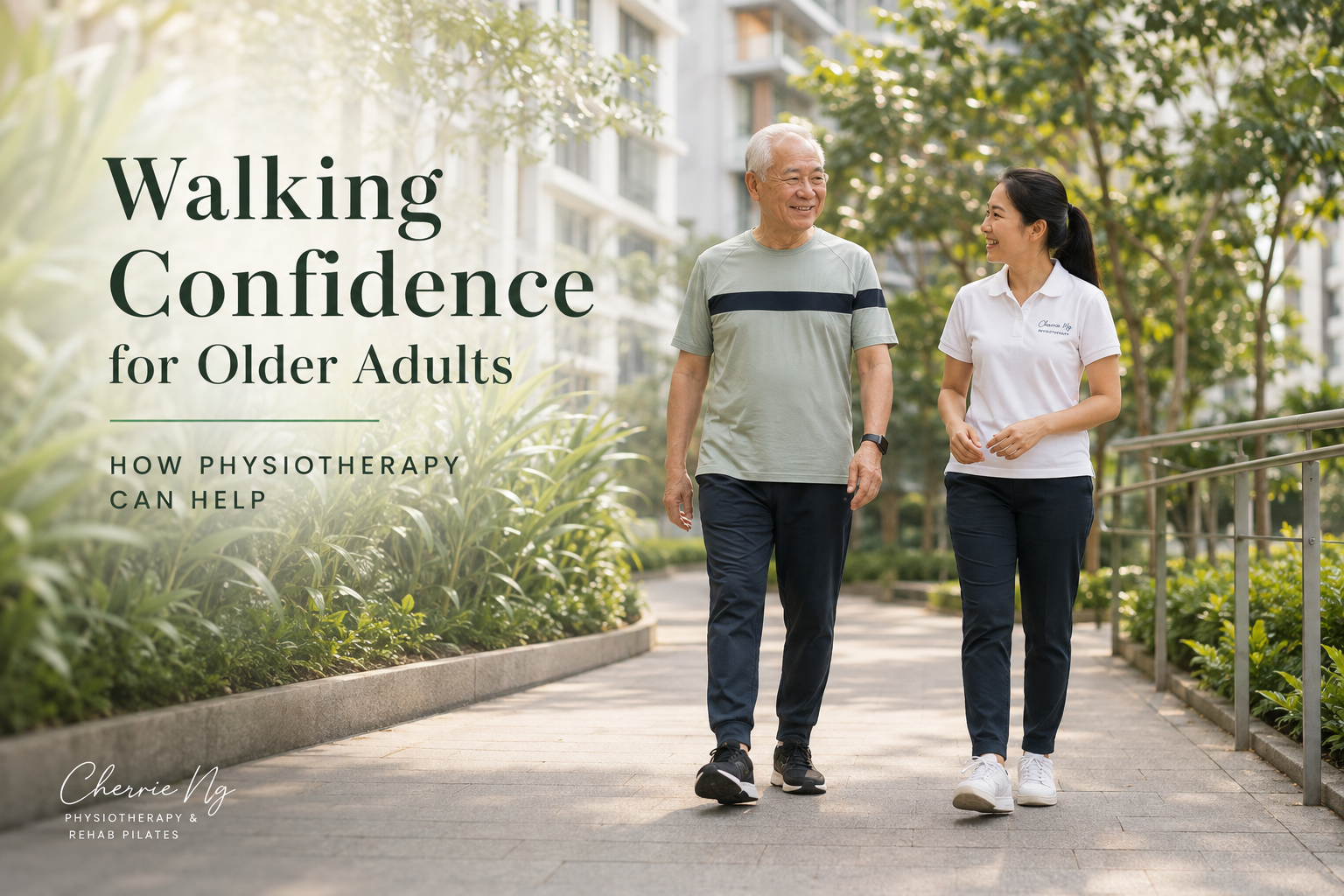
Physiotherapy may help an older adult rebuild walking confidence by first clarifying why walking feels unsafe, then practising the specific tasks that matter with an appropriate level of support. The plan may include gait practice, balance and strength work, walking-aid review, environmental changes and gradual exposure to more demanding routes. The World Falls Guidelines recommend exercise and, where appropriate, multidisciplinary interventions for concerns about falling.
Confidence should not be forced. Feeling braver is not the same as being physically ready. The goal is to build confidence that is matched by safer movement capacity.
Why can walking confidence decrease?
Walking may feel less secure after:
- A fall or near-fall
- Hospitalisation, surgery or a period of reduced activity
- New pain, stiffness or leg weakness
- Dizziness, faintness or a change in vision
- Difficulty turning, stepping over thresholds or using stairs
- Starting to use a cane, crutches or walker
- Moving to an unfamiliar home or community environment
- Repeated warnings from others to “be careful”
Sometimes the concern is proportionate to a real change in balance or health. Sometimes it remains strong after physical ability has improved. A 2023 Cochrane review of cognitive-behavioural interventions describes fear of falling as a lasting concern that can lead someone to avoid activities they remain capable of doing, and notes that it can occur even without a previous fall.
Avoidance should not simply be labelled as stubbornness. It is useful information about which tasks feel threatening and where assessment or a smaller first step may be needed.
Confidence and walking safety are related—but not identical
Two people can walk in a similar way and feel very different about it. One may underestimate risk and rush; another may have enough physical ability but avoid leaving the bedroom.
This is why a physiotherapist should consider both sides:
| Physical walking factors | Confidence and context factors |
|---|---|
| Balance, strength and endurance | Worry about falling or injury |
| Foot clearance, step length and turning | Places or situations being avoided |
| Pain, dizziness or fatigue | Previous fall experience |
| Footwear and walking-aid use | Family responses and available support |
| Floor, lighting and obstacles | Personal goals and acceptable risk |
The World Falls Guidelines recommend evaluating concerns about falling together with gait and balance so that the level of concern can be understood in context.
What may a physiotherapy assessment include?
An assessment may begin with the story rather than a test: where the person walks, what changed, whether falls or near-falls occurred, which routes are avoided and what they want to return to.
Depending on the situation, Cherrie may then observe:
- Rising from a chair and settling before the first step
- Walking speed, rhythm, foot clearance and direction changes
- Starting, stopping, turning and approaching a chair
- Balance and the ability to shift weight before stepping
- Leg strength and control during functional tasks
- Symptoms such as pain, dizziness, breathlessness or unusual fatigue
- The height, condition and use of any walking aid
- Footwear, floor surfaces, lighting and obstacles
- How much assistance a family member currently provides
The World Falls Guidelines list gait, balance, muscle strength, walking-aid suitability, footwear and concerns about falling among relevant assessment domains. They also recommend gait-speed assessment for falls-risk stratification while recognising that a broader assessment is needed. World Falls Guidelines
No single score decides whether a person is “safe”. Test findings have to be considered alongside symptoms, judgement, environment and goals.
How can physiotherapy rebuild walking confidence?
1. Start with a route that is manageable
The first practice route might be from the chair to the doorway rather than around the whole block. A clear, well-lit, predictable path allows attention to be placed on the walking task.
2. Practise the difficult part—not only distance
Confidence often breaks down at a particular moment: standing up, taking the first step, turning, passing through a doorway, changing surface or sitting down. Practising that component may be more useful than simply adding more minutes of walking.
3. Build balance and strength alongside walking
Walking practice may be combined with sit-to-stand, controlled stepping, weight transfer and progressive leg-strength tasks. Exercise programmes centred on balance and functional tasks reduce falls, while walking-only programmes have less certain fall-prevention evidence. Cochrane review of exercise for preventing falls
For more detail, see why strength also matters in elderly balance training.
4. Progress one demand at a time
A route can become harder through distance, duration, turns, speed, surface, distractions or reduced support. Changing one main demand at a time makes the response easier to judge.
A practical progression might move from bedroom to hallway, then to the building corridor, garden path and a familiar nearby destination. This is an example, not a fixed protocol; the starting point and pace should match the person.
5. Review the walking aid
A cane or walker is not automatically a setback. If an aid is needed, the relevant questions are whether it suits the person’s physical and cognitive needs, is in good condition, is adjusted appropriately and is used consistently during real tasks. The World Falls Guidelines recommend checking both walking-aid suitability and proper use. World Falls Guidelines
Do not remove an aid just to make an exercise look more advanced. Less equipment is only progress when walking remains appropriately controlled and safe.
6. Give feedback that is specific
“You are fine” may not feel convincing after a fall. More useful feedback identifies what happened: the turn was controlled, the feet cleared the threshold, or a rest was taken before technique deteriorated. The person should remain involved in choosing meaningful goals and an acceptable level of challenge.
Does exercise reduce fear of falling?
Exercise may help, but the effect is not guaranteed or necessarily long-lasting. A Cochrane review of exercise and fear of falling found low-quality evidence of a small-to-moderate improvement immediately after exercise programmes, with uncertainty about whether the change continued after the programmes ended.
If concern remains limiting despite appropriate strength and balance work, more exercise is not the only option. NICE guideline NG249 advises considering cognitive-behavioural interventions when concerns about falling have not been helped by strength and balance exercise. A newer Cochrane review found that cognitive behavioural therapy, with or without exercise, probably reduces fear of falling after treatment, although evidence limitations remain. Cochrane CBT review
This may require coordination with a doctor, psychologist, occupational therapist or other professional rather than expecting physiotherapy alone to address every factor.
How can family members help?
Family support is most useful when it preserves choice and uses a shared plan. Helpful actions may include:
- Keeping the agreed practice route clear and well lit
- Placing the walking aid within reach
- Allowing enough time rather than rushing
- Using the cue agreed with the physiotherapist
- Recording falls, near-falls or symptoms accurately
- Encouraging the planned amount without forcing extra distance
Do not pull on the person’s arm or clothing, provide hands-on guarding without instruction, or replace every walking task when the person can safely participate. If physical help is required, ask the physiotherapist to teach the specific assistance method.
When should medical assessment come first?
Seek medical assessment before progressing walking practice when unsteadiness is new or rapidly worsening, follows a fall with injury, occurs with unexplained dizziness or loss of consciousness, or is accompanied by a significant new change in mobility. The World Falls Guidelines recommend detailed assessment for recurrent falls, severe falls, suspected loss of consciousness and other high-risk situations. World Falls Guidelines
Sudden facial droop, one-sided weakness or numbness, or new slurred or confused speech may be signs of stroke and require emergency help immediately, even if they improve. NHS stroke guidance In Malaysia, call 999; current Ministry of Health Malaysia trauma guidance identifies MERS 999 as the emergency call route.
Frequently asked questions
How long does it take to regain walking confidence?
There is no reliable fixed timeline. The reason for the difficulty, recent health events, current mobility, practice opportunities and personal goals all change the pace. Progress may first appear as needing less help or attempting a previously avoided route—not simply walking faster.
Should an older adult walk every day?
A therapeutic walking schedule must match symptoms, recovery and safety. Someone with recent falls, unexplained symptoms or hands-on assistance needs should be assessed before following a generic daily target.
Will using a walker make someone dependent?
Not automatically. An appropriate aid may support safer participation, while the wrong height, damaged equipment or inconsistent technique can create problems. Whether and how to reduce the aid should be based on reassessment, not pressure. World Falls Guidelines
Can rehab Pilates improve walking confidence?
A physiotherapist may use Pilates-informed exercises to practise strength, control or mobility within a broader plan. Confidence in walking still needs relevant standing, stepping and walking practice in settings that reflect the person’s goals.
Related reading
- Elderly Physiotherapy After Hospital Discharge: A Home Recovery Checklist
- Elderly Home Physiotherapy in KL: Balance, Walking and Daily Confidence
- Balance Training for Elderly Adults: Why Strength Also Matters
- Knee Replacement Physiotherapy in KL: Mobility, Strength and Confidence
If an older family member in Kuala Lumpur or selected Selangor areas is avoiding walking or needs more help than before, you can WhatsApp Cherrie with the main concern, recent falls or health events, current walking aid, assistance required and home location. She can advise whether physiotherapy or a home assessment may be appropriate within her service scope.
Sources and clinical references
- World Guidelines for Falls Prevention and Management for Older Adults
- Cochrane: Exercise for Preventing Falls in Older People Living in the Community
- Cochrane: Exercise for Reducing Fear of Falling in Older People Living in the Community
- NICE NG249: Falls—Assessment and Prevention
- Cochrane: Cognitive Behavioural Interventions for Reducing Fear of Falling
- NHS: Symptoms of a Stroke
- Ministry of Health Malaysia: Management of Abdominal Trauma in Adults
Foundational clinical sources and further reading
These authoritative sources provide general background relevant to this topic; they are not claim-by-claim citations. This content is educational and does not replace individual assessment, diagnosis or emergency medical care.
- What is physiotherapy? — World Physiotherapy