Elderly Care
Balance Training for Elderly Adults: Why Strength Also Matters
Learn how balance and leg strength work together, what elderly balance training may include and when an assessment should come first.
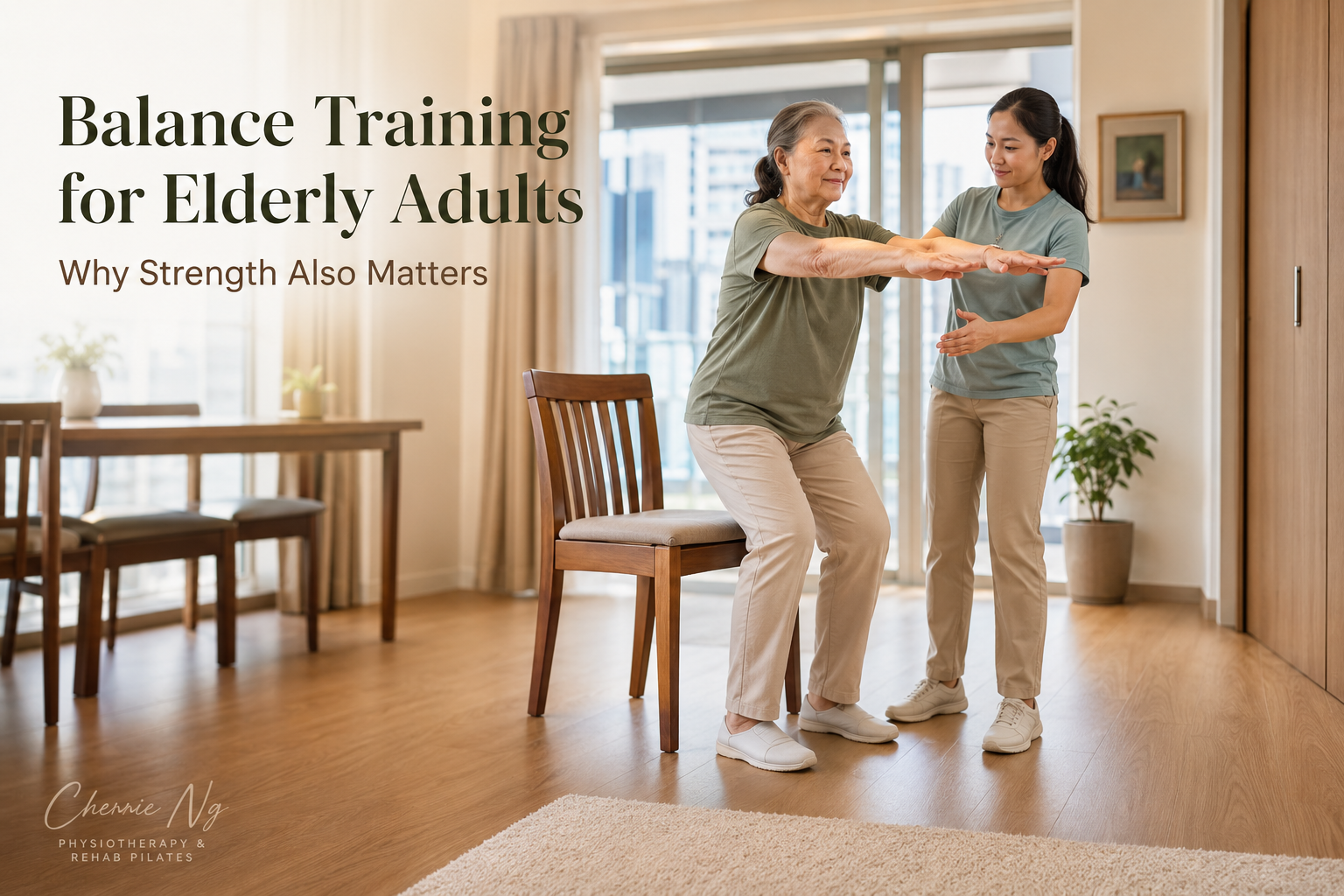
Good balance is not just the ability to stand still. Older adults also need enough leg strength and control to rise from a chair, move their weight, take a timely step, turn and slow the body safely. That is why useful balance training often combines balance-challenging tasks, functional movement and progressive strength work rather than treating them as separate goals.
Strength still is not the whole answer. A person can become stronger without practising the stepping, turning and postural control needed in daily life. The safest programme matches the individual’s health, falls history, current ability and environment.
What counts as balance training?
Balance training deliberately changes the demands of a task while keeping the risk controlled. Depending on the person, it may involve:
- Holding a stable position with an appropriate hand support
- Shifting weight from one leg towards the other
- Stepping forwards, sideways or around an obstacle
- Turning, stopping and changing direction
- Reaching while keeping the feet controlled
- Standing up, sitting down and transferring between surfaces
- Walking while responding to a simple instruction or environmental change
The aim is not to make someone wobble as much as possible. It is to select a challenge that remains recoverable, then progress it as control improves. Current NICE falls guidance recommends progressive programmes tailored to a person’s needs, preferences, goals and abilities, focusing on relevant components such as balance, coordination, strength and power.
Why does leg strength matter for balance?
Daily balance tasks require the legs to support and move the body. For example, standing from a chair asks the hips and knees to produce force; lowering back down asks them to control the movement. Stepping and changing direction also require the person to accept weight on one leg before moving the other.
Strength training can therefore support the physical capacity needed for functional balance practice. The WHO physical-activity guideline for older adults recommends varied multicomponent activity that emphasises both functional balance and strength, rather than presenting either one as a complete programme by itself.
This distinction matters:
| Strength-focused task | Balance or functional task |
|---|---|
| Controlled sit-to-stand repetitions | Standing, settling and turning after the chair rise |
| Supported heel raises | Shifting weight and stepping in different directions |
| Hip or knee resistance exercise | Walking, stopping and navigating a doorway |
| Controlled step-up for a suitable person | Responding to a change in surface or direction |
The same exercise may train more than one quality. A sit-to-stand can challenge strength, balance and coordination when it is selected and performed appropriately.
Is strength training alone enough to prevent falls?
Not based on the current evidence. A large Cochrane review of community-dwelling older adults found the clearest fall-reduction evidence for balance and functional exercise. Programmes combining multiple exercise types—most commonly balance and functional work plus resistance exercise—probably reduced falls, while the effect of programmes classified mainly as resistance training remained uncertain.
This does not mean strength work is unimportant. It means that a fall-prevention plan should normally practise the actual functions a person needs, not only isolated muscle work.
What might a physiotherapy balance assessment look at?
A balance assessment is broader than asking someone to stand on one leg. Depending on the concern, a physiotherapist may observe:
- Falls, near-falls, dizziness and situations that feel unsafe
- How the person rises from a chair and controls sitting down
- Standing balance with different foot positions
- Weight transfer, stepping and turning
- Walking speed, direction changes and obstacle negotiation
- Lower-limb strength and movement control
- Footwear and the fit and use of a walking aid
- Confidence, fear of falling and activities the person has stopped
- Vision, medication or medical issues that may need referral
The World Falls Guidelines recommend assessing gait, balance, muscle strength, walking aids, footwear and concerns about falling as relevant parts of a broader falls-risk assessment. No single balance test explains every fall risk.
How can balance and strength be trained together?
An individual programme may pair a strength task with a related functional task:
Sit-to-stand plus settling balance
Rise from a stable chair using the appropriate amount of hand support. After standing, pause until steady before turning or walking. The chair height, hand support and number of controlled repetitions can be adjusted separately.
Supported heel raises plus stepping
Heel raises can build lower-leg strength, while supported forward or sideways steps practise moving the body over a changing base of support. One should not automatically replace the other.
Side-leg strength plus sideways walking
A supported leg movement may target strength. Sideways stepping along a fixed counter then adds weight transfer, timing and foot placement.
Controlled step work plus direction changes
For someone assessed as ready, an appropriate step task may build leg capacity. Turning and direction-change practice is added separately because real movement is not always straight ahead.
For step-by-step examples and safer starting versions, read fall-prevention exercises for elderly adults.
How should the challenge progress?
Progress one element at a time where possible:
- Use a little less hand support
- Narrow the foot position
- Reach slightly farther within control
- Add a direction change
- Increase the controlled range or repetitions of a strength task
- Move from a predictable task to a simple response task
- Practise a function that matters at home, such as turning near a chair
The World Falls Guidelines recommend individualised, progressively challenging balance and functional exercise for community-dwelling older adults, with sit-to-stand and stepping given as examples. Challenge should be increased without turning practice into a near-fall.
Closing the eyes, standing on a cushion or removing all hand support is not automatically a useful progression. The best next step is the one that is relevant, measurable and safe for that person.
How often should older adults train balance and strength?
As public-health guidance, WHO recommends multicomponent activity emphasising functional balance and strength on three or more days per week, beginning with small amounts and progressing according to ability. WHO recommendations for older adults
A therapeutic programme may use a different schedule because medical conditions, fatigue, pain, recovery and supervision needs vary. Frequency should not be copied without considering the person’s current capacity and the difficulty of the exercises.
When should assessment come before home practice?
Arrange a medical and/or physiotherapy assessment before unsupervised standing exercise if the person has recurrent falls, a recent fall with injury, unexplained dizziness or loss of consciousness, new difficulty walking, rapidly declining mobility, or needs hands-on help to avoid falling. The World Falls Guidelines recommend more detailed assessment for older adults at high risk and targeted exercise or physiotherapy referral when gait or balance problems are present.
Sudden facial droop, one-sided weakness or numbness, or new slurred or confused speech may indicate stroke and requires emergency help immediately, even if the symptoms improve. NHS stroke guidance In Malaysia, call 999 for emergency assistance; current Ministry of Health Malaysia trauma guidance identifies MERS 999 as the route to the emergency medical coordinating centre.
Balance problems can involve more than exercise capacity. Medication, blood pressure, vision, neurological conditions, pain, footwear and home hazards may also need attention as part of a broader assessment. World Falls Guidelines
Frequently asked questions
Is walking a balance exercise?
Walking uses balance, but ordinary walking may not sufficiently challenge controlled stepping, turning or recovery. It can be one part of a programme rather than the only balance exercise; Cochrane found insufficient evidence for walking-only programmes to reduce falls. Cochrane review
Should an older adult use weights?
Weights or resistance bands may be suitable when technique, medical status and setup allow. Resistance is not compulsory at the start: chair height, hand support, movement range and repetitions can also change the strength demand.
Are seated exercises useful for balance?
Seated exercise may be used as a starting point when standing work is not yet appropriate. A goal of improving standing balance will usually need appropriately supported standing and functional practice when safe.
Can rehab Pilates support balance training?
For selected older adults, a physiotherapist may use Pilates-informed exercises within a broader movement plan. The choices should be adapted to transfers, equipment access and falls risk, and should not replace relevant standing, stepping and walking practice.
Related reading
- Walking Confidence for Older Adults: How Physiotherapy Can Help
- Fall Prevention Exercises for Elderly Adults: What to Practise Safely
- Elderly Home Physiotherapy in KL: Balance, Walking and Daily Confidence
If an older family member in Kuala Lumpur or selected Selangor areas is becoming less steady, Cherrie can be contacted by WhatsApp with their falls history, walking aid, main mobility concern, medical restrictions and home location. She can advise whether physiotherapy or a home assessment may be appropriate within her service scope.
Sources and clinical references
- NICE NG249: Falls—Assessment and Prevention
- WHO Guidelines on Physical Activity and Sedentary Behaviour
- Cochrane: Exercise for Preventing Falls in Older People Living in the Community
- World Guidelines for Falls Prevention and Management for Older Adults
- NHS: Symptoms of a Stroke
- Ministry of Health Malaysia: Management of Abdominal Trauma in Adults
Foundational clinical sources and further reading
These authoritative sources provide general background relevant to this topic; they are not claim-by-claim citations. This content is educational and does not replace individual assessment, diagnosis or emergency medical care.
- What is physiotherapy? — World Physiotherapy