Elderly Care
Fall Prevention Exercises for Elderly Adults: What to Practise Safely
Learn which balance, strength and functional exercises may help reduce falls, how to practise safely and when older adults need assessment first.
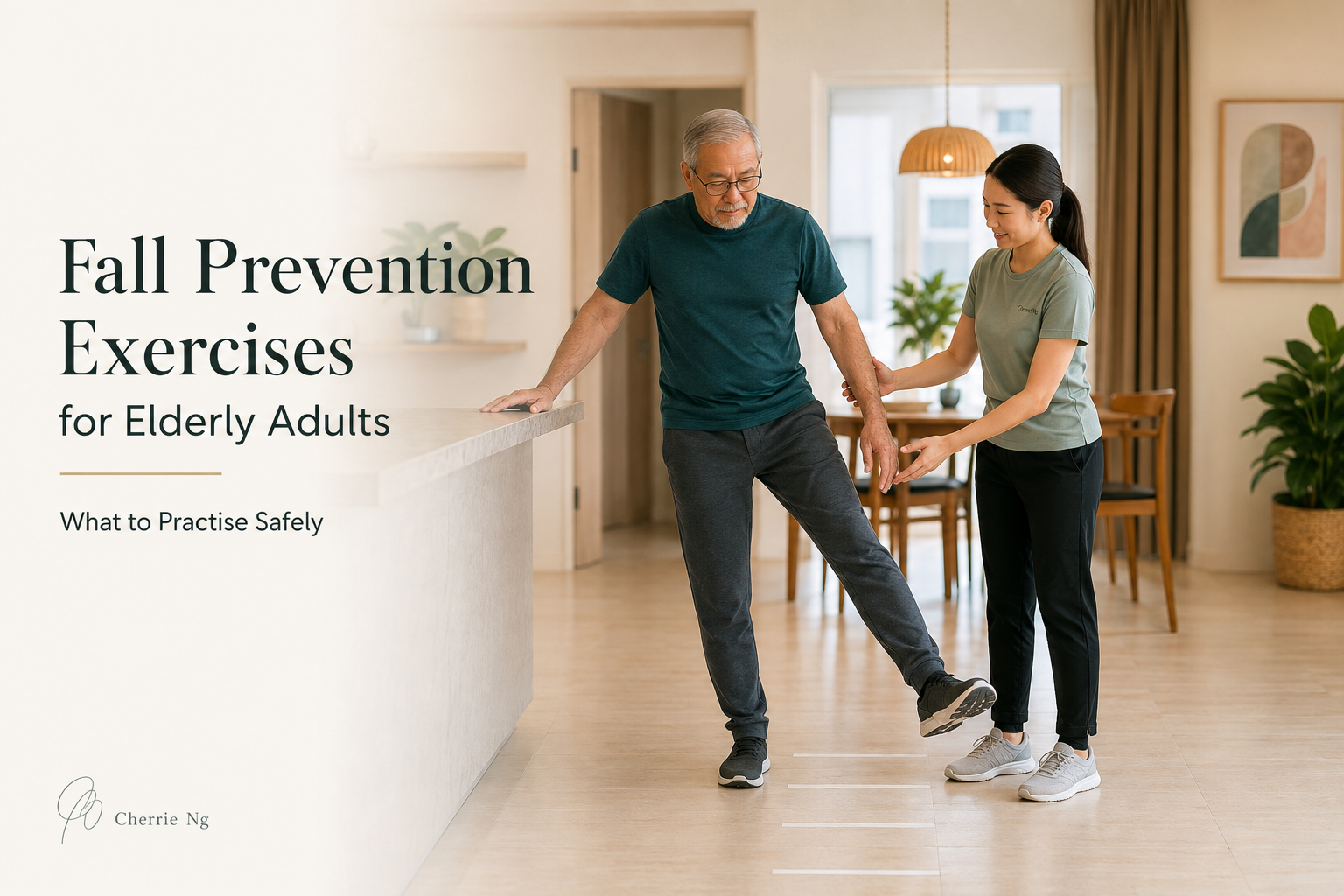
Fall-prevention exercise for older adults should usually combine balance and functional practice, often with progressive leg-strength work. The safest programme is matched to the person’s ability, health, falls history and home environment—it is not a single exercise copied from a video, and it cannot guarantee that a fall will never happen.
The examples below are educational starting points, not a personal prescription. If someone has recently fallen, feels unsteady, has unexplained dizziness or needs another person to prevent them from falling, assessment should come before unsupervised standing exercise.
What does the evidence support?
A large Cochrane review of community-dwelling older adults found that exercise programmes reduced falls. Programmes centred on balance and functional exercise had the clearest evidence, while multicomponent programmes commonly combined these tasks with resistance exercise. The review did not find enough evidence to treat walking-only or resistance-only programmes as equivalent fall-prevention approaches.
Current NICE falls guidance says a fall-prevention exercise programme should be progressive and tailored to the person’s needs, preferences, goals and abilities. It should focus on relevant components such as balance, coordination, strength and power, and include regular review and progression.
Three principles follow:
- Specific: practise the skills that are difficult, such as standing, turning or stepping.
- Appropriately challenging: the task must ask the body to adapt without creating uncontrolled risk.
- Progressive: change the task as ability improves rather than repeating the same easy version indefinitely.
Who should be assessed before starting?
Speak to a doctor or physiotherapist before beginning a new programme if the older adult:
- Has fallen recently, especially more than once
- Feels unsteady during ordinary standing or walking
- Has unexplained dizziness, fainting or sudden changes in mobility
- Has new pain or injury after a fall
- Uses a walking aid but is unsure whether it fits or how to use it
- Has recently left hospital or has new surgical restrictions
- Has osteoporosis with known fractures or high fracture risk
- Has not exercised for a long time and has medical conditions or concerns
The NHS physical-activity guidance for older adults advises speaking to a GP first when someone has not exercised for some time or has medical conditions or concerns, and ensuring intensity matches fitness.
A fall is not always caused by weakness. Medication, vision, blood pressure, neurological conditions, footwear, cognition and home hazards may also need assessment. Exercise can be important without being the only intervention.
Set up the space before exercising
For standing exercises at home:
- Use a fixed counter, solid rail or heavy chair that cannot slide
- Clear loose rugs, cords, pets, clutter and wet areas from the floor
- Use supportive footwear that fits; avoid slippery socks
- Keep the phone or personal alarm accessible
- Make sure lighting is bright enough to see the floor and obstacles
- Place the support close enough that it can be reached without leaning
- Have appropriate supervision if the person cannot safely recover their balance
Do not use a wheeled chair, lightweight table, open door or another person as the only handhold. A family member should not provide physical guarding unless they have been shown how to do it safely.
Five exercise types that may be practised safely
Choose the version that can be controlled. Begin with a small amount, rest as needed and prioritise quality over counting. These exercises are not all suitable for everyone.
1. Supported sit-to-stand
Sit towards the front of a sturdy chair with both feet on the floor. Lean the trunk forward, stand in a controlled way, pause until steady, then lower slowly back to the chair. Use the armrests or a stable support if needed; removing hand support is a progression, not a requirement.
The CDC chair-rise guide uses this task to strengthen the thighs and buttocks and advises controlling the return to sitting rather than collapsing into the chair.
Make it easier: use a slightly higher firm seat or the armrests.
Possible progression: use less hand support, add a few controlled repetitions or use a slightly lower appropriate chair after assessment.
2. Supported weight shifts
Stand facing a fixed counter with feet comfortably apart and both hands available for support. Slowly shift weight towards one leg while keeping both feet on the floor, return to the centre, then move towards the other side.
The aim is controlled movement, not reaching as far as possible. This can prepare for tasks that require moving the body over one foot before taking a step.
Make it easier: keep both hands firmly supported and make the shift small.
Possible progression: use lighter fingertip support or reach slightly farther only when the movement remains steady.
3. Sideways stepping with support
Stand alongside a long counter or rail. Step one foot sideways, then bring the other foot towards it without crossing the legs. Continue slowly for the available safe distance, then return in the other direction.
The NHS balance-exercise guide includes controlled sideways walking and recommends practising near a wall or stable chair in case balance is lost.
Make it easier: take smaller steps and maintain hand support.
Possible progression: increase the number or size of controlled steps before reducing support.
4. Supported heel raises
Hold a fixed counter, keep the body upright and slowly lift both heels so the weight moves towards the balls of the feet. Pause briefly if steady, then lower with control. Kent Community Health includes this supported movement in its falls-focused strengthening guidance. Kent Community Health: Strengthening Exercises
This is a strength task rather than a complete balance programme. It should not replace stepping, turning and functional practice.
Make it easier: use both hands and a smaller lift.
Possible progression: add controlled repetitions or use lighter support. Single-leg versions are not an automatic next step and may require supervision.
5. Staggered stance or heel-to-toe practice
Stand beside a fixed counter. Place one foot slightly in front of the other and hold the position while looking forward. A narrow heel-to-toe position is harder, so start with the feet farther apart if needed.
The NHS includes heel-to-toe walking among home balance exercises and recommends wall support where necessary. NHS balance exercises
Make it easier: widen the feet and keep a firm hand on the counter.
Possible progression: narrow the stance, use lighter support, or add a small number of heel-to-toe steps alongside the counter.
Do not progress by closing the eyes, standing on an unstable surface or removing all support simply because it looks more advanced. The progression must be useful and safe for that person.
Is walking enough to prevent falls?
Walking supports general activity and endurance, but walking by itself may not adequately challenge balance reactions, controlled stepping or leg strength. Cochrane found insufficient evidence for walking-only programmes to reduce falls, while balance and functional programmes were effective. Cochrane review
Walking can still be part of a broader plan. Useful practice might include safe starts and stops, turning, navigating doorways, changing speed or using the correct walking aid—selected according to the person’s ability and environment.
How should exercises progress?
Change one variable at a time where possible:
- A few more controlled repetitions
- A slightly longer practice period
- A larger but controlled range
- Less hand support
- A narrower stance
- A more relevant functional task
- A new direction or carefully increased speed
Progress only if the current version can be completed without repeated loss of balance, unsafe grabbing, marked pain or symptoms that persist afterward. “Challenging” does not mean nearly falling.
NICE defines exercise progression as an individualised increase in intensity, frequency, duration or complexity based on performance over the programme. NICE NG249
When should exercise stop?
Stop the session and seek medical advice if exercise causes lightheadedness, dizziness, fainting, chest pain, uncomfortable breathing or a newly irregular heartbeat; these are stop-exercise signs listed in Cambridge University Hospitals’ home-exercise safety guidance. Do not try to train through a sudden decline.
Sudden facial droop, weakness or numbness on one side, or new slurred or confused speech can be signs of stroke and require emergency help immediately, even if they improve. NHS stroke symptoms
After a fall, call Malaysia’s emergency service at 999 if the person may have injured the head, neck, back or hip, cannot get up, loses consciousness or appears seriously unwell. Do not attempt to lift them alone when injury is possible. The injury and lifting advice follows NHS falls guidance, while current Malaysian Ministry of Health trauma guidance identifies MERS 999 as the emergency call route for injured patients.
For increasing unsteadiness, recurrent falls or fear that stops normal movement, arrange a medical and/or physiotherapy assessment. The next step may include exercise, but medication, vision, blood pressure, footwear, home safety or another health condition may also need attention.
Frequently asked questions
How often should older adults do balance exercise?
General public-health guidance recommends regular strength and balance activity, but a therapeutic fall-prevention programme should set frequency and difficulty around the person’s assessment, recovery and ability. More is not better when technique or safety deteriorates.
Should someone hold the older adult during balance exercise?
Not unless the helper knows how to guard safely. It is often better to choose an easier task with a fixed support. Someone who needs hands-on help to prevent a fall should be assessed before practising independently.
Are seated exercises enough?
Seated movement can be a useful starting point for strength or activity tolerance. However, a person who aims to improve standing balance usually needs appropriately supported standing and functional practice when medically safe.
Can rehab Pilates be used for fall prevention?
Pilates-informed exercise may contribute to strength, control and mobility for selected older adults, but it should not replace an individualised balance and functional programme. Positions, transfers and equipment must match the person’s ability.
Related reading
- Elderly Physiotherapy After Hospital Discharge: A Home Recovery Checklist
- Walking Confidence for Older Adults: How Physiotherapy Can Help
- Balance Training for Elderly Adults: Why Strength Also Matters
- Elderly Home Physiotherapy in KL: Balance, Walking and Daily Confidence
If you or an older family member in Kuala Lumpur or selected Selangor areas is unsure how to begin safely, you can WhatsApp Cherrie with the main mobility concern, falls history, walking aid, medical restrictions and home location. She can advise whether a physiotherapy or home assessment may be appropriate within her scope.
Sources and clinical references
- NICE NG249: Falls—Assessment and Prevention
- Cochrane: Exercise for Preventing Falls in Older People Living in the Community
- NHS: Physical Activity Guidelines for Older Adults
- CDC STEADI: Chair Rise Exercise
- NHS: Balance Exercises
- Kent Community Health: Strengthening Exercises
- Cambridge University Hospitals: Cardiac Rehabilitation Home Exercise Safety Guidance
- NHS: Symptoms of a Stroke
- NHS: Falls
- Ministry of Health Malaysia: Management of Abdominal Trauma in Adults
Foundational clinical sources and further reading
These authoritative sources provide general background relevant to this topic; they are not claim-by-claim citations. This content is educational and does not replace individual assessment, diagnosis or emergency medical care.
- What is physiotherapy? — World Physiotherapy