Post-Natal
Diastasis Recti Physiotherapy: What New Mothers Should Know
A practical guide to diastasis recti physiotherapy in KL, including assessment, exercise evidence and when postnatal symptoms need review.
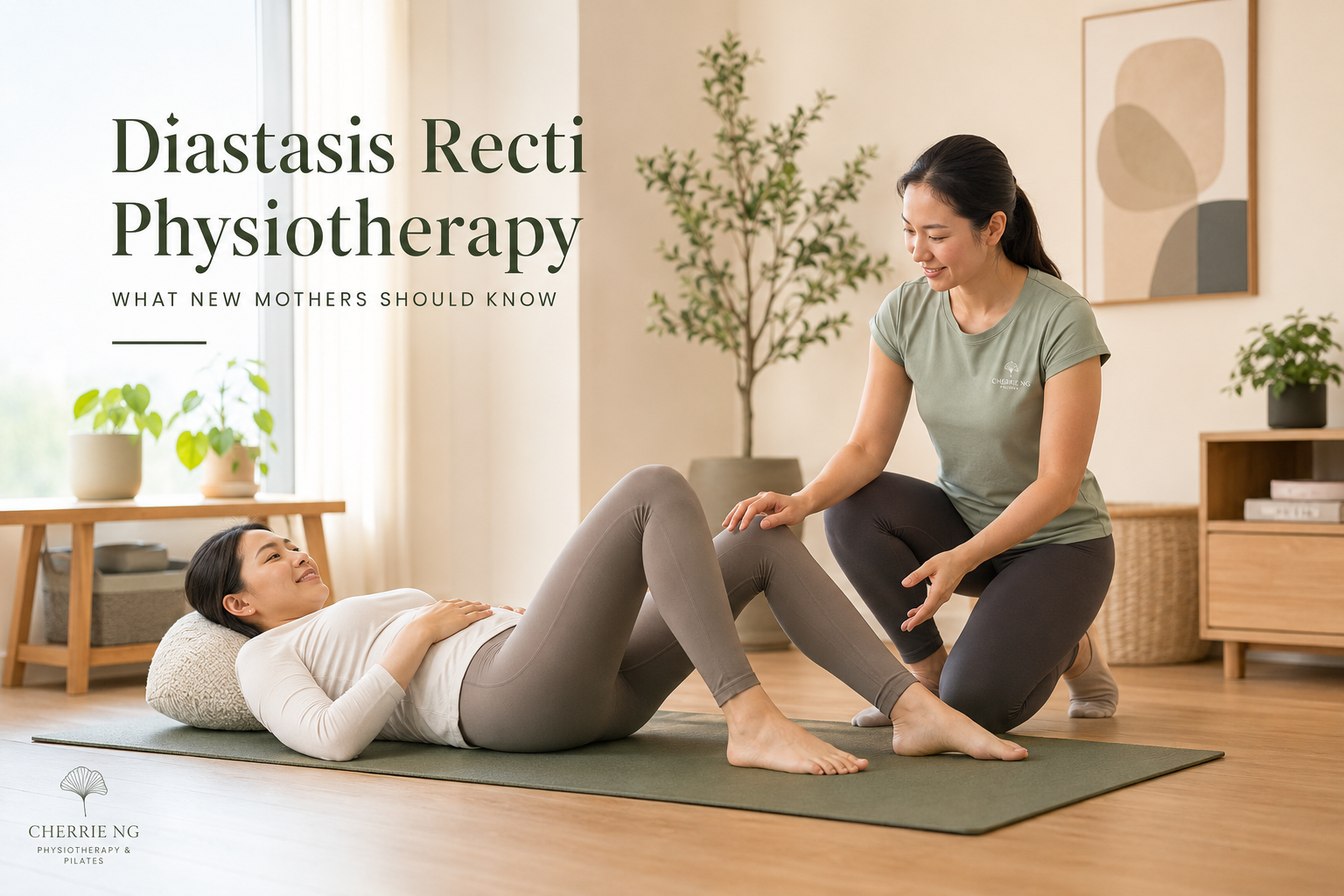
Diastasis recti physiotherapy can help a new mother understand abdominal separation, rebuild strength and return to daily activity without making the whole recovery about “closing a gap.” A useful assessment looks at breathing, abdominal-wall control, symptoms, pelvic-floor concerns and functional goals—not finger width alone.
Separation during pregnancy is common and often changes naturally after birth, as explained in the NHS guide to the post-pregnancy body. Some women remain concerned about visible doming, weakness, discomfort or how the abdomen manages lifting and exercise. Physiotherapy may provide a personalised starting point, but it cannot guarantee a flat stomach or a particular measurement. This article is general education rather than a diagnosis or individual exercise plan.
What is diastasis recti?
The two rectus abdominis muscles run vertically along the front of the abdomen. Between them is connective tissue called the linea alba. During pregnancy, this area lengthens and widens as the abdomen changes. This separation is called diastasis recti, or divarication, and the amount varies between people.
Diastasis recti is not simply a “torn muscle.” The European Hernia Society guideline describes it as thinning and widening of the linea alba and uses a width greater than 2 cm as a practical definition, while acknowledging that evidence for an exact threshold is limited.
It is also not automatically a hernia. A hernia involves a defect through which tissue can protrude, whereas diastasis describes widening between the rectus muscles. The two can occur together, so a new focal lump, significant pain or uncertainty about what you are seeing should be medically assessed rather than self-diagnosed. The European Hernia Society guideline distinguishes diastasis with and without a concomitant hernia.
What might you notice?
You may notice:
- A gap or softer area along the midline of the abdomen
- A ridge, dome or cone when sitting up, coughing or lifting
- Difficulty coordinating abdominal tension with breathing
- Reduced confidence with carrying, gym training or postnatal exercise
- Abdominal discomfort or a sense that the trunk is not managing load well
Appearance alone does not tell you how well the abdominal wall functions. Two people with a similar measured distance may have different symptoms, strength and goals. Conversely, a smaller gap does not automatically mean every exercise will feel comfortable.
Back pain, leaking and pelvic heaviness can exist at the same time, but they should not automatically be blamed on the separation. The European Hernia Society notes that evidence connecting the measured separation with specific symptoms is limited, so these concerns deserve their own assessment. European Hernia Society guideline
Is a finger-width self-check enough?
A gentle self-check can help you notice change, but it is not a complete diagnosis. Finger width varies with hand size, position and how much the abdominal wall is loaded. Repeated checking can also create anxiety without showing whether function is improving.
The European Hernia Society guideline considers clinical examination and finger-width measurement adequate for many cases. When a precise measurement is necessary, it suggests ultrasound or calipers. The same guideline emphasises that width, post-pregnancy status and the presence of a hernia are separate considerations.
For rehabilitation, useful progress measures may include:
- Less discomfort or uncontrolled doming during a chosen task
- Better breathing and effort control
- Improved trunk, hip and whole-body strength
- More confidence with lifting, carrying and exercise
- Better tolerance during the activity and afterwards
What may happen during a physiotherapy assessment?
Cherrie may first ask about pregnancy and delivery, how long it has been since birth, caesarean or perineal healing, abdominal or pelvic symptoms, current activity and what you want to return to.
An external movement assessment may look at:
- The abdomen at rest and during a small head lift or other relevant movement
- How tension develops along the linea alba, not only the distance between the muscles
- Breathing, rib-cage movement and whether effort causes breath-holding or bearing down
- Abdominal, hip, back and leg strength
- Rolling, standing up, squatting, lifting and carrying
- Whether a change in range, support, load or cue improves control
- Pelvic-floor symptoms such as leaking, heaviness or pain that may need specialist referral
This does not require anyone to judge the shape of your body. The purpose is to understand what currently limits you and choose an appropriate progression. If a hernia or another medical condition is suspected, physiotherapy should not replace medical imaging or review when that is needed.
Can exercise close the gap?
Exercise may reduce inter-rectus distance for some postpartum women, but the average change is not a promise for an individual and “closure” is not the only worthwhile outcome. A 2025 systematic review and meta-analysis in the British Journal of Sports Medicine found low-certainty evidence that postpartum abdominal training reduced the distance measured at rest, and moderate-certainty evidence for a reduction during a head-lift task. The authors highlighted imprecision, varied programmes and a lack of general whole-body exercise trials.
This means there is no single proven routine that every mother must follow. A programme may begin with supported breathing and low-load abdominal control, then progress toward stronger trunk, hip and whole-body work. Depending on the assessment, this could include heel slides, bridges, side-lying exercises, squats, hinges, rows, carries and progressively more demanding Pilates or gym movements.
The goal is not to isolate one “deep-core” muscle forever. It is to coordinate breathing and abdominal pressure while gradually building capacity for real tasks.
Are sit-ups and planks forbidden?
Not forever. Exercise names do not determine suitability on their own. A sit-up, plank or loaded lift may be too demanding at one stage and manageable later with a different range, position or load.
Early on, an exercise may need adjustment if it causes pain, marked uncontrolled doming, breath-holding, pelvic heaviness or a flare that does not settle. Visible doming is information about how the current task is being managed; it is not proof that you have damaged the abdomen.
Avoiding every challenging movement indefinitely can also prevent useful strength progression. Assessment can help identify a version you can manage now and a route toward the activities that matter to you.
What about abdominal binders, taping and massage?
A binder may feel supportive for some people, especially early after birth or surgery, but support and comfort are different from rebuilding strength. Current guidance does not identify one non-surgical treatment or exercise programme as best for every person. European Hernia Society guideline
Massage or taping may change comfort or awareness temporarily, but current exercise evidence does not establish them as methods that permanently reconnect the muscles. 2025 postpartum exercise systematic review If you use any support, it should not cause pain, restrict comfortable breathing, irritate a wound or replace gradual movement and appropriate medical care.
When should you seek an assessment?
Consider physiotherapy or medical review if:
- The separation, doming or abdominal discomfort is worrying you
- You are unsure how to restart exercise or increase load
- Daily lifting, carrying or getting up feels difficult
- You have persistent back or pelvic pain
- You notice leaking, pelvic heaviness, bowel concerns or pain with intercourse
- You suspect a focal hernia or have a painful abdominal lump
- Progress has stalled despite a gradual exercise approach
Pelvic-floor symptoms or the need for an internal examination may require a pelvic-health physiotherapist with the appropriate training. A suspected hernia may need assessment by a doctor or surgeon.
When medical care comes first
Diastasis recti does not explain every postnatal symptom. The CDC urgent maternal warning-sign guidance advises immediate medical care during pregnancy or within one year after birth for symptoms including heavy bleeding, chest pain, trouble breathing, fainting, a severe or worsening headache, vision changes, fever, severe persistent abdominal pain, or swelling, redness and pain in one leg. Thoughts of harming yourself or your baby also require urgent help.
Stop exercising and seek medical care if something feels seriously wrong. Tell the healthcare team that you gave birth recently, even if the symptom seems unrelated to pregnancy.
Frequently asked questions
Does a two-finger gap mean I have diastasis recti?
Finger width is an approximate screen, not a complete diagnosis. Definitions and measurement methods vary, and function cannot be judged from width alone. European Hernia Society guideline If the finding worries you, an assessment can look at the abdominal wall, symptoms and relevant tasks together.
Can diastasis recti improve months or years after birth?
You can still work on strength, control and activity tolerance after the early postnatal period. The change in measured distance varies, so a useful programme should include functional goals rather than relying only on gap closure.
Do I need surgery?
Most people asking about postnatal abdominal separation do not begin with surgery. The European Hernia Society guideline says physiotherapy may be considered before surgical management. A surgical opinion may be appropriate for selected persistent concerns, particularly when a hernia is also present; that decision requires medical assessment and shared decision-making.
Can rehab Pilates help?
Rehab Pilates can provide adjustable positions and progressive trunk and hip loading. It may form part of a physiotherapy plan when the exercises match your symptoms and current capacity. It should not be sold as a guaranteed way to close the gap.
Related reading
- Pelvic Floor Physiotherapy Basics: When to Ask for Support
- Post-Natal Physiotherapy in KL: A Gentle Return to Movement
- Postnatal Pilates in KL: How to Restart Safely After Birth
- Deep Core vs Six-Pack Abs: Why Rehab Pilates Focuses on Control
If you are in Kuala Lumpur or Selangor and want help assessing abdominal function after birth, you can WhatsApp Cherrie to ask whether postnatal physiotherapy or one-to-one rehab Pilates may suit your situation.
Sources and clinical references
Foundational clinical sources and further reading
These authoritative sources provide general background relevant to this topic; they are not claim-by-claim citations. This content is educational and does not replace individual assessment, diagnosis or emergency medical care.
- What is physiotherapy? — World Physiotherapy
- WHO guidelines on physical activity and sedentary behaviour — World Health Organization