Post-Natal
Pelvic Floor Physiotherapy Basics: When to Ask for Support
Learn when pelvic floor physiotherapy may help, what an assessment involves, why Kegels are not always enough and when medical care comes first.
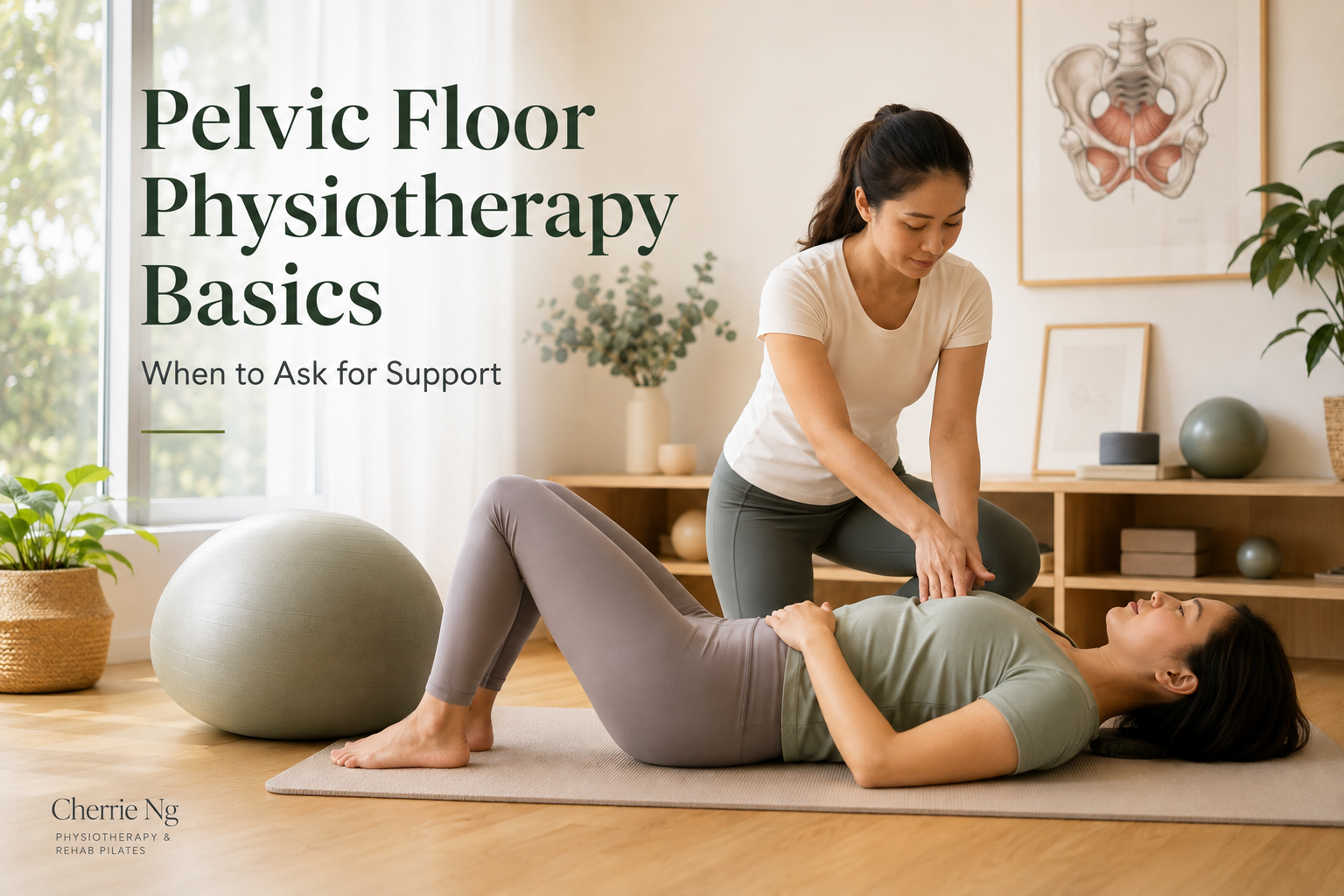
Pelvic floor physiotherapy may be worth asking about if you experience leaking, urgency, pelvic heaviness, difficulty emptying your bladder or bowel, pelvic pain, painful sex, or uncertainty about recovery after birth. You do not need to wait until symptoms become severe or assume they are simply part of motherhood.
The right support is not always “more Kegels.” Pelvic-floor muscles need to contract, relax and coordinate with breathing and movement. Assessment helps clarify whether strengthening, relaxation, bladder or bowel strategies, graded exercise, medical review or referral is the appropriate next step. This guide is general education, not a diagnosis or personal treatment plan.
What is the pelvic floor?
The pelvic floor is a group of muscles and supporting tissues at the base of the pelvis. It contributes to bladder and bowel control, supports the pelvic organs and plays a role in sexual function. When these muscles and the wider pelvic system do not work well together, symptoms can include urinary or faecal incontinence, difficulty emptying, pelvic-organ prolapse, sexual dysfunction and chronic pelvic pain. NICE guideline NG210
Pelvic-floor function is not separate from the rest of the body. Breathing, abdominal pressure, hips, trunk strength, toileting habits, pain, daily lifting and exercise demands can all be relevant during an individual assessment.
Symptoms you can ask for help with
Pelvic health physiotherapy services commonly assess concerns such as:
- Urine leakage with coughing, sneezing, running, jumping or lifting
- A sudden or frequent urge to pass urine
- Difficulty starting urine flow or feeling that the bladder does not empty
- Leakage of wind or stool, bowel urgency or difficulty emptying
- Heaviness, pressure or a vaginal bulging sensation
- Pelvic, perineal, vaginal or tailbone pain
- Pain during or after intercourse
- Uncertainty following a significant perineal tear, assisted birth or other postnatal complication
- Abdominal separation alongside bladder, bowel or pelvic symptoms
These examples align with the conditions listed by Somerset NHS pelvic health physiotherapy. Similar symptoms can have different causes, so an online checklist cannot tell you which treatment you need.
Pelvic-floor muscles can be weak, overactive or poorly coordinated
Leaking is often associated with weakness, but weakness is not the only possibility. Pelvic-floor muscles may also have difficulty relaxing or may remain overactive. This can occur alongside pelvic pain, urinary urgency, constipation or painful intercourse. King’s College Hospital pelvic health physiotherapy
This is why repeatedly squeezing harder is not a universal solution. If the muscles are already tense or if you bear down instead of lifting, unsupervised exercises may not address the actual problem. NICE recommends that supervised programmes assess both the ability to contract and relax, then tailor training to discomfort, ability, needs and goals. NICE guideline NG210
What happens during a pelvic-floor physiotherapy assessment?
A pelvic-health physiotherapist usually begins with a private conversation. Questions may cover bladder and bowel habits, pregnancy and birth, pain, heaviness, sexual symptoms, periods, surgery, exercise, medications, fluid intake and the activities you want to regain.
Depending on the symptoms and your consent, assessment may include:
- Breathing, abdominal and pelvic movement
- Hip, back and whole-body strength or mobility
- How you cough, lift, squat or perform a relevant exercise
- A bladder or bowel diary
- External observation of pelvic-floor movement
- An optional vaginal or rectal examination by an appropriately trained clinician
An internal examination is not automatic. The clinician should explain why it may help, what it involves and ask for consent. You may decline, stop at any time or ask about a chaperone, and useful advice can still be provided without an internal examination. Somerset NHS pelvic health physiotherapy
Cherrie’s general postnatal physiotherapy may be an initial pathway for external movement screening and return-to-exercise planning when this falls within the session scope. When specialist internal pelvic-floor assessment or treatment is needed, an appropriately trained pelvic-health physiotherapist or medical clinician is the more appropriate referral.
What might treatment include?
Treatment depends on the findings and may combine:
- Learning an effective pelvic-floor contraction and full relaxation
- Individualised strength or endurance practice
- Breathing and pressure-management strategies
- Bladder training or urge-management education
- Bowel habits, positioning and avoiding unnecessary straining
- Relaxation approaches for an overactive pelvic floor
- Gradual return to walking, lifting, Pilates, gym training or impact
- Coordination with a GP, gynaecologist, urogynaecologist, colorectal clinician or other professional when needed
Pelvic-floor muscle training has evidence behind it, but results are not instant or guaranteed. NICE recommends supervised training for at least three months as first-line care for stress or mixed urinary incontinence, which reflects the time needed to practise, review technique and judge response—not a promise that everyone improves on the same schedule. NICE guideline NG123
For postpartum prevention, a 2025 systematic review and meta-analysis found moderate-certainty evidence that pelvic-floor muscle training during the first year after birth reduced the odds of urinary incontinence and pelvic-organ prolapse in the included studies. Evidence was more limited for symptom severity, anal incontinence and sexual function, so a programme should not be promoted as a cure for every pelvic symptom.
Do all new mothers need pelvic-floor physiotherapy?
Not every new mother needs specialist treatment, but everyone should be able to ask questions and receive appropriate screening. NICE encourages pelvic-floor muscle training during and after pregnancy and recommends that supervised programmes be delivered by a physiotherapist or another professional with relevant expertise. NICE guideline NG210
Consider asking for support if symptoms bother you, change your exercise or daily choices, are worsening, or leave you uncertain about what is safe. NICE identifies assisted vaginal birth and obstetric anal-sphincter injury as reasons to consider supervised postnatal pelvic-floor muscle training. NICE guideline NG210
Returning to Pilates, running or lifting
A calendar date alone cannot show readiness. A gradual return may consider healing, symptoms during and after exercise, pelvic-floor coordination, leg and trunk strength, impact tolerance and the demands of your chosen activity.
You do not necessarily need to avoid lifting or impact forever. A symptom-aware progression may start with easier positions and loads, then build toward squats, carries, faster movement, jumping or running. If leaking, heaviness, pain or bowel symptoms appear, the plan may need adjustment or specialist assessment rather than simply pushing through.
When medical care should come first
Pelvic-floor physiotherapy does not replace medical investigation. During pregnancy or within one year after birth, the CDC urgent maternal warning-sign guidance advises immediate medical care for heavy bleeding, chest pain, trouble breathing, fainting, severe persistent abdominal pain, a severe or worsening headache, vision changes, fever, or swelling, redness and pain in one leg. Thoughts of harming yourself or your baby also require urgent help.
If something feels seriously wrong, seek medical care and tell the healthcare team that you are pregnant or gave birth within the last year.
Frequently asked questions
Are Kegels the same as pelvic-floor physiotherapy?
No. Pelvic-floor contractions may be one part of treatment, but physiotherapy also considers relaxation, coordination, bladder and bowel habits, pain, breathing, movement and your goals. Some people need down-training rather than more squeezing.
Is an internal examination compulsory?
No. It should only happen after an explanation and with your consent. You can decline or stop, and the physiotherapist can discuss external assessment and treatment options.
Is leaking after childbirth normal?
Leaking can occur after childbirth, but “common” does not mean you must ignore it. 2025 postpartum exercise systematic review If it bothers you, persists or affects activity, ask a doctor or appropriately trained pelvic-health physiotherapist for assessment.
Does Cherrie offer specialist pelvic-floor physiotherapy?
The site does not list specialist internal pelvic-floor examination as a service Cherrie provides. You can ask her about postnatal movement and whether general physiotherapy, rehab Pilates or referral to a pelvic-health clinician with specific training is the appropriate pathway.
Related reading
- Post-Natal Physiotherapy in KL: A Gentle Return to Movement
- Diastasis Recti Physiotherapy: What New Mothers Should Know
- Postnatal Pilates in KL: How to Restart Safely After Birth
If you are in Kuala Lumpur or Selangor and are unsure where to start with postnatal movement or pelvic-floor symptoms, you can WhatsApp Cherrie to ask whether external physiotherapy screening is suitable or a specialist pelvic-health referral would be more appropriate.
Sources and clinical references
- NICE NG210: Pelvic Floor Dysfunction—Recommendations
- Somerset NHS Foundation Trust: Pelvic Health Physiotherapy
- King’s College Hospital: Pelvic Health Physiotherapy
- NICE NG123: Urinary Incontinence and Pelvic Organ Prolapse—Recommendations
- British Journal of Sports Medicine: Impact of Postpartum Exercise on Pelvic Floor Disorders
- CDC: Urgent Maternal Warning Signs and Symptoms
Foundational clinical sources and further reading
These authoritative sources provide general background relevant to this topic; they are not claim-by-claim citations. This content is educational and does not replace individual assessment, diagnosis or emergency medical care.
- What is physiotherapy? — World Physiotherapy
- WHO guidelines on physical activity and sedentary behaviour — World Health Organization