Back Pain
Slipped Disc Physiotherapy in KL: Assessment, Exercise and When to Seek Medical Care
Learn how slipped disc physiotherapy in KL approaches assessment, exercise and activity, plus symptoms that need urgent medical care.
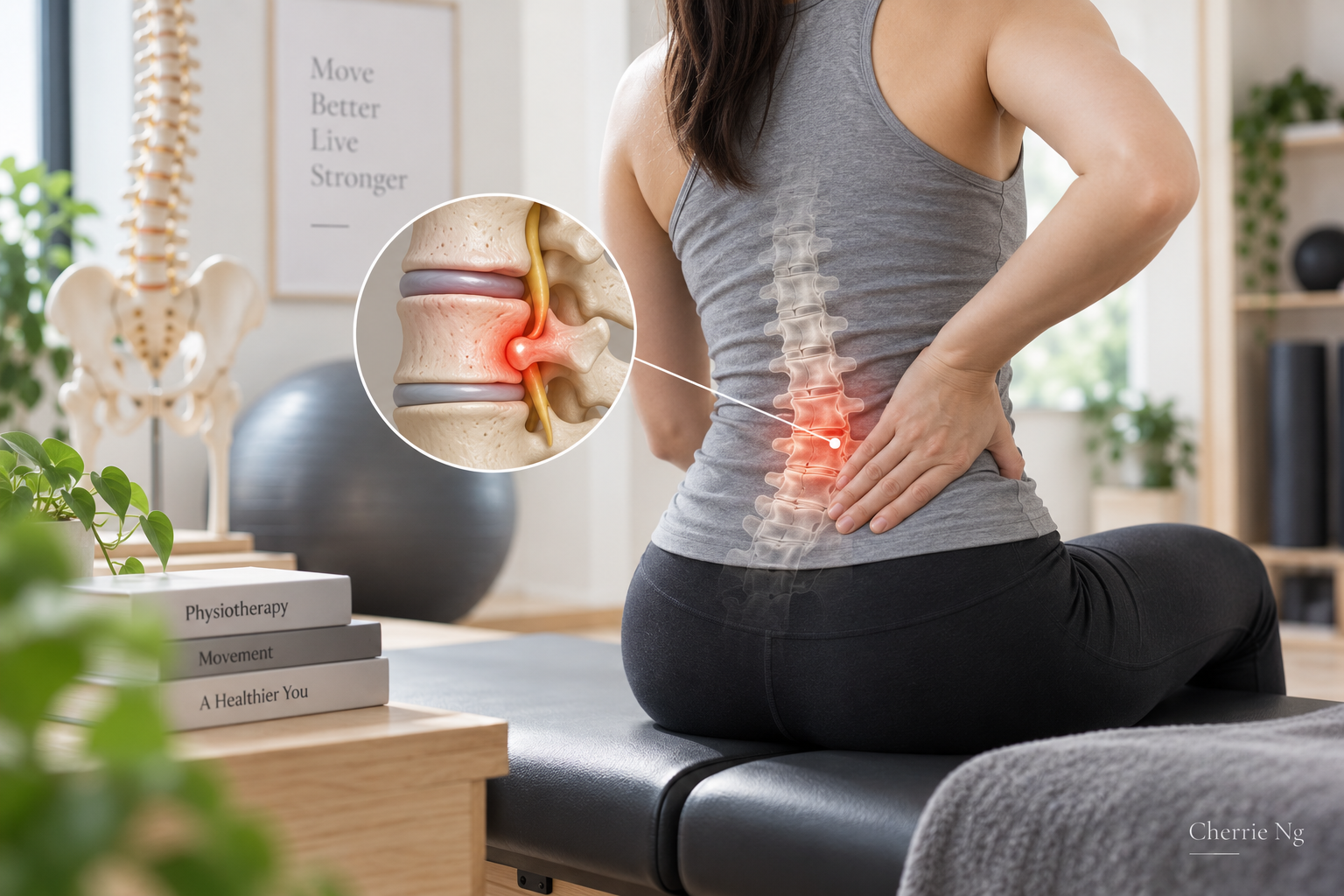
Slipped disc physiotherapy in KL usually begins with assessment—not a standard list of “disc exercises.” A physiotherapist may look at your back and leg symptoms, strength, sensation, movement, daily demands and warning signs before deciding whether guided activity is suitable or medical review should come first.
“Slipped disc” is a common search term for a prolapsed or herniated disc. It does not mean the whole disc has literally slipped out of place, and a scan finding alone does not explain every episode of back pain. This article is educational and cannot diagnose the source of your symptoms.
What does “slipped disc” mean?
Discs sit between the bones of the spine. A disc can bulge or herniate, and symptoms may occur when nearby nerve tissue is irritated or compressed. Possible symptoms include lower-back pain, pain travelling into the buttock or leg, tingling, numbness, weakness, or difficulty bending and straightening. Some disc changes cause no symptoms at all. NHS slipped disc overview
The words used on a scan—such as bulge, protrusion or extrusion—should be interpreted together with the clinical picture. They are not a reliable do-it-yourself severity scale.
Does an MRI-confirmed disc bulge explain the pain?
Not automatically. A systematic review of 3,110 people without pain found that degenerative spine imaging features were common and became more frequent with age. The authors stressed that imaging findings need to be interpreted in the context of a person’s clinical condition. Systematic review of spinal imaging findings in asymptomatic people
Malaysian Ministry of Health emergency-department guidance similarly notes that findings such as bulging discs and spinal degeneration can be asymptomatic and may not be the cause of pain. Malaysia MOH Pain Management in Emergency and Trauma Department guideline
This does not mean a scan is irrelevant. It means the report, symptoms, examination and reason for imaging should agree before decisions are based on it.
Symptoms a physiotherapist may ask about
An assessment may explore:
- where the pain starts and whether it travels below the buttock or knee;
- tingling, numbness, altered sensation or leg weakness;
- whether coughing, sitting, bending, walking or changing position affects symptoms;
- how sleep, work, driving, lifting and exercise are affected;
- when symptoms began and whether they are improving, stable or worsening;
- previous back episodes, scans, operations and other health conditions; and
- any changes in bladder, bowel or sexual function, or sensation around the groin.
Back pain alone, back pain with leg symptoms and progressive neurological symptoms require different decisions. A physiotherapist should screen first rather than assume every person with a “slipped disc” label belongs in the same programme.
What might a physiotherapy assessment include?
Depending on the presentation and what is safe, Cherrie may assess:
- comfortable standing, sitting and walking;
- movements that ease, reproduce or spread symptoms;
- leg strength and functional tasks such as a sit-to-stand;
- sensation or reflex-related findings when relevant to screening;
- hip and lower-limb movement;
- balance, lifting strategy and tolerance for daily tasks; and
- your goals, concerns and confidence with movement.
The aim is not to “push the disc back in.” It is to understand what you can do safely, identify reasons to refer, and build a plan around function and symptom response.
Do you always need an MRI before physiotherapy?
No. NICE recommends against routinely offering imaging in a non-specialist setting for low back pain with or without sciatica. In a specialist setting, imaging is considered when the result is likely to change management. NICE low back pain and sciatica guideline NG59
Imaging may be considered by an appropriate medical professional when there is concern about serious pathology, significant or worsening neurological loss, symptoms that are not following the expected course, or when a specialist decision depends on the result. Bring an existing report if you have one, but do not delay urgent medical care to arrange physiotherapy.
What can slipped disc physiotherapy involve?
When serious neurological problems and other urgent causes have been excluded, conservative care is commonly considered first. A World Federation of Neurosurgical Societies Spine Committee review recommends conservative treatment as first-line care for lumbar disc herniation in the absence of cauda equina syndrome, motor deficit or another serious neurological deficit. WFNS Spine Committee recommendations
A physiotherapy plan may include:
- Clear explanation: Connecting symptoms and examination findings without treating the scan report as your identity.
- Activity adjustment: Finding tolerable ways to sit, walk, work, sleep and change position during a sensitive phase.
- Graded movement: Building a starting level that does not repeatedly cause a marked or lasting symptom increase.
- Strength and capacity: Progressing trunk, hip and leg tasks according to function rather than chasing one “perfect” exercise.
- Work or lifting practice: Reintroducing relevant tasks with manageable load and useful variation.
- Self-management: Agreeing what to practise, what response to monitor and when the plan should be reviewed.
NICE advises tailored self-management, continuation of normal activities where appropriate, and exercise selected around a person’s needs, preferences and capabilities. It recommends considering manual therapy only as part of a package that includes exercise, rather than as a stand-alone answer. NICE guideline NG59
Which exercises are best for a slipped disc?
There is no single best exercise for every disc-related presentation. One person may initially tolerate short walks and supported leg work; another may respond better to a carefully chosen spinal movement, hip exercise or controlled lifting pattern.
The useful questions are:
- Does the movement make leg symptoms spread farther or become notably stronger?
- Does any increase settle soon after the activity, or remain worse?
- Is strength, sensation or walking changing?
- Can the dose be adjusted without abandoning movement altogether?
- Does the exercise relate to a task you want to regain?
An online video cannot check neurological signs or adapt the dose. If leg symptoms are new, worsening or uncertain, get assessed before forcing a generic routine.
Is rest better than exercise?
Short periods of relative rest may be understandable when pain is highly irritable, but prolonged bed rest is generally not the goal. Malaysia’s emergency pain guideline advises minimising bed rest and staying active for acute musculoskeletal back pain, while NICE encourages normal activity and tailored self-management where appropriate. Malaysia MOH emergency pain guideline
“Stay active” does not mean ignoring escalating leg pain or weakness. It means choosing a manageable level, changing position regularly and progressing according to response.
Does manual therapy fix a slipped disc?
Hands-on care cannot be promised to reposition a disc. If manual therapy is considered, it should have a clear short-term purpose and support an active plan. NICE places manual therapy within a treatment package that includes exercise. It also advises against traction for low back pain with or without sciatica. NICE guideline NG59
Cherrie does not provide dry needling. Her approach may include movement assessment, education, progressive exercise, task practice and rehab Pilates principles when suitable; no technique or outcome is guaranteed.
When should you seek urgent medical care?
Seek emergency medical assessment immediately if severe low-back pain travels into the leg and you develop new bladder, bowel or sexual-function changes, or new numbness around the perineum (the area around the genitals and anus). NICE recommends immediate referral for assessment of possible cauda equina syndrome in this situation. NICE suspected neurological conditions guideline NG127
Medical assessment should also come before routine exercise if you have rapidly worsening weakness, major trauma, fever or infection risk, a cancer history with concerning new symptoms, unexplained weight loss, or symptoms that are severe and changing quickly. Malaysia’s emergency pain guideline identifies infection, trauma, malignancy or unexplained weight loss, neurological signs and cauda equina syndrome among acute-back-pain red flags. Malaysia MOH emergency pain guideline
Read the fuller guide to back pain red flags and urgent medical care.
When might a specialist opinion be appropriate?
Not every disc herniation needs surgery. The NHS notes that surgery is not usually required, but specialist discussion may be considered when other treatment has not helped or when weakness or numbness is worsening. NHS slipped disc guidance
A physiotherapist should refer or coordinate with a doctor when the presentation falls outside routine rehabilitation, neurological findings are progressing, symptoms remain disabling despite an appropriate plan, or further investigation may change management.
Slipped disc physiotherapy with Cherrie in KL
Cherrie can assess suitable musculoskeletal back and leg symptoms through private physiotherapy and selected home or office visits in Kuala Lumpur and Selangor. Coverage, access, suitability and fees are confirmed case by case before booking.
Send a short description of where symptoms travel, whether you notice numbness or weakness, how long the problem has lasted, what daily activities are affected, your location, and whether you already have a medical report. Urgent warning signs should go to emergency medical services rather than WhatsApp booking.
Related reading
- Lower Back Pain Physiotherapy in KL: Common Causes and Next Steps
- Sciatica Physiotherapy in KL: Symptoms, Exercises and When to Seek Help
- Back Pain Red Flags: When to Seek Medical Care Quickly
Sources and clinical references
- NHS: Slipped disc
- Systematic review: Imaging features of spinal degeneration in asymptomatic populations
- Malaysia Ministry of Health: Pain Management in Emergency and Trauma Department, second edition
- NICE NG59: Low back pain and sciatica in over 16s
- WFNS Spine Committee: Conservative treatment for lumbar disc herniation
- NICE NG127: Suspected neurological conditions
Frequently asked questions
Can physiotherapy help a slipped disc?
It may support recovery when an assessment shows that conservative rehabilitation is suitable. The plan may include education, activity adjustment, graded exercise and task practice. It should also identify symptoms that need medical review.
Can a physiotherapist diagnose a slipped disc without an MRI?
A physiotherapist can assess the symptom pattern, movement and neurological signs, but should not claim certainty from one test. Imaging is not routinely needed for every case and may be arranged through an appropriate medical pathway when it would change management.
Can a slipped disc be pushed back into place?
That is not an appropriate promise. Treatment should focus on symptoms, safety, movement and function—not a claim that hands-on care mechanically puts a disc back.
Should I exercise when pain goes down my leg?
The answer depends on symptom behaviour and neurological findings. Do not force a routine if pain spreads farther, weakness or numbness worsens, or walking changes. An individualized assessment can help choose a starting level.
How long does slipped disc recovery take?
There is no reliable deadline for an individual without assessment. Symptom severity, neurological involvement, daily demands, health context and response to activity all matter. Review progress rather than treating a generic online timeline as a guarantee.
When is slipped disc surgery considered?
A specialist may discuss surgery when non-surgical care has not improved symptoms or when neurological loss such as weakness or numbness is worsening. New bladder, bowel or perineal symptoms require immediate emergency assessment rather than a routine surgery appointment.
To ask whether physiotherapy with Cherrie is suitable, WhatsApp your area, symptom pattern, duration, affected activities and any medical findings. This initial exchange does not replace an examination or emergency care.
Foundational clinical sources and further reading
These authoritative sources provide general background relevant to this topic; they are not claim-by-claim citations. This content is educational and does not replace individual assessment, diagnosis or emergency medical care.
- What is physiotherapy? — World Physiotherapy
- Musculoskeletal health — World Health Organization
- Low back pain and sciatica in over 16s: assessment and management (NG59) — National Institute for Health and Care Excellence