Post-Surgery
Scar Mobility After Surgery: When and How Should Movement Progress?
Learn when scar mobility work may begin after surgery, why movement should progress gradually and which wound signs need medical review.
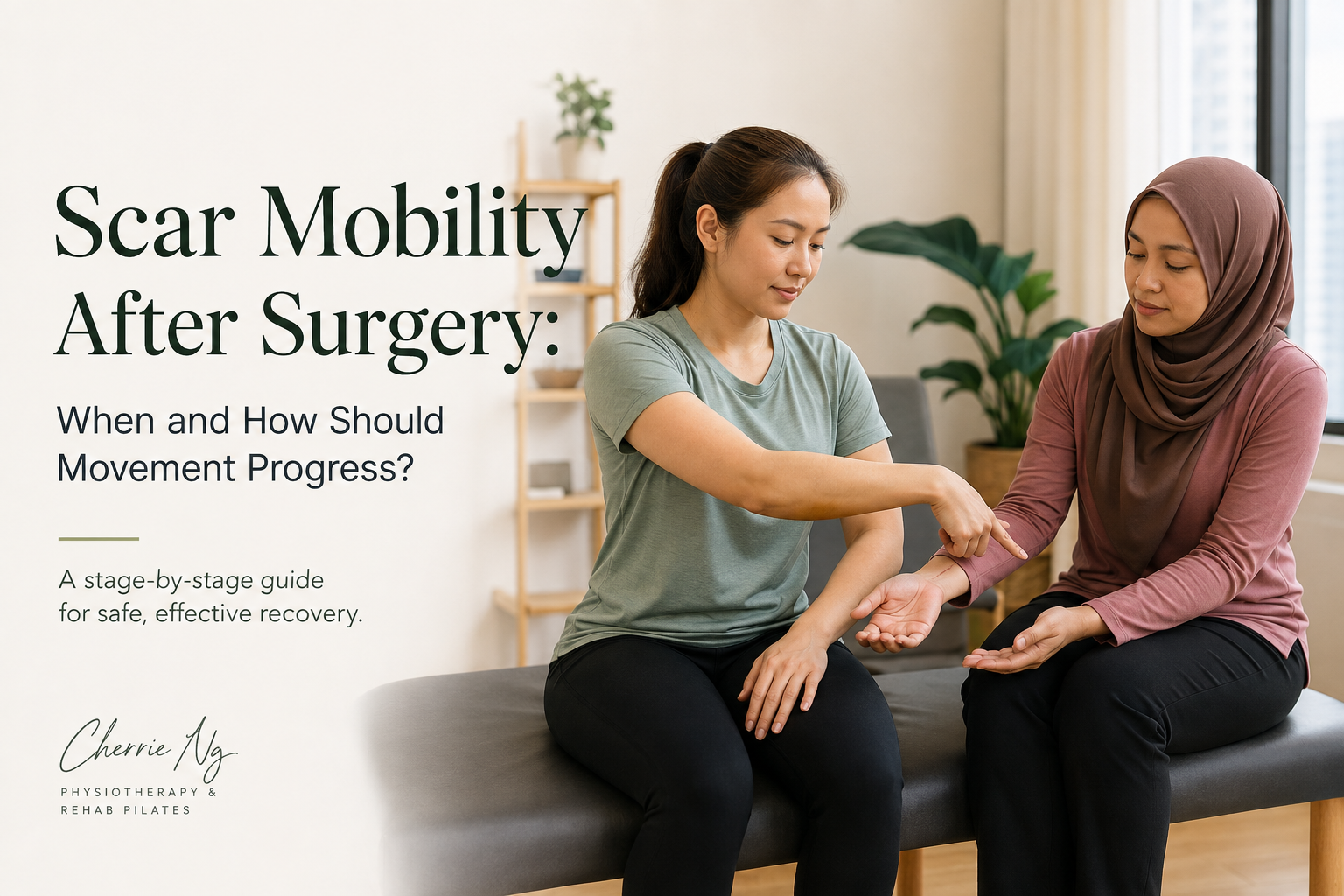
Scar mobility work may be considered only after the wound is fully closed and the surgical team has said the area is ready. Before that point, recovery usually centres on wound protection and the movements specifically allowed after your operation. Later, gentle touch, skin movement and progressively larger functional movements may be introduced—but scar massage is not a race, and harder pressure does not guarantee a better result.
This guide is about external, healed surgical scars. It does not cover open-wound care, internal pelvic treatment or procedures intended to change a scar’s appearance.
A wound and a scar are not the same stage
A surgical wound is still healing. It may have stitches, clips, glue, a dressing, scabs or areas that have not closed. A scar is what remains after the skin wound has healed. The NHS scar guide states that scar massage should only be done when the wound is fully healed; scars can continue to fade and change for up to two years or more.
Your surgeon or wound team should decide when your particular wound is healed enough for direct contact. Timing varies with the operation, wound location, closure method, complications and individual health. A date that was appropriate for someone else’s operation is not automatic clearance for yours.
Do not massage over:
- An open area, scab, blister or wound edge that is separating
- Stitches, clips, glue or a dressing unless your surgical team has specifically advised it
- Increasing redness, warmth, swelling, bleeding or drainage
- A scar that has suddenly become much more painful
If you are unsure whether the skin is fully healed, pause and ask the team responsible for your wound.
Why can a healed scar feel tight or sensitive?
After healing, a scar may feel dry, itchy, numb, sensitive, firm or less mobile than nearby skin. A scar close to or crossing a joint can also make some movements or daily tasks feel restricted. These features and the long maturation period are described in the Royal National Orthopaedic Hospital’s postoperative scar-care guide.
Feeling tight does not prove that the scar is “stuck,” and discomfort does not tell you which tissue is responsible. Movement may also be affected by swelling, protection after surgery, weakness, joint stiffness, fear of loading, or procedure-specific restrictions. That is why assessment should consider the whole task rather than treating the visible line in isolation.
Scar mobility is more than scar massage
The goal is not to “break” scar tissue. A gradual plan may include several layers:
- Comfortable contact: getting used to clean, gentle touch around—and later over—the healed scar when cleared.
- Skin movement: small, comfortable movements of the skin in different directions without forcing or scraping.
- Joint movement: restoring the allowed range around the operated area.
- Muscle capacity: rebuilding control and strength within current surgical restrictions.
- Meaningful function: progressing reaching, dressing, stairs, lifting, walking, work or sport according to the operation and your goals.
The RNOH guide advises starting light massage only in the weeks after the wound is fully healed, keeping it light and gentle until six weeks after surgery, and seeking advice if concerned. Treat this as general education, not a timeline that overrides your own surgeon’s instructions.
What does the evidence say about massage?
Scar massage is commonly used, but the research does not support guaranteed claims. A 2022 scoping review of postoperative scar massage found that studies used very different protocols and outcomes, often combined massage with other rehabilitation treatments, and lacked consistent methods. The authors concluded that massage may have benefits for pain, movement and scar characteristics, but better research is needed.
This means it is reasonable to consider gentle scar work for an appropriate, healed scar, while being honest about uncertainty. Massage cannot promise to remove a scar, prevent all adhesions or restore movement by itself. The wider movement and strength programme may matter just as much for the activity you want to regain.
What might a physiotherapy assessment look at?
For a healed scar that seems to affect movement, a physiotherapy assessment may review:
- The operation date, procedure and surgeon’s rehabilitation protocol
- Whether the wound has been medically cleared for direct contact
- Pain, sensitivity, swelling and changes in the scar or nearby skin
- Scar location and how the skin moves during the relevant task
- Allowed joint range, muscle control, strength and walking or lifting tolerance
- Braces, weight-bearing limits and movement precautions
- The daily activity that feels restricted
Cherrie can assess external, fully healed scars as part of musculoskeletal rehabilitation in Kuala Lumpur or selected Selangor areas. She does not provide wound care, remove dressings or stitches, diagnose infection, perform internal pelvic scar treatment, or change the surgeon’s restrictions.
How should movement progress?
Movement progression should follow the operation—not just how the scar looks. The NHS enhanced-recovery guide supports becoming active as soon as medically appropriate after many operations, while the healthcare team advises what is suitable for the specific procedure.
A practical progression might move from:
- Small, comfortable ranges to larger allowed ranges
- Supported movement to independent movement
- Slow, predictable tasks to more varied tasks
- Low resistance to gradually increased resistance
- Short practice periods to longer daily or work demands
Change one variable at a time where possible. Mild stretching or awareness may be acceptable after clearance, but sharp pain, new wound symptoms, marked swelling or a lasting flare are reasons to stop and review the plan. Do not use pain as proof that scar tissue is being “released.”
Rehab Pilates may fit later if its positions and loads respect the procedure. It can be one way to practise breathing, trunk control, mobility and progressive strength, but it does not replace operation-specific rehabilitation.
When should medical review come before scar work?
Contact your surgical team promptly if the surgery site develops increasing redness or pain, cloudy drainage or fever; the CDC lists these as possible signs of a surgical-site infection. The NHS also advises urgent medical help when a scar is swollen or painful, feels warm, or has pus coming from it. NHS scar guidance
Medical or specialist review is also appropriate when:
- The wound opens, bleeds unexpectedly or is not healing as expected
- The scar becomes progressively raised, hard, enlarges beyond the original wound, or significantly limits movement
- Pain or sensitivity is worsening rather than settling
- You are uncertain about a new lump, colour change or skin reaction
- Your surgeon has not yet cleared direct scar contact
Do not try to massage through these signs. A physiotherapy appointment should not delay wound, surgical, dermatology or emergency assessment.
Frequently asked questions
When can I start scar massage after surgery?
Only when the wound is fully healed and your surgical team has cleared direct contact. Do not decide from the calendar alone, because closure and restrictions vary by procedure.
Should scar massage hurt?
No. More pain is not evidence of more benefit. Start gently after clearance and stop if the skin becomes irritated, the pain is sharp or increasing, or wound-related symptoms appear.
Can massage remove a surgical scar or break adhesions?
Massage cannot remove a scar, and evidence for postoperative scar massage uses inconsistent methods. It may be one part of care for selected healed scars, but claims that it will break all adhesions or restore movement are too strong.
What if my scar crosses a joint?
Assessment may be useful if a healed scar near a joint appears to limit reaching, bending, walking or another meaningful task. The plan should consider the scar, joint mobility, strength, surgical precautions and the movement itself.
Related reading
- Post-Surgery Physiotherapy: When Should You Start Rehab?
- Post-Natal Physiotherapy in KL: A Gentle Return to Movement
If a fully healed scar is making movement feel uncertain after surgery, you can WhatsApp Cherrie with the procedure, surgery date, wound-clearance status, current restrictions and the task that feels limited. She can advise whether a physiotherapy assessment or home visit may be appropriate within her scope.
Sources and clinical references
Foundational clinical sources and further reading
These authoritative sources provide general background relevant to this topic; they are not claim-by-claim citations. This content is educational and does not replace individual assessment, diagnosis or emergency medical care.
- What is physiotherapy? — World Physiotherapy