Rehab Pilates
Reformer Pilates for Rehab in KL: Who It Helps and What to Ask Before Booking
Learn when reformer Pilates may support rehab, who it may suit, and what to ask before starting in Kuala Lumpur or Selangor.
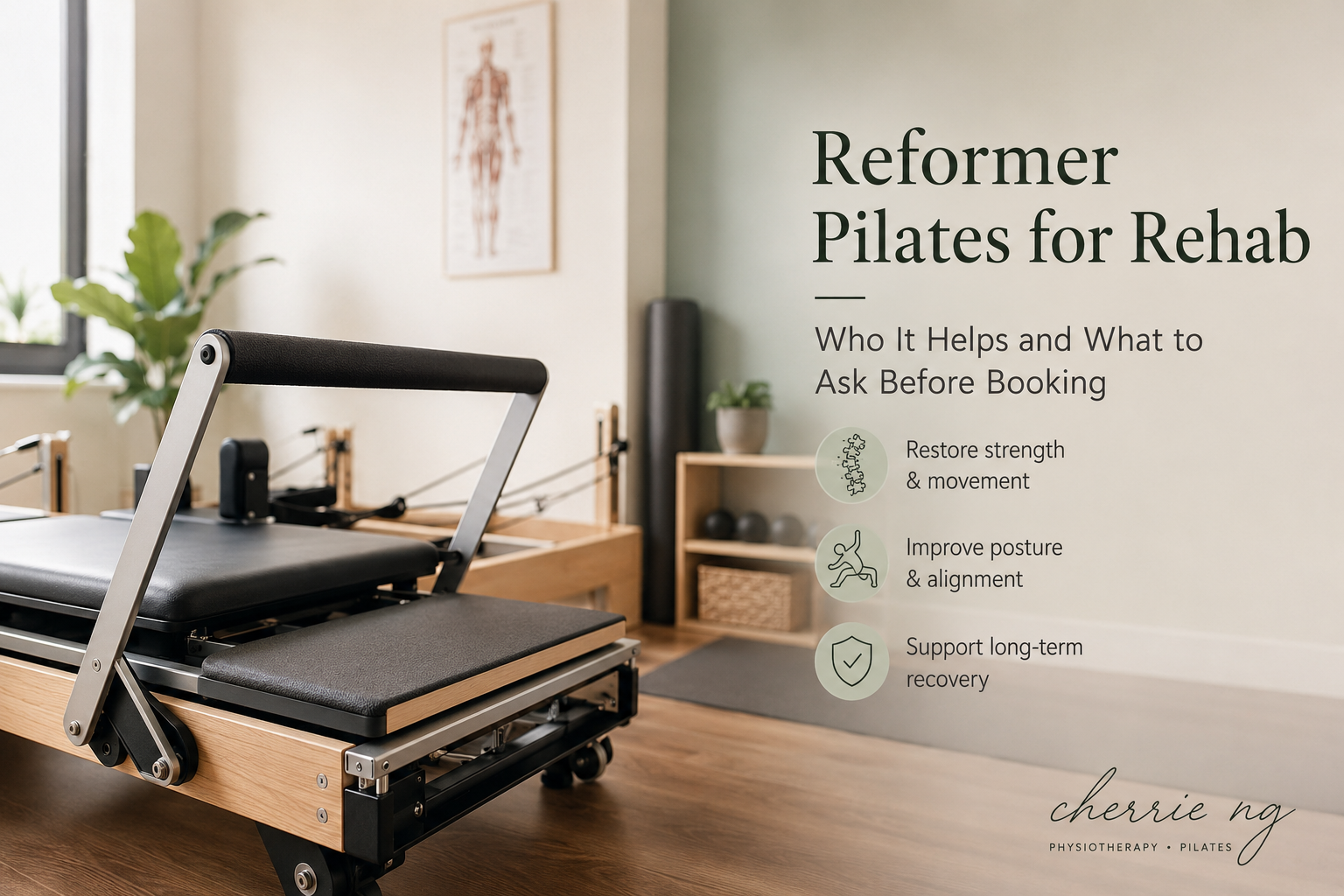
Reformer Pilates may support rehab when the exercises are chosen around your symptoms, strength, mobility and goals instead of following a fixed class sequence. In Kuala Lumpur and Selangor, it can be a useful option for people who want guided movement after pain, injury, posture strain or a period of reduced activity.
The reformer is not automatically safer or better than mat Pilates. What matters most is the assessment, the exercise selection and how the session is progressed.
What is reformer Pilates?
Reformer Pilates uses a spring-loaded carriage, straps and pulleys to create support or resistance during movement. Depending on the setup, the same machine can make an exercise feel easier, more controlled or more challenging.
For rehab-focused work, this flexibility is useful. A physiotherapist or clinically trained instructor may use the reformer to adjust:
- How much body weight you need to control
- How much resistance your muscles work against
- Whether you start lying down, sitting, kneeling or standing
- How much range of motion is comfortable
- How quickly balance, coordination and strength are challenged
This does not mean every reformer exercise is suitable for every body. The machine is only helpful when the exercise matches your current stage.
Who may benefit from reformer Pilates for rehab?
Reformer Pilates may be suitable if you want guided exercise support for:
- Lower back, neck or shoulder discomfort
- Desk-related posture strain
- Hip, knee or ankle weakness after injury
- Returning to movement after a flare-up
- Post-natal core and movement recovery
- Post-surgery strengthening after medical clearance
- General strength, balance and movement confidence
It may be especially helpful if you feel unsure how to exercise safely, need lower-impact options, or want more feedback than a general group class can provide.
What a physiotherapy-led session may look at
Before choosing reformer exercises, a physiotherapy-led session may assess your symptom history, posture, joint mobility, strength, breathing strategy, balance, movement control and daily goals.
For example, two people asking for reformer Pilates after back pain may need different starting points. One person may need gentle spinal movement and hip strength. Another may need pacing advice, confidence with bending, or a gradual return to loading.
This is why rehab-focused reformer work should feel specific. You should understand why an exercise is chosen, what effort level is expected and how to adjust if symptoms change.
What to ask before booking reformer Pilates
Before starting, it helps to ask:
- Is there an assessment before exercise selection?
- Can exercises be modified for pain, injury history or post-natal needs?
- Will the session be one-to-one or a group class?
- What should I do if an exercise increases symptoms?
- Is physiotherapy assessment recommended before Pilates for my situation?
- How will progress be reviewed over time?
These questions are useful because “reformer Pilates” can mean many different things. A fitness class, a private Pilates session and a physiotherapist-led rehab session may all use the same equipment, but the decision-making can be very different.
When physiotherapy should come first
Start with physiotherapy assessment if your pain is new, worsening, linked to trauma, spreading down the arm or leg, or affecting daily activities. Assessment should also come first if you notice numbness, weakness, balance changes, unexplained symptoms or pain that feels unusual for you.
Seek medical care promptly if pain follows major trauma, worsens quickly, comes with fever, unexplained weight loss, new numbness or weakness, loss of bladder or bowel control, chest pain, or symptoms that feel unusual for you.
Reformer Pilates can support recovery, but it should not replace medical review or physiotherapy assessment when symptoms need screening.
How to start safely
Start at a level where you can control the movement and breathe normally. Mild muscle effort can be expected, but sharp pain, spreading symptoms, increasing numbness or a strong flare-up afterward are signs to stop and ask for guidance.
Good rehab progression is usually gradual. The session may begin with supported control, then progress toward more resistance, balance, standing work or sport-specific movement as your body is ready.
If you are unsure whether reformer Pilates, mat Pilates or physiotherapy is the right starting point, a short assessment can help clarify the safest next step.
Related reading
- Clinical Pilates in Bangsar South: Who It Helps and What to Expect
- Reformer Pilates in KL: Fitness, Rehab and What to Ask Before Booking
- Rehab Pilates in Kuala Lumpur: How to Choose the Right Session Safely
- What Is Rehab Pilates and How Is It Different from Regular Pilates?
- Mat Pilates vs Reformer Pilates: Which Is Better for Beginners and Rehab?
- Clinical Pilates vs Regular Pilates: Which Is Better for Recovery?
- Physiotherapist-Led Pilates in KL: Who Is It Suitable For?
Frequently asked questions
Is reformer Pilates good for rehab?
It may be useful for rehab when the exercises are selected after assessment and adjusted to your symptoms, strength and goals. It is not a substitute for clinical screening when pain is new, worsening or unclear.
Is reformer Pilates better than mat Pilates?
Not always. Reformer work can provide support and resistance, while mat work can be simple and practical for home practice. The better choice depends on your body, goals and current stage.
Can I do reformer Pilates if I have back pain?
Some people with back pain may benefit from carefully adapted reformer exercises, but persistent, worsening or nerve-related symptoms should be assessed first. The starting point should match what your back can tolerate.
If you are in Kuala Lumpur or Selangor and want to understand whether reformer Pilates is suitable for your body, you can WhatsApp Cherrie to ask about physiotherapy, rehab Pilates or assessment options.
Foundational clinical sources and further reading
These authoritative sources provide general background relevant to this topic; they are not claim-by-claim citations. This content is educational and does not replace individual assessment, diagnosis or emergency medical care.
- What is physiotherapy? — World Physiotherapy
- WHO guidelines on physical activity and sedentary behaviour — World Health Organization