Rehab Pilates
Private vs Group Rehab Pilates: Which Setting Fits You Better?
Compare private and group rehab Pilates by assessment needs, supervision, privacy, pace and budget before choosing a session in KL.
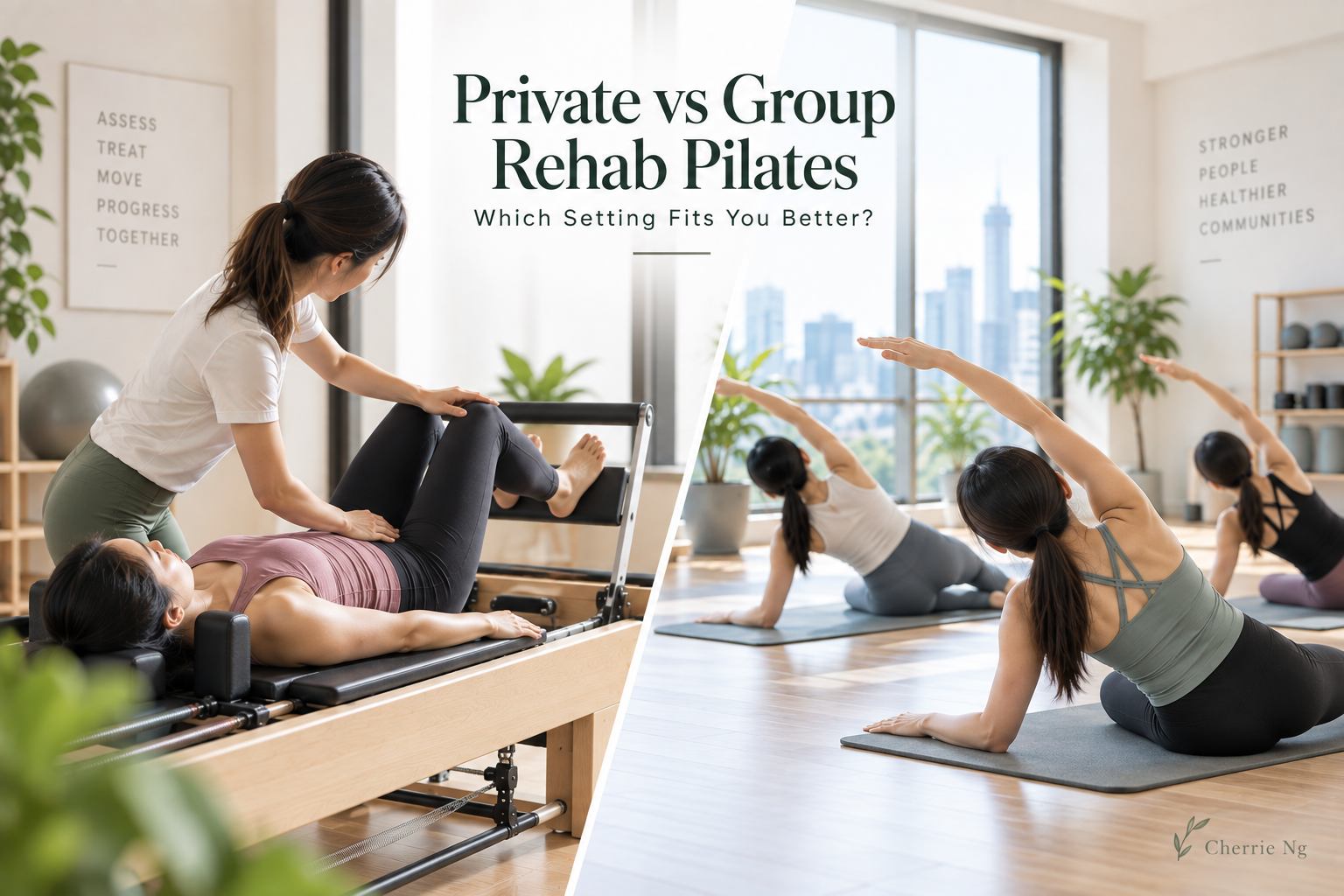
Private rehab Pilates usually fits better when symptoms are new, changing or complex, you need close movement assessment, or exercises require frequent modification. A small-group setting may fit when your condition is stable, you understand your options and can follow shared instructions safely. Neither format is automatically better: the right choice depends on your needs, the instructor’s scope and how the session is organised.
This guide compares formats generally. It does not imply that every format is currently available from Cherrie. Her published service focuses on private physiotherapy and rehab Pilates by arrangement; ask directly about current options before booking.
Private vs group rehab Pilates at a glance
| Question | Private session | Small-group session |
|---|---|---|
| Main plan | Built around one person | Shared structure with individual options |
| Observation | Continuous or frequent | Attention is divided across participants |
| Exercise changes | Can happen throughout | Usually need to fit the group flow |
| Privacy | Better for personal health discussion | Less private unless screening is separate |
| Pace | Can pause, repeat or progress as needed | Uses a manageable shared pace |
| Social setting | Quiet and focused | More social and community-oriented |
| Fee structure | Usually higher per person | Often lower per person, depending on provider |
These are typical differences, not guarantees. Ask about actual group size, screening, instructor qualifications, equipment and how modifications are handled.
When might a private session fit better?
Consider beginning privately when:
- You are unsure whether the problem is suitable for Pilates
- Pain is easily aggravated or changes substantially day to day
- Symptoms spread into an arm or leg, or you have unexplained weakness or balance changes
- You recently had surgery and need medical restrictions followed
- You are returning after injury and do not know which loads are tolerable
- Post-natal, pelvic-health or other personal concerns require privacy
- You need help getting on or off equipment safely
- Fear of movement makes a shared pace difficult
- You want detailed feedback for a specific work, sport or daily task
Private care creates more room for assessment and adjustment, but “one-to-one” does not guarantee clinical quality. Ask what assessment occurs, how progress is reviewed and when the practitioner refers out.
When might a small group fit well?
A small group may be reasonable when:
- Symptoms and medical restrictions are stable
- You already know your main exercise modifications
- You can follow verbal and visual instructions safely
- You do not need continuous physical assistance
- The group level and goals match your ability
- The instructor can see participants clearly and offers alternatives
- You enjoy learning with others and attend more consistently with a schedule
The word “small” matters only if the instructor can supervise appropriately. There is no universal class size that suits every participant and exercise. Ask how many people attend and what happens if symptoms change.
Is one format more effective?
Evidence supports Pilates-based exercise for some conditions, but it does not establish that private rehab Pilates is universally superior to a group format. A 2024 systematic review reported that Pilates may reduce pain and disability for people with low-back pain, but it studied Pilates interventions—not a simple rule that one delivery setting works best for everyone. Systematic review of Pilates for low-back pain
Research also does not make Pilates a universal treatment. A 2025 review of Pilates for chronic neck pain found improvement compared with control conditions, while Pilates was not clinically superior to other exercise approaches for disability. Systematic review of Pilates for chronic neck pain
Choose a format that lets you participate consistently, receive enough supervision and progress appropriately. The exercise label matters less than whether the plan matches your condition and goals.
What should screening cover before a group?
Before joining a recovery-focused group, the provider should have a reasonable way to learn about relevant health history, symptoms, recent surgery or injury, medical restrictions, exercise experience and goals. Screening is not diagnosis, and a group introduction cannot replace individual clinical assessment when the presentation is uncertain.
Ask:
- Is there an individual assessment or introduction first?
- Who leads the class, and what is their clinical and Pilates scope?
- What is the maximum group size?
- Are participants grouped by experience or rehabilitation needs?
- How are painful or unsuitable exercises modified?
- Can the instructor pause to reassess someone?
- What happens if symptoms worsen?
- Is health information discussed privately?
Can you move from private to group sessions?
Sometimes it is practical to begin with individual assessment and teaching, then consider a suitable group once symptoms and exercise options are clearer. Others may stay in private care because their needs change frequently; some may start in a group and later book an individual review.
The transition should not follow a fixed session count. Consider whether you can set up safely, understand modifications, recognise when to stop, tolerate the shared pace and complete expected exercises without continuous assistance.
What may Cherrie assess privately?
Depending on your concern, Cherrie may ask about symptoms, medical history, daily activities and goals, then look at relevant mobility, strength, balance, breathing, posture habits and movement response. Exercises can be adjusted through position, support, range, resistance, tempo and repetition.
Cherrie’s public information describes private physiotherapy and rehab Pilates support by arrangement, alongside separate corporate group Pilates and events. A corporate or general group movement session offers shared education and exercise; it is not individual physiotherapy assessment. Confirm current format, location and availability through WhatsApp rather than assuming a group rehab class is offered.
When should assessment or medical care come first?
Choose assessment before a class if symptoms are unexplained, worsening, frequently spreading, or affecting strength, balance, walking, sleep or normal tasks. Obtain appropriate medical clearance when you have post-surgery or condition-specific restrictions.
Do not use Pilates in place of urgent care. Seek urgent help for chest pain, severe breathing difficulty, sudden facial or limb weakness, loss of bladder or bowel control, major trauma, fainting or a rapidly worsening condition.
Frequently asked questions
Is private rehab Pilates the same as physiotherapy?
Not necessarily. A physiotherapist may use Pilates-informed exercise in rehabilitation, but physiotherapy can also include clinical assessment, education, activity planning and other appropriate interventions. Ask what service you are booking.
Is a duet session private or group Pilates?
It sits between the two. Attention is shared, so it works best when both participants’ levels and needs can be managed safely together. Confirm whether individual screening happens first.
Is group rehab Pilates suitable after surgery?
Only when medical restrictions and healing stage are clear and the provider can accommodate them. Individual assessment may be a better first step.
Does a higher private-session fee mean better results?
No format or price guarantees an outcome. Compare scope, assessment, communication, progression and fit with your needs—not price alone.
Related reading
- What Is Rehab Pilates and How Is It Different from Regular Pilates?
- Physiotherapist-Led Pilates in KL: Who Is It Suitable For?
- Clinical Pilates vs Regular Pilates: Which Is Better for Recovery?
If you are in Kuala Lumpur or selected Selangor areas, you can WhatsApp Cherrie with your concern, exercise experience and preferred setting. She can clarify current private service options and whether physiotherapy assessment or rehab Pilates may be appropriate.
Sources and clinical references
Foundational clinical sources and further reading
These authoritative sources provide general background relevant to this topic; they are not claim-by-claim citations. This content is educational and does not replace individual assessment, diagnosis or emergency medical care.
- What is physiotherapy? — World Physiotherapy
- WHO guidelines on physical activity and sedentary behaviour — World Health Organization