Treatment Choices
Manual Therapy vs Exercise Rehab: Why Both May Matter
Compare hands-on treatment with exercise rehab, what each can contribute, and how physiotherapy combines them around your goals and response.
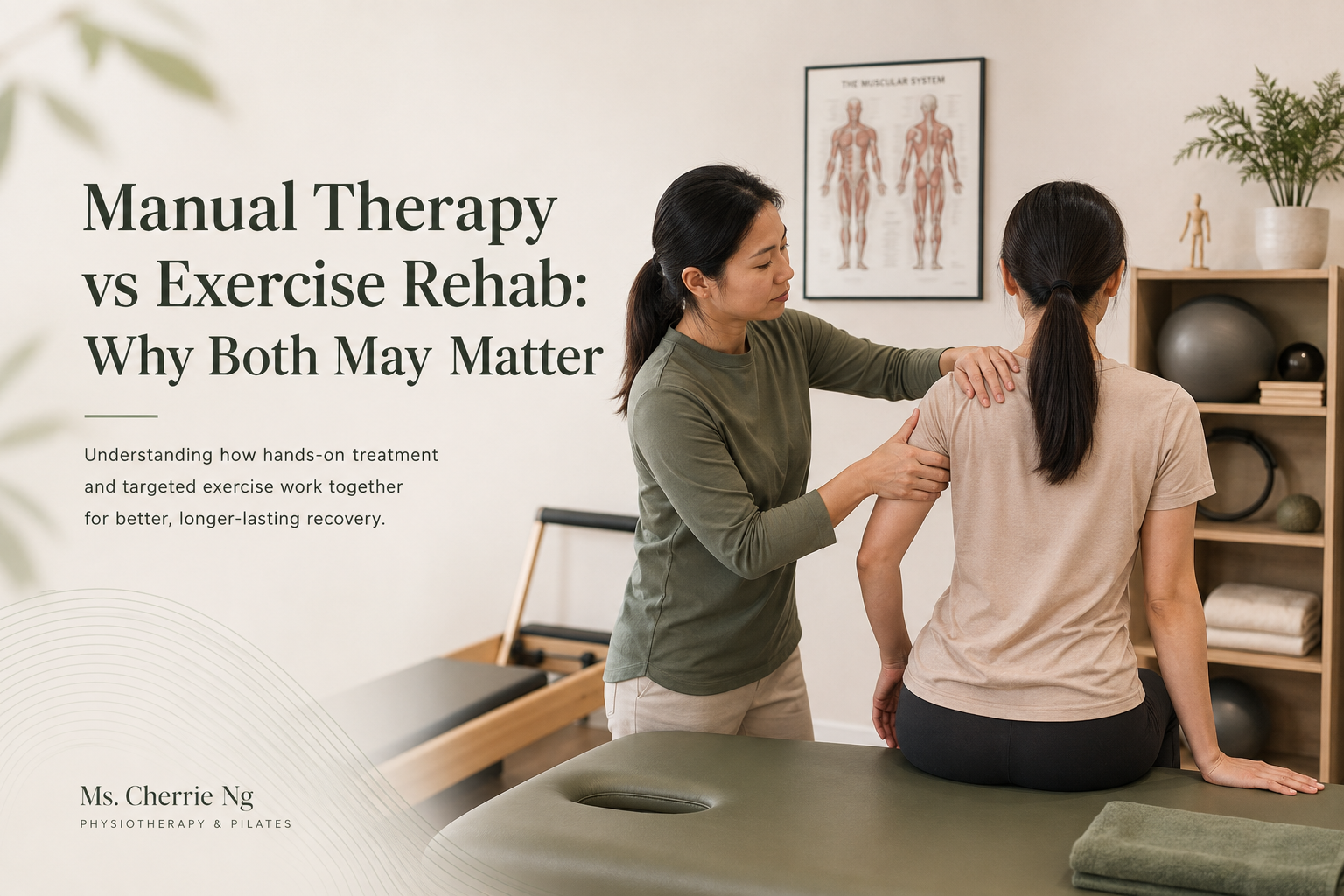
Manual therapy and exercise rehab are not necessarily rivals. Hands-on techniques may help with a selected short-term goal, such as making a movement feel more comfortable, while exercise helps you practise movement, rebuild capacity and progress toward daily, work or sport goals. Which one matters more depends on your condition, assessment, preferences and response—not on a fixed formula.
For people seeking physiotherapy in Kuala Lumpur or Selangor, a useful question is not simply “Which treatment is better?” but “What is each part of the session helping me do, and how will the plan progress?” This article is general education and cannot diagnose the cause of your symptoms.
What counts as manual therapy?
Manual therapy is a broad term for hands-on techniques delivered by a trained practitioner. Depending on the assessment and scope of practice, this may include joint mobilisation, guided movement or soft-tissue techniques.
It may be considered when a person is guarded, stiff, sensitive or hesitant to move. A useful response is not only “the area feels looser”; it may also be that a relevant task—turning the neck, reaching, walking or starting an exercise—becomes easier to practise.
Manual therapy should not be presented as putting a joint “back in place,” permanently correcting posture or removing the need to move. For low-back pain with or without sciatica, NICE says manual therapy may be considered only as part of a treatment package that includes exercise, with or without psychological therapy. NICE guideline NG59
What does exercise rehab contribute?
Exercise rehab is planned movement used to work toward a specific goal. It may include mobility, strength, balance, coordination, endurance, gradual exposure to a sensitive task or rehab Pilates principles. The starting level and progression should reflect your current capacity rather than a generic list from the internet.
Exercise gives you something you can continue between sessions. It can also show how your symptoms respond to load and help a physiotherapist adjust the plan. For chronic primary low-back pain, WHO includes exercise programmes and some physical therapies, such as spinal manipulative therapy and massage, among recommended nonsurgical options within holistic, person-centred care. WHO chronic primary low-back pain guideline
Does combining them work better?
Sometimes—but not for every person, condition or outcome. Research does not support a simple rule that adding more hands-on treatment always produces a better result.
For nonspecific neck pain, a 2023 systematic review found that manual therapy plus exercise improved pain and disability more than exercise alone in the included studies, but much of the evidence was low to moderate certainty and quality-of-life outcomes did not differ. Systematic review of manual therapy plus exercise for nonspecific neck pain
For rotator cuff-related shoulder pain, another systematic review found no meaningful additional benefit in pain or function when manual therapy was added to exercise. Systematic review of manual therapy plus exercise for rotator cuff-related shoulder pain
These different findings are a reminder to match care to the person and the problem. Evidence from one body area should not be treated as a promise for another, and average study results do not predict exactly how one individual will respond.
What a physiotherapy assessment may look at
Before deciding on hands-on treatment, exercise or a combination, Cherrie may ask about your symptom history, daily demands, previous treatment, health background and goals. The movement assessment may look at mobility, strength, control, balance, task tolerance and how symptoms change with different positions or loads.
The plan may then ask:
- Is there a movement or task you currently avoid?
- Would a short hands-on technique make that task easier to practise today?
- Which exercise targets the capacity needed for your real goal?
- Can you perform it confidently and repeat it between sessions?
- What sign will show that the exercise should progress, change or pause?
A session does not have to include manual therapy to be complete. It also should not stop at temporary comfort if your goal requires strength, confidence or repeated exposure to daily activity.
Questions to ask during treatment
You can make the plan clearer by asking:
- What is this technique intended to change today?
- How will we check whether it helped?
- What should I practise before the next session?
- What level of discomfort is acceptable during exercise?
- How will the exercise become more challenging as I improve?
- What would make you recommend medical review or a different approach?
Good rehabilitation should make you more informed and involved, not dependent on a technique you do not understand.
When to seek assessment or medical care
Consider a physiotherapy assessment when symptoms keep returning, limit sleep or daily activity, follow an injury, or make you unsure how to resume exercise safely. Seek urgent medical care after significant trauma or if you develop major or worsening weakness, loss of sensation, fever with marked swelling or illness, chest pain or shortness of breath. For back pain, new bladder or bowel changes or numbness around the saddle area also need urgent assessment. NHS back-pain urgent-care guidance NHS shoulder-pain urgent-care guidance
Related reading
- Physiotherapy vs Massage: Which One Do You Need?
- What Happens During Your First Physiotherapy Session?
- Shoulder Pain Physiotherapy in KL: Why It Happens and What Helps
- Kinesio Taping in Physiotherapy: What It Does and Does Not Do
Frequently asked questions
Is manual therapy the same as massage?
Not exactly. Massage is one form of hands-on care, while manual therapy may also include joint mobilisation and other guided techniques selected after assessment. The purpose and clinical context matter more than the label.
Can I recover with exercise alone?
Some people can follow an exercise-led plan without manual therapy. Others may find a short period of hands-on care useful alongside exercise. The answer depends on the condition, your goals, how irritable the symptoms are and how you respond.
Should treatment feel painful to work?
No. Strong pain is not proof that a technique or exercise is effective. Mild, acceptable symptoms can sometimes occur during rehab, but the response during the activity and afterward should guide the next step.
Sources and clinical references
- NICE guideline NG59: Low back pain and sciatica in over 16s
- WHO guideline for nonsurgical management of chronic primary low-back pain
- Systematic review of manual therapy plus exercise for nonspecific neck pain
- Systematic review of manual therapy plus exercise for rotator cuff-related shoulder pain
- NHS back-pain urgent-care guidance
- NHS shoulder-pain urgent-care guidance
If you are in Kuala Lumpur or Selangor and are unsure whether hands-on treatment, exercise rehab, rehab Pilates or medical review fits your situation, you can WhatsApp Cherrie and share what is limiting you.
Foundational clinical sources and further reading
These authoritative sources provide general background relevant to this topic; they are not claim-by-claim citations. This content is educational and does not replace individual assessment, diagnosis or emergency medical care.
- What is physiotherapy? — World Physiotherapy