Treatment Choices
Kinesio Taping in Physiotherapy: What It Does and Does Not Do
Learn when kinesiology tape may be used, what current evidence says, its limits, and why taping should support rather than replace rehabilitation.
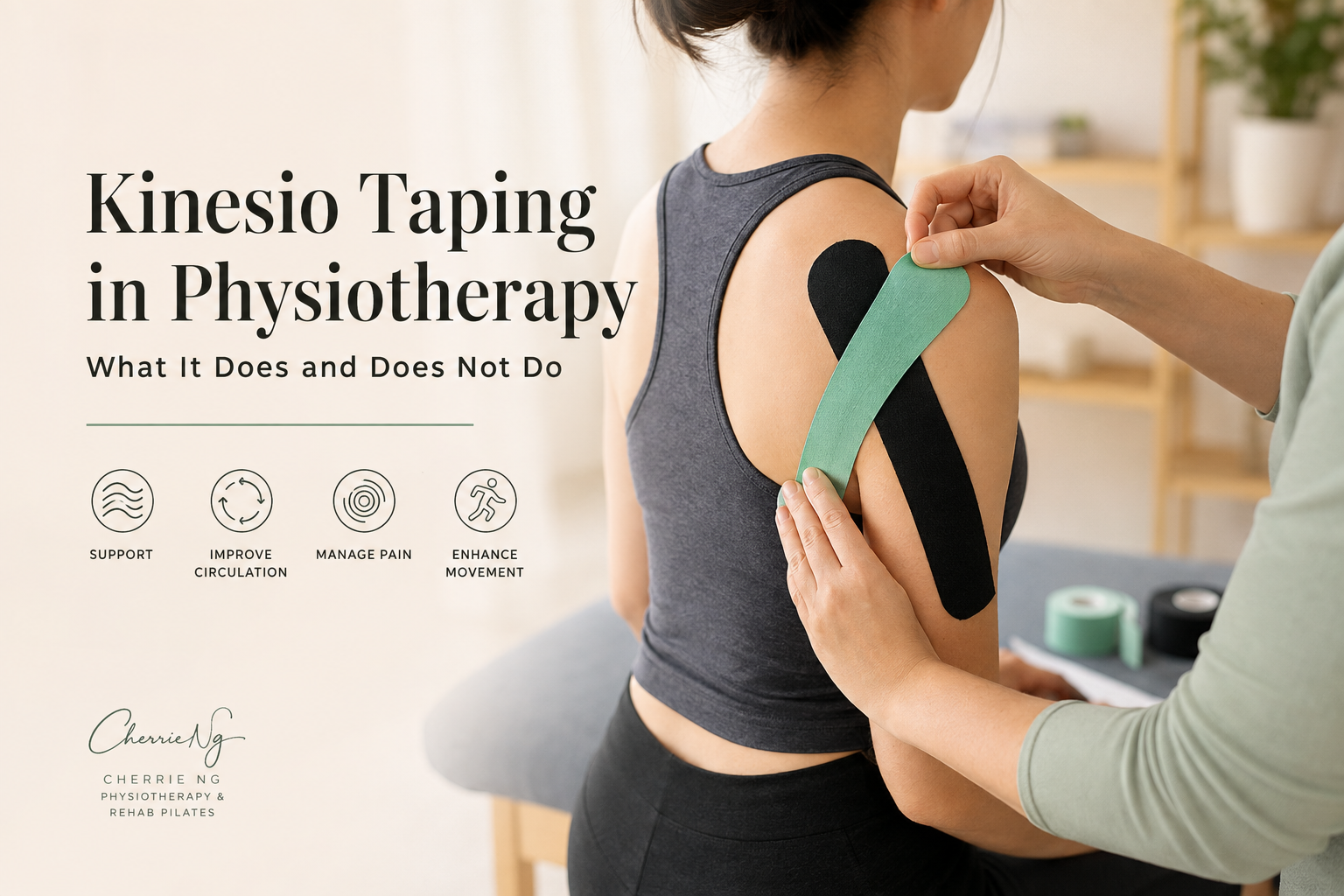
Kinesio taping can be used as a short-term aid within physiotherapy, but it is not a diagnosis, a permanent correction or a substitute for rehabilitation. Some people may notice a temporary change in comfort or confidence with movement; whether that matters depends on the condition, the task and what the tape helps them do next.
If you are considering kinesiology tape for neck, shoulder, knee or sports-related symptoms, ask what the tape is intended to change and how it fits into the wider plan. This article is general education and does not confirm that taping is currently available as a standalone service.
What is kinesio taping?
Kinesiology tape is an elastic adhesive tape applied to the skin in different shapes and directions. Unlike medicated patches, it does not contain an active drug. A Cochrane review describes it as elastic, adhesive, latex-free cotton tape without active pharmacological agents. Cochrane review of kinesio taping for rotator cuff disease
In physiotherapy, tape may be trialled to support a specific short-term goal, such as making a movement feel more manageable or helping someone feel more aware of an area during an exercise. The useful question is not whether the tape looks technical, but whether it produces a relevant, repeatable change.
What kinesio tape does not do
Tape should not be described as permanently realigning a joint, switching a muscle on, curing an injury or correcting posture by itself. It also cannot tell you why an area hurts.
The latest broad evidence review found that kinesio taping may improve pain in the immediate or short term and function immediately, but may have little or no effect on medium-term pain, short- or medium-term function, strength or range of motion. The authors rated the overall evidence very uncertain because study quality was often poor and results varied across conditions. 2026 overview of systematic reviews on kinesio taping
This means tape is better viewed as an optional tool than as the centre of a rehabilitation plan.
Does taping work for every condition?
No. Results are condition-specific, and even studies of the same body area do not always show a clinically useful effect.
For rotator cuff disease, a Cochrane review of 23 trials found very uncertain effects on pain, function and active movement compared with sham taping or other conservative treatments. Its overall conclusion was that kinesio taping appeared to provide little or no benefit, with scarce evidence about adverse events. Cochrane review of kinesio taping for rotator cuff disease
For patellofemoral pain at the front of the knee, a 2024 systematic review reported pain improvement but no significant improvement in knee function or symptoms. Systematic review of kinesio taping for patellofemoral pain
These findings do not mean nobody can feel a difference. They mean that a short-term response should not be mistaken for tissue healing, restored capacity or proof that everyone needs tape.
When taping may fit into physiotherapy
A physiotherapy assessment may look at your symptom history, movement, strength, mobility, balance, training load, work demands and goals before deciding whether any external support is worth trying.
For an acute lateral ankle sprain, a clinical practice guideline recommends braces or taping together with progressive weight-bearing exercise. The choice of external support should consider injury severity, healing stage, protection needed, pain, preference and cost. 2021 lateral ankle sprain clinical practice guideline
A simple taping trial may be reasonable when:
- There is a clear movement or task to retest
- The skin is healthy and the person is comfortable wearing adhesive tape
- The tape makes practice easier without creating false confidence
- It sits alongside appropriate exercise, load management or activity progression
- The plan includes a way to reduce reliance on tape when it is no longer useful
If movement, strength or confidence does not change, there may be little reason to continue using it.
Questions to ask before using kinesio tape
- What is the tape intended to help with today?
- Which movement will we check before and after application?
- How does it fit with my exercise or return-to-activity plan?
- What should I do if the tape feels restrictive or irritating?
- How long should I wear it, and when should I remove it?
- Is there a simpler alternative that achieves the same goal?
These questions keep the focus on function rather than the appearance or colour of the tape.
Skin safety and when not to rely on tape
Tape should be applied to clean, dry, intact skin. NHS patient guidance advises patch testing for sensitivity, avoiding rashes, cuts, burns or irritated skin, and removing tape immediately if irritation develops. Royal Marsden NHS kinesiology-taping guidance
Tape should also not delay assessment of a potentially serious injury. Seek urgent medical advice after an injury if pain or swelling is severe or worsening, you cannot bear weight, the area looks deformed, or it becomes numb, tingly, discoloured or cold. NHS sprains and strains guidance
Related reading
- Sports Injury Rehab in KL: Why Rest Alone Is Usually Not Enough
- Ankle Sprain Physiotherapy in KL: Why Balance Training Matters
- Manual Therapy vs Exercise Rehab: Why Both May Matter
Frequently asked questions
Is kinesio tape the same as rigid sports tape?
No. Kinesiology tape is elastic and allows movement. Other athletic-taping methods may use more rigid materials for a different support goal. The correct choice depends on the injury, activity and assessment.
Can tape replace strengthening exercises?
Usually not. Tape cannot build strength, balance, endurance or sport-specific tolerance. If it helps, it should make appropriate movement or exercise easier to practise—not remove the need for progression.
Should tape feel very tight?
No. More stretch is not automatically better and can irritate the skin. Remove the tape if it causes itching, persistent redness, burning, numbness or increasing discomfort.
Sources and clinical references
- Cochrane review of kinesio taping for rotator cuff disease
- 2026 overview of systematic reviews on kinesio taping
- Systematic review of kinesio taping for patellofemoral pain
- 2021 lateral ankle sprain clinical practice guideline
- Royal Marsden NHS kinesiology-taping guidance
- NHS sprains and strains guidance
If you are in Kuala Lumpur or Selangor and pain or an injury is limiting movement, work or sport, you can WhatsApp Cherrie to ask whether a physiotherapy assessment and active rehabilitation plan may be suitable.
Foundational clinical sources and further reading
These authoritative sources provide general background relevant to this topic; they are not claim-by-claim citations. This content is educational and does not replace individual assessment, diagnosis or emergency medical care.
- What is physiotherapy? — World Physiotherapy