Treatment Choices
Heat or Ice for Pain: A Physiotherapist's Practical Guide
Should you use heat or ice for pain? Learn a practical way to choose, how to apply each safely, their limits, and when symptoms need assessment.
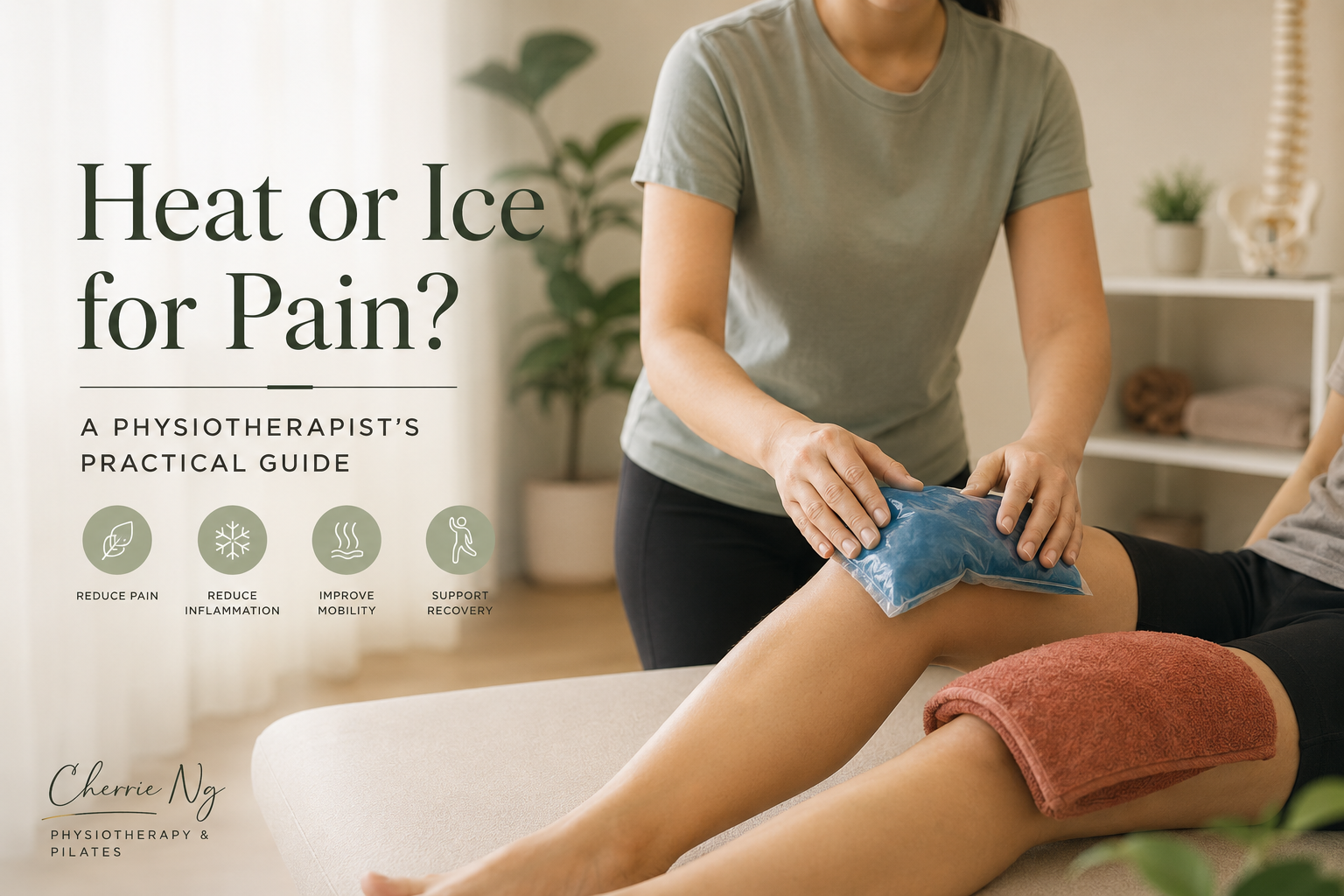
Ice may be worth trying when an area is newly injured, hot or swollen, especially if cold feels soothing. Gentle heat may suit stiffness, muscle spasm or a non-traumatic ache. Neither is universally better: both are short-term comfort tools, not treatments that diagnose or cure the cause of pain.
The practical choice depends on what happened, what you want the pack to help with, how your symptoms respond and whether it is safe for your skin and circulation. If either option makes symptoms worse, stop.
A quick way to choose heat or ice
| Situation | A reasonable first choice | Why |
|---|---|---|
| A recent sprain or strain with swelling | Wrapped cold pack | May provide short-term pain relief and help manage early swelling |
| Stiffness or muscle spasm without a recent injury | Gentle covered heat | May feel soothing and make movement more comfortable |
| Uncomplicated lower-back ache | Whichever feels better | Both can offer temporary relief; heat has somewhat better evidence for short-term relief |
| After an operation | Follow the surgical team’s instructions | The procedure, wound, sensation and precautions change what is safe |
| Numb skin, poor circulation or an open wound | Neither without professional advice | Heat and cold can damage tissue when warning sensations are reduced |
This is a starting point rather than a rule. For example, a person with a new back strain may prefer warmth, while another person finds a brief wrapped cold pack more comfortable. University Hospitals Sussex advises that either heat or cold may provide temporary relief for lower-back pain and suggests using the one that helps. University Hospitals Sussex low-back pain guidance
When ice may help
Cold is commonly used after a recent sprain or strain when pain and swelling are prominent. NHS guidance for sprains and strains recommends a wrapped ice pack for up to 20 minutes every two to three hours during the first two to three days, while also protecting the area and beginning movement when pain allows. NHS sprains and strains guidance
The main goal is symptom relief—not “freezing away” inflammation or guaranteeing faster healing. Evidence is more modest than many claims suggest. A 2026 systematic review of 28 randomised trials after musculoskeletal surgery found only small short-term pain effects below the threshold considered clinically important, with no substantial benefit for swelling or function; certainty ranged from very low to moderate. 2026 systematic review of postoperative cryotherapy
After an operation, do not apply a pack over a wound or improvise around dressings. Follow the surgeon or rehabilitation team’s instructions because the procedure and precautions matter.
When heat may help
Gentle heat can be useful when stiffness or muscle spasm is the main problem and there has not been a recent traumatic injury with increasing swelling. Some people find that warmth makes it easier to start moving, especially after sitting or resting.
For acute or subacute lower-back pain, a Cochrane review found limited evidence that heat wraps may provide a small, short-term reduction in pain and disability. Evidence for cold was insufficient. Cochrane review of superficial heat or cold for low-back pain
That does not mean heat corrects the spine or heals a strained muscle. It simply means warmth may help you feel comfortable enough to move. Current NICE guidance for low-back pain still centres self-management, continuing normal activities where possible and exercise appropriate to the person’s needs—not reliance on a passive pack. NICE low-back pain recommendations
How to use a cold pack safely
- Wrap the pack in a damp towel; never place ice directly on the skin.
- Use it only where skin sensation and circulation are normal.
- Keep sessions brief—roughly 10 to 20 minutes depending on the size and area—and let the skin return to normal before repeating.
- Check the skin regularly. Stop if it becomes blue, blotchy or increasingly painful, or if numbness is excessive.
- Do not use it over an open wound, and do not fall asleep with it in place.
These points align with NHS hospital guidance, which also recommends shorter exposure over small or bony areas. Gloucestershire Hospitals ice and heat guidance
How to use a heat pack safely
- Choose gentle warmth, not a pack hot enough to burn.
- Wrap it in a dry towel rather than placing it directly on the skin.
- Use it only where sensation and circulation are normal and the skin is intact.
- Try 15 to 20 minutes first; follow the product or clinician’s instructions and allow the skin to return to normal before repeating.
- Do not lie or sleep on a heat pack.
Sherwood Forest Hospitals advises wrapping heat or ice, checking the skin and avoiding both over open wounds, with reduced sensation or circulation, or while asleep. Sherwood Forest Hospitals heat and ice guidance
Take extra care, and seek individual advice first, if you have diabetes-related sensation changes, neuropathy, vascular disease, fragile skin, significant swelling, a recent operation or difficulty communicating discomfort.
What heat and ice cannot tell you
A pack cannot identify whether pain comes from a sprain, fracture, irritated nerve, joint problem, infection or something unrelated to the muscles and joints. Temporary relief also does not prove that an activity is safe to resume at full intensity.
For many musculoskeletal problems, the longer-term plan may include appropriate movement, progressive loading, strength, mobility, sleep and activity modification. Heat or ice can support that plan when it helps, but should not become the whole plan.
When a physiotherapy assessment may help
Consider an assessment if pain is not settling, keeps returning, changes how you walk or move, affects sleep or work, or makes you unsure how much activity is safe. A physiotherapist may ask about the injury and symptom pattern, check swelling, sensation, circulation, movement, strength, loading tolerance and function, then help you decide what to do next.
Seek urgent medical care after an injury if pain or swelling is severe or worsening, you cannot bear weight, the area looks deformed, or you feel feverish or unwell. Emergency assessment is appropriate if you heard a crack, the body part has changed shape, or it becomes numb, tingly, blue, grey or cold. NHS sprains and strains guidance
Related reading
- Sports Injury Rehab in KL: Why Rest Alone Is Usually Not Enough
- Shoulder Pain Physiotherapy in KL: Common Causes and Treatment Options
- Lower Back Pain Physiotherapy in KL: Common Causes and Next Steps
Frequently asked questions
Can I alternate heat and ice?
Sometimes, but alternating is not automatically more effective. Each change in temperature increases the chance of skin irritation, and contrast treatment is not necessary for most everyday aches. If you try both, use a barrier, keep each exposure brief and wait for the skin to return to normal between them.
Can I sleep with a heat or ice pack?
No. You may not notice excessive heat, cold or skin changes while asleep. Remove the pack before sleeping.
Should I use heat or ice after exercise?
You do not need either after every exercise session. A wrapped cold pack may feel useful after a recent injury that becomes sore or swollen; gentle heat may feel better for stiffness. More importantly, review the exercise dose if symptoms repeatedly flare or remain worse afterward.
Sources and clinical references
- NHS sprains and strains guidance
- Gloucestershire Hospitals ice and heat guidance
- Sherwood Forest Hospitals heat and ice guidance
- University Hospitals Sussex low-back pain guidance
- 2026 systematic review of postoperative cryotherapy
- Cochrane review of superficial heat or cold for low-back pain
- NICE low-back pain recommendations
If you are in Kuala Lumpur or Selangor and pain is not settling or is limiting movement, work or sport, you can WhatsApp Cherrie to ask whether a physiotherapy assessment and active rehabilitation plan may be suitable.
Foundational clinical sources and further reading
These authoritative sources provide general background relevant to this topic; they are not claim-by-claim citations. This content is educational and does not replace individual assessment, diagnosis or emergency medical care.
- What is physiotherapy? — World Physiotherapy