Sports Rehab
Can Weak Glutes Contribute to Knee Pain?
Learn how hip strength may relate to knee pain, why weak glutes are not always the cause, and what balanced physiotherapy rehab may include.
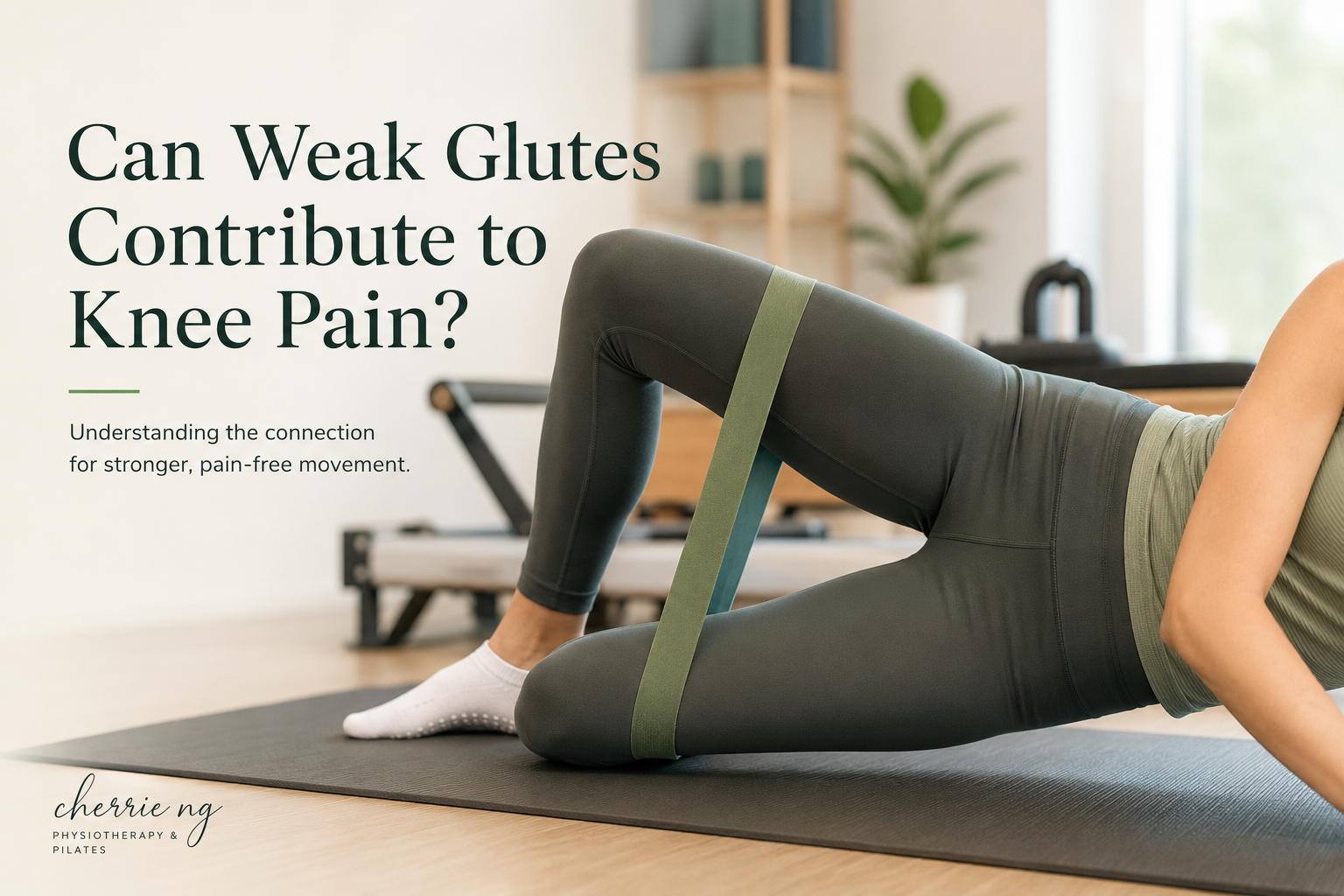
Weak glutes can contribute to reduced hip and leg capacity in some people with knee pain, especially during running, stairs, squats and single-leg tasks. However, weak glutes are not automatically the cause of every painful knee. Symptoms may also relate to knee strength, training load, injury, mobility, recovery and the specific demands of your activity.
A physiotherapy assessment can help determine whether hip strengthening belongs in your plan and what else needs attention. This article is general education, not a diagnosis or a reason to begin a generic “glute activation” routine for unexplained knee pain.
What do the glutes do during movement?
The gluteal muscles include the gluteus maximus, medius and minimus. Together with other hip and trunk muscles, they help produce and control hip movement, support the pelvis, and manage the position of the leg during walking, running, stairs, squats, jumping and landing.
The glutes do not work in isolation. The quadriceps, hamstrings, calves, foot muscles and trunk all share load during these tasks. A knee problem is rarely explained by one muscle switching “off.”
Does glute weakness cause knee pain?
Sometimes hip weakness may be a relevant part of the assessment, but cause and effect are not always clear. People with patellofemoral pain may test weaker at the hip, yet a systematic review of prospective research found that reduced isometric hip strength did not consistently predict who would develop patellofemoral pain. Weakness may sometimes develop after pain reduces activity or changes how a person uses the leg.
This distinction matters. Finding a weak muscle does not prove it caused the pain, and becoming stronger does not require blaming your movement or posture. Strength testing is useful when it guides an individual plan, not when it becomes a universal explanation.
When hip strength may be relevant
Hip strength may deserve attention when you notice difficulty with:
- Controlling a step-down or single-leg squat
- Running, cutting or landing repeatedly
- Climbing stairs or hills
- Returning to activity after injury or a long break
- Maintaining balance during single-leg tasks
- Building training volume without fatigue changing your movement
These situations do not diagnose glute weakness by themselves. Pain, confidence, technique, knee and ankle capacity, and task familiarity can all influence what the movement looks like.
What a physiotherapy assessment may look at
Cherrie may first ask where the knee hurts, when symptoms began, whether there was an injury or swelling, and what activities or recent load changes are relevant. Running distance, gym training, stairs, work demands and previous rehabilitation can help shape the assessment.
Assessment may include:
- Knee movement, swelling and symptom response
- Hip, quadriceps, hamstring and calf strength
- Hip and ankle mobility
- Squats, step-downs, stairs and single-leg tasks
- Balance, running, hopping or landing when appropriate
- How control and symptoms change with repeated effort
The aim is to understand the gap between your current capacity and your goal. One person may benefit from more hip work; another may need greater knee loading, ankle mobility, activity changes or medical review.
What balanced strengthening may include
For patellofemoral pain, current best-practice guidance recommends education and knee-focused exercise, with hip-focused exercise added according to individual needs. This means useful rehab is often broader than doing clamshells or band walks alone.
Depending on assessment findings, a programme may progress through exercises such as:
- Bridges or hip extension exercises
- Side steps or other lateral hip work
- Sit-to-stand, squats and step-ups
- Split squats, lunges or step-downs
- Single-leg hinges and balance tasks
- Calf and quadriceps strengthening
- Running, jumping or sport-specific progressions
Exercise selection, range, load and difficulty should match your symptoms and goal. A runner preparing for hills needs different end-stage capacity from someone rebuilding confidence on household stairs.
How should exercises be progressed?
A useful starting exercise should feel challenging enough to train without causing sharp pain, increasing swelling, repeated giving way or a clear deterioration afterward. Progress may come from adding resistance, repetitions, range, speed, single-leg demand or a more specific task.
More exercises are not automatically better. Two or three well-chosen movements performed consistently may be more useful than a long routine that does not progress. Symptom response and function should guide whether the programme stays the same, advances or needs adjustment.
Can rehab Pilates help hip and knee control?
Rehab Pilates-informed exercises may help some people practise trunk, pelvis and hip control with adjustable resistance and movement ranges. They can support a broader strength plan, especially when someone needs a manageable route back to loaded movement.
Pilates should not be treated as a replacement for all knee rehabilitation. If your goal involves running, heavy lifting, jumping or sport, the later programme should prepare you for those specific loads. Pilates for back pain also explains how movement-based exercise can be adapted rather than prescribed as one routine for everyone.
When to seek medical care
Seek prompt medical care if knee pain follows major trauma, you cannot bear weight, the knee is severely swollen, red or hot, there is fever, sudden locking, major instability, an obvious change in shape, new numbness or weakness, or severe calf pain or swelling.
Arrange an assessment if knee pain keeps returning, is worsening, affects walking or stairs, comes with swelling, or is not improving despite sensible changes. Strengthening the hip should not be used to delay assessment of a significant or uncertain knee problem.
Related reading
- Runner’s Knee Physiotherapy in KL: Load, Strength and Recovery
- Knee Pain Physiotherapy in KL: Common Causes and Rehab Options
- Pilates for Back Pain in KL: Is It Safe and Effective?
Frequently asked questions
Are clamshells enough to strengthen the glutes for knee pain?
They may be a useful starting exercise for some people, but they do not prepare the whole leg for every task. Progress often needs more loaded and functional exercises that match stairs, running, lifting or sport.
Should my knees never move inward during a squat?
Not necessarily. Movement varies between people and tasks. Rather than forcing one “perfect” position, assessment considers symptoms, control, available range, load and whether another movement option feels or performs better.
Will stronger glutes cure my knee pain?
No single exercise or muscle can guarantee that. Hip strengthening may be one helpful part of rehabilitation, but knee capacity, load management, mobility, recovery and the underlying problem may also need attention.
If you are in Kuala Lumpur or Selangor and knee pain is affecting stairs, running, gym training or daily movement, you can WhatsApp Cherrie to ask whether a physiotherapy assessment may be suitable.
Foundational clinical sources and further reading
These authoritative sources provide general background relevant to this topic; they are not claim-by-claim citations. This content is educational and does not replace individual assessment, diagnosis or emergency medical care.
- What is physiotherapy? — World Physiotherapy
- Musculoskeletal health — World Health Organization
- WHO guidelines on physical activity and sedentary behaviour — World Health Organization