Knee Pain
Knee Pain When Squatting: Common Reasons and When to Get Assessed
Knee pain when squatting may relate to load, mobility, strength or an injury. Learn what to notice, how to modify activity and when to seek assessment.
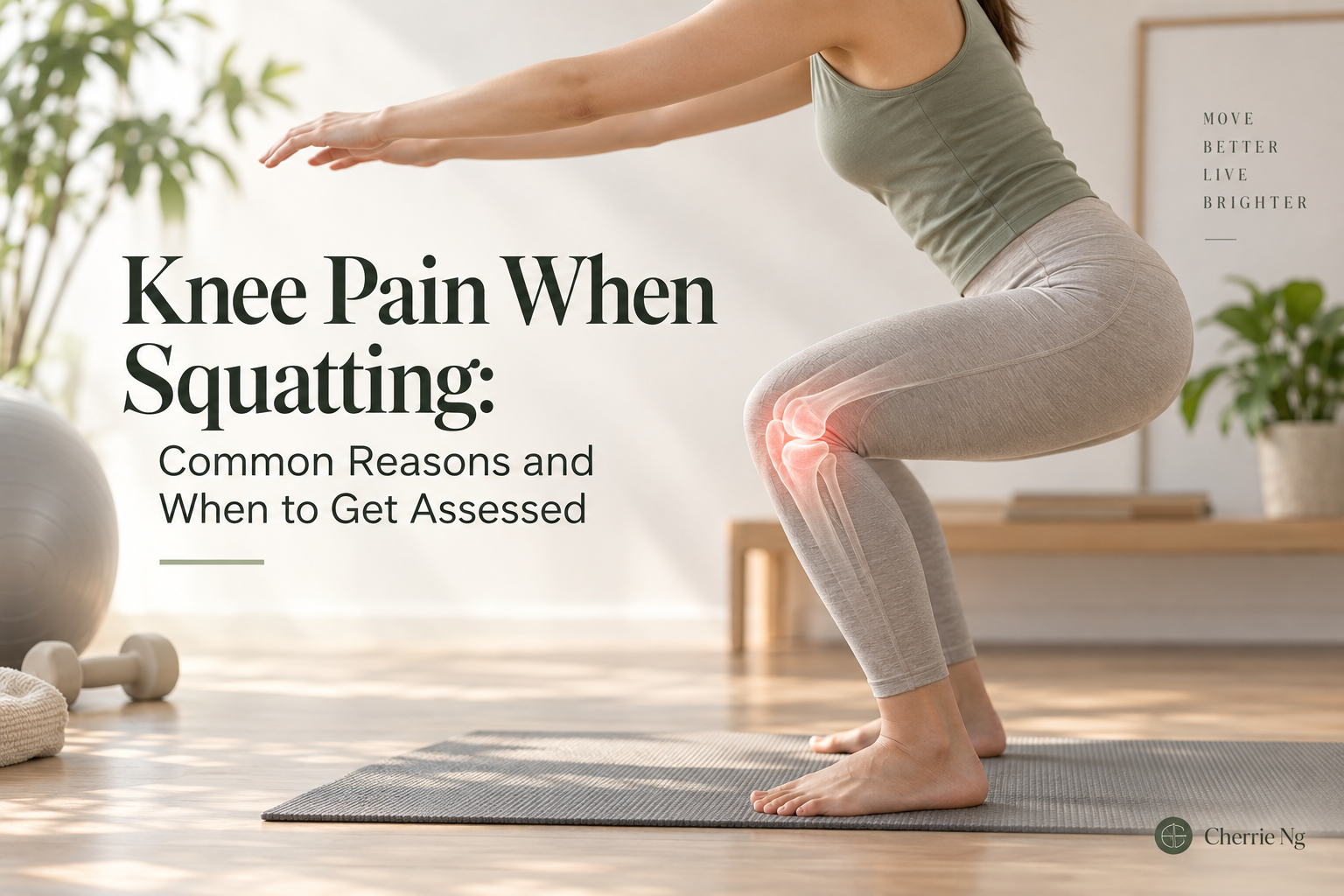
Knee pain when squatting does not automatically mean your knee is damaged or that you must stop bending it forever. Pain can be influenced by how much load you are using, a recent change in activity, hip or ankle movement, leg strength, an injury, or a condition around the kneecap. A physiotherapy assessment can help clarify the pattern without relying on self-diagnosis.
What to notice about squat-related knee pain
Before changing your programme, notice:
- Whether pain is at the front, inside, outside or back of the knee
- Whether it starts on the way down, at the bottom or while standing up
- Whether a shallow squat is comfortable but a deep squat is not
- Whether stairs, running, kneeling or prolonged sitting cause similar symptoms
- Whether there is swelling, locking, giving way, clicking or reduced movement
- Whether symptoms began after a fall, twist, new exercise or sudden increase in training
Pain around or behind the kneecap that is aggravated by squatting, stairs, running or prolonged sitting can occur with patellofemoral pain. The factors involved are often varied, so this pattern does not confirm a diagnosis. NHS guidance on patellofemoral knee pain
Other patterns may need a different assessment. Pain after a twist with swelling or locking, pain below the kneecap during repeated jumping or running, or symptoms after direct trauma should not be grouped together automatically. NHS knee-pain guidance
Why can squatting bring on pain?
A squat asks the knee, hip and ankle to share load while the body controls balance and depth. Symptoms may become sensitive after a sudden increase in training, repeated deep bending, more stairs or hills, reduced conditioning, or a change in sport or gym routine. Hip, thigh, ankle and foot function may also be relevant to how the movement feels, but no single “weak muscle” explains every person’s knee pain.
Clicking or grinding does not automatically mean the knee is being harmed. It can occur with some forms of front-of-knee pain, but a painful click, locking, repeated giving way or major swelling deserves assessment rather than reassurance from sound alone. NHS patellofemoral pain information
What can you try before an assessment?
If the pain is mild and there was no major injury, temporarily reduce the depth, load, repetitions or frequency that clearly aggravates it. You could use a chair or support, choose a smaller range, or keep other comfortable activities in your routine. Avoid repeatedly testing the painful depth or adding heavy squats while the knee is irritable.
The aim is usually to find a tolerable starting point, then build capacity gradually. A physiotherapist may later progress squat depth, step-downs, lunges, leg strengthening, hip control, balance or sport-specific tasks according to your symptoms and goals. Exercise therapy and strengthening around the knee and hip are commonly used in the management of patellofemoral pain, but the exact plan should be individualised. NHS patellofemoral pain guidance
What does a physiotherapy assessment look at?
Cherrie may ask when the pain began, what your training or work has changed, and how symptoms affect stairs, walking, sitting, kneeling, gym, Pilates or sport. She may observe a squat, step-down, gait or single-leg task if appropriate.
The assessment may also consider knee range of motion, swelling, hip and ankle mobility, strength, balance, foot function, movement control and how symptoms respond to different loads. Physiotherapists commonly assess walking, stairs, squatting, single-leg balance and related areas such as the hip, thigh, ankle and foot when evaluating knee pain. ChoosePT knee pain assessment guide
This helps decide whether to begin with activity modification, mobility, progressive strength work, movement retraining, rehab Pilates-informed control, or medical referral.
When should you get assessed?
Consider physiotherapy if knee pain keeps returning with squats or exercise, affects stairs or walking, limits your training, comes with swelling, or leaves you unsure which movements are safe. Assessment is also sensible if symptoms are not improving over the next few weeks or are getting worse. NHS knee-pain guidance
Seek urgent medical advice if the knee is very painful, you cannot move it or bear weight, it is badly swollen or has changed shape, it locks or repeatedly gives way, or it is hot and red with fever or feeling unwell. NHS urgent knee-pain guidance
This article is general education, not a diagnosis. If the pain followed a significant injury or feels unusual for you, medical assessment should come before returning to loaded squats.
Sources and clinical references
- NHS: Patellofemoral knee pain
- NHS: Patellofemoral pain
- NHS: Knee pain
- ChoosePT: Physical Therapy Guide to Knee Pain
Related reading
- Knee Pain Physiotherapy in KL: Common Causes and Rehab Options
- Patellofemoral Pain: Why the Front of the Knee Hurts
- Knee Strengthening Exercises: What to Start With Safely
If knee pain is affecting squats, stairs, walking or exercise in Kuala Lumpur or Selangor, you can WhatsApp Cherrie to ask whether a physiotherapy assessment is suitable.
Foundational clinical sources and further reading
These authoritative sources provide general background relevant to this topic; they are not claim-by-claim citations. This content is educational and does not replace individual assessment, diagnosis or emergency medical care.
- What is physiotherapy? — World Physiotherapy
- Musculoskeletal health — World Health Organization