Local SEO
Clinical Pilates in Bangsar South: Who It Helps and What to Expect
Considering clinical Pilates in Bangsar South? Learn who it may suit, what the first session involves and how rehab-focused exercises are progressed.
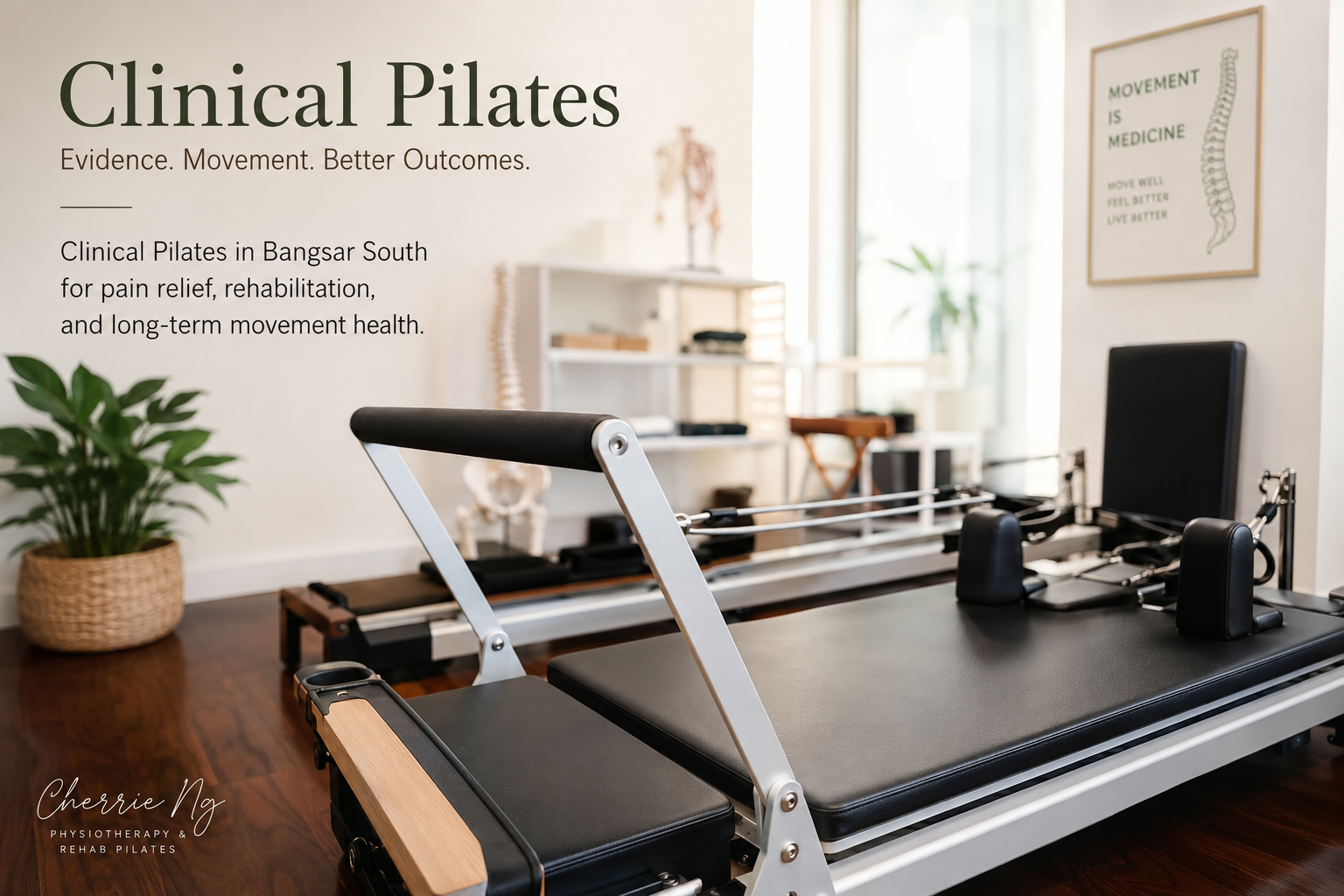
Clinical Pilates in Bangsar South may suit people who want exercise selected around pain, injury recovery, posture concerns or a gradual return to activity. On this website, “clinical Pilates” means an individual, rehab-focused use of Pilates principles guided by physiotherapy reasoning—not a promise that one exercise method will fix every condition.
The useful difference is the process: screening, assessment, an appropriate starting level, symptom-aware coaching and progression toward your real goals. A Reformer or a difficult exercise does not automatically make a session clinical.
Who may benefit from a rehab-focused approach?
An individual clinical Pilates session may be worth discussing if you:
- Want to restart exercise after pain, injury or a long break
- Have recurring back, neck or shoulder discomfort
- Feel uncertain about joining a general group class
- Need exercises adapted after physiotherapy or surgery
- Want to rebuild strength, mobility, control or movement confidence
- Need posture support for desk work without chasing one “perfect” position
- Want a plan that connects to gym, sport, work or daily activities
Rehabilitation should be centred on the person’s functioning, goals and preferences. The World Health Organization notes that it may combine exercise, education, task adaptation and environmental changes rather than relying on a single treatment. World Health Organization rehabilitation fact sheet
These examples do not confirm that Pilates is the right starting point. New, worsening or unexplained symptoms may need physiotherapy or medical assessment before exercise is progressed.
What happens before the exercises begin?
The first part of the session should clarify what you need help with. Cherrie may ask about:
- Where symptoms occur and how they change
- Relevant diagnoses, injuries, operations and medical advice
- Current work, exercise and daily demands
- Movements that feel difficult or worrying
- Exercises or treatments you have already tried
- What you hope to return to
A movement assessment may then consider joint mobility, strength, balance, breathing, trunk control, posture, coordination and symptom response. The relevant checks depend on your concern; not everyone needs the same assessment.
The findings help establish a starting point. Two people with low back pain, for example, may receive different exercises because their symptoms, abilities and goals are different.
What can you expect during a session?
A rehab-focused Pilates session may include:
- Mat-based or Reformer-assisted exercises
- Breathing and trunk-control practice
- Mobility work for relevant joints or body regions
- Progressive strengthening for the trunk, hips, shoulders or legs
- Balance and coordination tasks
- Movement preparation for work, lifting, sport or daily activities
- A short home programme when appropriate
Exercises may be simplified, supported, loaded or made more complex. Progression should reflect your response, movement quality, effort and goals—not pressure to complete advanced movements quickly.
Symptoms should be monitored during rehabilitation. Tell Cherrie if an exercise produces sharp pain, spreading symptoms, increasing numbness, unusual dizziness or a response that does not settle as expected.
Can clinical Pilates help low back pain?
Pilates can be one suitable exercise option for some people with low back pain. A 2024 systematic review and meta-analysis reported improvements in pain and disability compared with no exercise and some non-specific exercise comparisons. This evidence does not establish one programme for every person or every source of back pain. Systematic review of Pilates exercise for low back pain
NICE guidance recommends considering exercise for low back pain while taking the person’s needs, preferences and capabilities into account. It does not require Pilates specifically, which is a useful reminder that adherence, suitability and progression matter more than a branded method. NICE guideline NG59
Is it suitable for older adults?
Age alone does not decide suitability. A 2022 systematic review involving middle-aged and older adults with chronic musculoskeletal conditions reported improvements in some pain, disability and physical-function outcomes, but included only seven studies and found no overall superiority over other exercise. Systematic review of Pilates for older adults with chronic musculoskeletal conditions
An older adult may need adjustments for balance, getting on and off equipment, bone health, joint symptoms, blood pressure, previous falls or other health conditions. Those factors should be discussed rather than assuming a standard class is appropriate.
Is Reformer Pilates better for rehabilitation?
Not automatically. A Reformer can provide support, resistance and movement feedback. Mat exercises can also be highly adaptable and may be easier to repeat independently.
The equipment should serve the exercise goal. A simple mat exercise may be more useful than an impressive Reformer movement if it better matches your current ability and the task you want to improve.
Before booking, ask whether the session includes an individual assessment and how the programme will be adapted. Access to equipment is not a substitute for clinical reasoning.
Clinical Pilates, physiotherapy or both?
Clinical Pilates may fit when exercise progression is the main focus and symptoms are sufficiently understood. A physiotherapy assessment may be the better first step when:
- Pain is new, rapidly worsening or linked to trauma
- Symptoms spread into an arm or leg
- Numbness, weakness or balance changes are present
- Recent surgery has specific precautions
- Normal work, sleep or daily movement is significantly affected
- You are unsure whether exercise is appropriate
Physiotherapy and Pilates-based rehabilitation can also overlap. Assessment may lead to education, targeted exercise, manual therapy when appropriate and a gradual transition toward more independent training.
How does clinical Pilates support posture?
Posture work should focus on function rather than forcing one ideal shape. Depending on your assessment, exercises may help build:
- Strength and endurance for desk or standing tasks
- Upper-back, hip or shoulder movement options
- Confidence changing position
- Capacity for lifting, carrying or exercise
- Awareness of tension without constant bracing
The aim is not to hold the abdomen tight or pull the shoulders back all day. It is to develop enough movement choices and capacity for the activities that matter to you.
How are Bangsar South sessions arranged?
This is a practitioner-led mobile and private-call-out service. It should not be interpreted as a walk-in studio or a guarantee that every Bangsar South building has a permanent Pilates facility.
When enquiring, share:
- Your residence, condominium, office or nearest landmark
- Your main concern and current activity level
- Whether you are asking about physiotherapy or rehab Pilates
- Relevant diagnoses, surgery dates or medical precautions
- Your preferred day or time range
- Visitor parking, security and access details
Cherrie can then discuss whether a session is suitable, what setting may work and whether travel or access can be arranged.
How should you prepare?
Wear clothing that allows comfortable movement. Bring or send relevant medical reports, operation instructions and a list of precautions if applicable.
It also helps to think about:
- The activity you most want to improve
- Movements that currently trigger symptoms
- What exercise you can already do comfortably
- Equipment available where the session will take place
- Questions about home practice and progression
You do not need to be flexible or experienced in Pilates before starting.
When should medical care come first?
Do not start a routine Pilates session in place of urgent medical care. For back pain, seek urgent help for new bladder or bowel problems, numbness around the buttocks, genitals or inner thighs, or severe or quickly worsening leg weakness or walking difficulty. NHS low back pain red-flag guidance
Seek medical advice before exercise when symptoms are severe, rapidly changing, associated with major trauma, or when surgical and medical precautions are unclear.
Frequently asked questions
Do I need previous Pilates experience?
No. The starting point can be adapted for a beginner. The session should explain each movement rather than expect you to know the terminology.
Will every session use a Reformer?
Not necessarily. Mat work, standing exercises or functional movements may be more appropriate for a particular goal. Confirm the available setting and equipment before booking.
Is clinical Pilates only for people in pain?
No. It may also support a structured return to exercise or a transition from rehabilitation toward independent training. Someone seeking general fitness without symptoms may prefer a regular class.
How quickly should exercises progress?
There is no universal schedule. Progression depends on your response, technique, confidence, goals and ability to practise. A fixed timeline without assessment would be misleading.
Related reading
- Physiotherapist in Bangsar South: Rehab, Pilates and Desk Strain Support
- Reformer Pilates for Rehab in KL: Who It Helps and What to Ask Before Booking
- Physiotherapist-Led Pilates in KL: Who Is It Suitable For?
Sources and clinical references
- World Health Organization: Rehabilitation
- Systematic review of Pilates exercise for low back pain
- NICE guideline NG59: Low back pain and sciatica
- Systematic review of Pilates for older adults with chronic musculoskeletal conditions
- NHS: Low back pain red-flag guidance
If you are considering clinical Pilates in Bangsar South, WhatsApp Cherrie with your location, main concern and movement goal. She can first help clarify whether physiotherapy assessment, individual rehab Pilates or another next step may suit you.
Foundational clinical sources and further reading
These authoritative sources provide general background relevant to this topic; they are not claim-by-claim citations. This content is educational and does not replace individual assessment, diagnosis or emergency medical care.
- What is physiotherapy? — World Physiotherapy
- WHO guidelines on physical activity and sedentary behaviour — World Health Organization