Home Visits
Home Physiotherapy in Cheras: Conditions, Sessions and Travel Areas
Considering home physiotherapy in Cheras? Learn who it may suit, what a session includes, how travel coverage works and when to seek medical care.
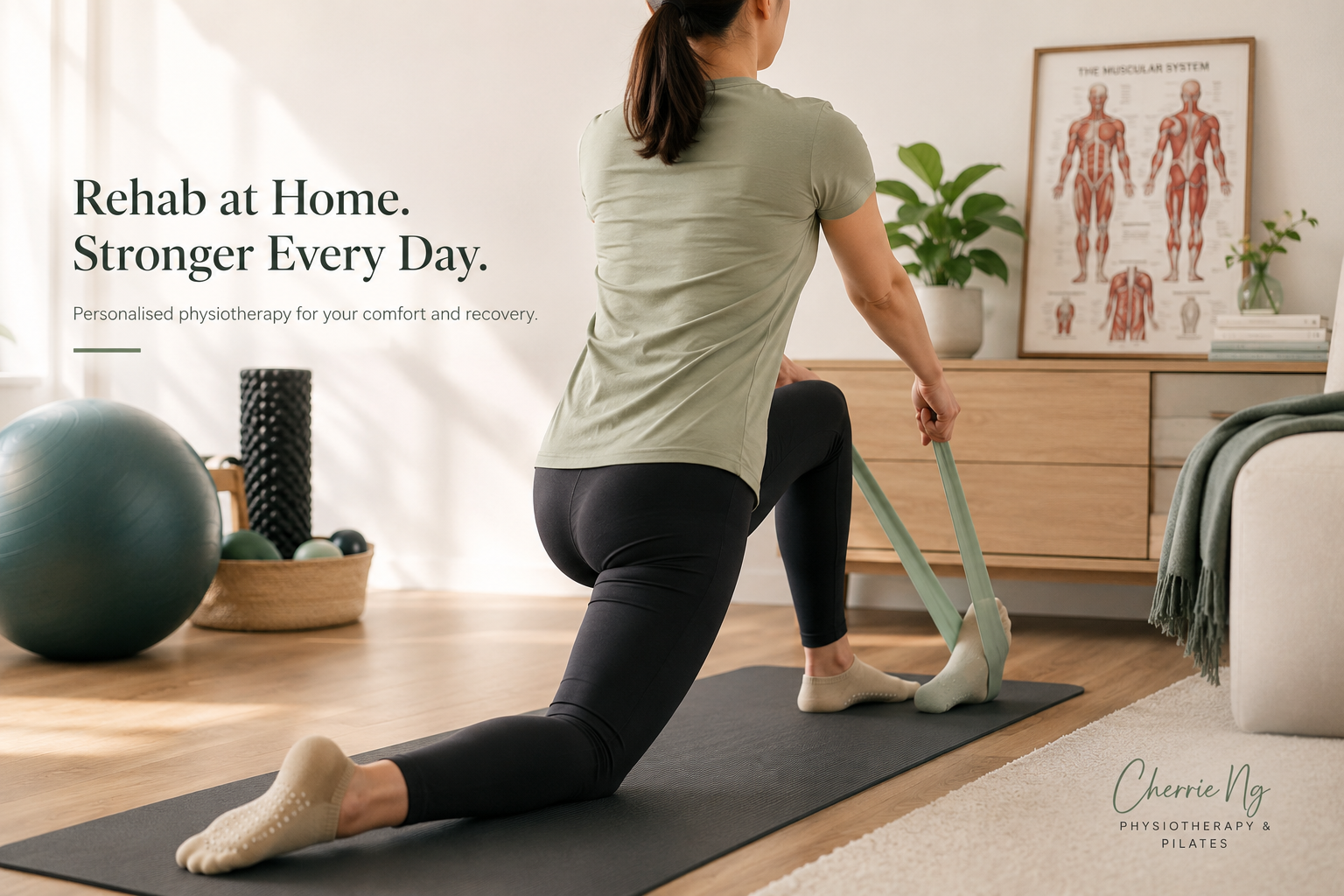
Home physiotherapy in Cheras brings assessment and rehabilitation into the place where you actually sit, walk, use stairs, work and exercise. It may be a practical option when travelling is difficult, when daily activities need to be observed at home, or when a family member is involved in care.
It is not automatically the right setting for every condition. Cherrie first needs to understand your symptoms, mobility, medical context, goals and exact location before confirming whether a home visit is suitable and whether travel can be arranged.
Who may consider a physiotherapy home visit?
A home visit may be worth discussing if you:
- Have neck, shoulder, back, hip, knee or ankle symptoms that make travel uncomfortable
- Are rebuilding movement after an injury, illness or operation and have been cleared for rehabilitation
- Need help with walking, balance, stairs, getting out of bed or standing from a chair
- Want an exercise plan adapted to your room, furniture and available equipment
- Need desk, sleeping or daily-task guidance in the environment where symptoms occur
- Support an older family member and want practical movement or transfer guidance
- Find traffic, transport, clinic access or caregiving arrangements difficult
Rehabilitation is intended to improve functioning and participation in meaningful daily activities, and it can be delivered in community settings such as a person’s home. It should remain person-centred and matched to individual goals and preferences. World Health Organization rehabilitation fact sheet
These situations do not confirm that physiotherapy is the correct treatment. Screening and assessment help decide whether home rehabilitation, clinic care, medical review or another service is more appropriate.
What conditions can be supported at home?
The more useful question is often not “Can this diagnosis be treated at home?” but “Can the necessary assessment and rehabilitation be carried out safely in this environment?”
Depending on the individual, home physiotherapy may support:
- Musculoskeletal pain affecting the back, neck, shoulder, hip, knee, ankle or foot
- Movement and strength rebuilding after an injury
- Post-surgery mobility and exercise after instructions or precautions are confirmed
- Reduced walking confidence, balance or general mobility in an older adult
- Work-from-home posture and movement concerns
- A gradual return to exercise or normal daily tasks
Evidence should not be stretched from one diagnosis to every patient. For example, a 2024 systematic review found that home-based exercise improved pain and several physical-function outcomes for people with knee or hip osteoarthritis, but the authors also noted limitations in the available trials. Systematic review of home exercise for hip and knee osteoarthritis
For community-dwelling older adults, another systematic review found that home programmes improved mobility, balance and strength compared with control groups, while additional supervision produced better results for some strength and balance comparisons. This supports individual programming and appropriate follow-up rather than simply handing someone a generic exercise sheet. Systematic review and meta-analysis of home exercise for older adults
What happens during a home physiotherapy session?
A first session commonly begins with questions about:
- Your main concern and when it started
- What makes symptoms better or worse
- Relevant diagnoses, operations, falls, medicines or medical advice
- Activities you are avoiding or finding difficult
- Your home setup, support needs and rehabilitation goals
Cherrie may then assess movement, strength, joint mobility, balance, walking, posture and symptom response. The assessment can also look at a real task, such as getting up from your sofa, using your stairs, working at your desk or walking through a narrow area of the home.
Depending on the findings, the session may include:
- Education and activity modification
- Mobility, balance or strengthening exercises
- Walking, stair or transfer practice
- Movement and posture strategies for a specific task
- Manual therapy when appropriate
- Rehab Pilates principles where suitable
- A manageable home programme and progression plan
For older adults with fall concerns, the World Health Organization lists gait, balance and functional training, home assessment and modification, and individual risk assessment followed by tailored intervention among relevant fall-prevention approaches. WHO falls fact sheet
What is different about being assessed at home?
Home assessment provides context that may not be visible in a clinic. It can show whether a low chair, loose rug, narrow walkway, stair pattern, desk height or family-assisted transfer is relevant to the person’s difficulty.
This does not mean every home item must be changed, or that environment alone explains pain. The aim is to identify practical options that fit the person’s ability and priorities. Sometimes the useful change is an exercise progression; sometimes it is practising a task differently; sometimes medical review or another professional is needed.
Which Cheras travel areas are covered?
Cheras covers a wide area across Kuala Lumpur and Selangor, so home-visit availability is confirmed case by case rather than promised by a fixed area name.
When enquiring, send:
- Your exact suburb, condominium, office or nearest landmark
- A location pin when possible
- Parking, lift, security-registration or access information
- The main condition or activity you need help with
- Your preferred day or time range
Cherrie can then check travel time, access and the type of session required before offering suitable options. Being located in Cheras does not guarantee that every address or requested time is available.
How should you prepare?
You usually do not need special equipment for the first visit. Prepare a safe space where you can stand, walk several steps and sit. If lying exercises may be relevant, have a mat or suitable bed area available.
It also helps to keep these nearby:
- Medical or surgical instructions relevant to rehabilitation
- A current medicine list if it affects the assessment
- Walking aids, braces or exercise equipment you already use
- Comfortable clothing and supportive footwear
- A family member or caregiver when their input or assistance matters
Do not buy equipment before assessment unless a healthcare professional has already advised it.
How many sessions will you need?
There is no responsible fixed number for every condition. Frequency depends on the assessment, diagnosis or medical restrictions, symptom behaviour, mobility, goals, response to exercise, support at home and how independently the plan can be continued.
The first visit should help establish a starting point and a review plan. Progress may be judged through meaningful tasks—such as walking tolerance, stair ability, confidence, strength or return to work—not only by pain intensity on one day.
When is a home visit not the right first step?
Home physiotherapy is not an emergency service. Seek urgent medical care for sudden facial drooping, one-sided arm weakness or speech difficulty, even if the symptoms later improve; these can be stroke warning signs. NHS stroke symptoms guidance
For back pain, urgent assessment is also needed for new loss of feeling around the genitals or anus, changes in bladder or bowel control, or pain, weakness or numbness affecting both legs. NHS back pain guidance
Medical review may also need to come first after major trauma, with rapidly worsening symptoms, or when post-surgery instructions and weight-bearing precautions are unclear. If you are uncertain, describe the symptoms before booking so the safest next step can be discussed.
Frequently asked questions
Do I need a doctor’s referral for a home visit?
Not every enquiry requires a referral, but recent surgery, complex medical conditions or unclear symptoms may require medical instructions or review. Share any reports, precautions and current concerns before the session.
Can a family member join the session?
Yes, when their involvement is useful and the client agrees. A caregiver may help explain daily challenges or learn how to support a task without replacing the client’s own effort.
Is home physiotherapy only for older adults?
No. It may also suit working adults, people recovering from injury or surgery, and clients whose symptoms or schedule make travel difficult. Suitability depends on the assessment rather than age alone.
Can the session take place in a condominium?
Potentially. Share the exact location and any visitor registration, parking, lift booking or access requirements in advance so travel feasibility can be checked.
Related reading
- Physiotherapist in Cheras: Home Visits, Rehab Pilates and Movement Care
- Home Physiotherapy in Kuala Lumpur: What to Expect
Sources and clinical references
- World Health Organization: Rehabilitation
- Systematic review of home-based exercise for hip and knee osteoarthritis
- Systematic review and meta-analysis of home exercise for community-dwelling older adults
- World Health Organization: Falls
- NHS: Symptoms of a stroke
- NHS: Back pain
If you are considering home physiotherapy in Cheras, WhatsApp Cherrie with your main concern, exact location and the activity you want help with. She can first check whether a home visit is suitable and whether travel can be arranged.
Foundational clinical sources and further reading
These authoritative sources provide general background relevant to this topic; they are not claim-by-claim citations. This content is educational and does not replace individual assessment, diagnosis or emergency medical care.
- What is physiotherapy? — World Physiotherapy